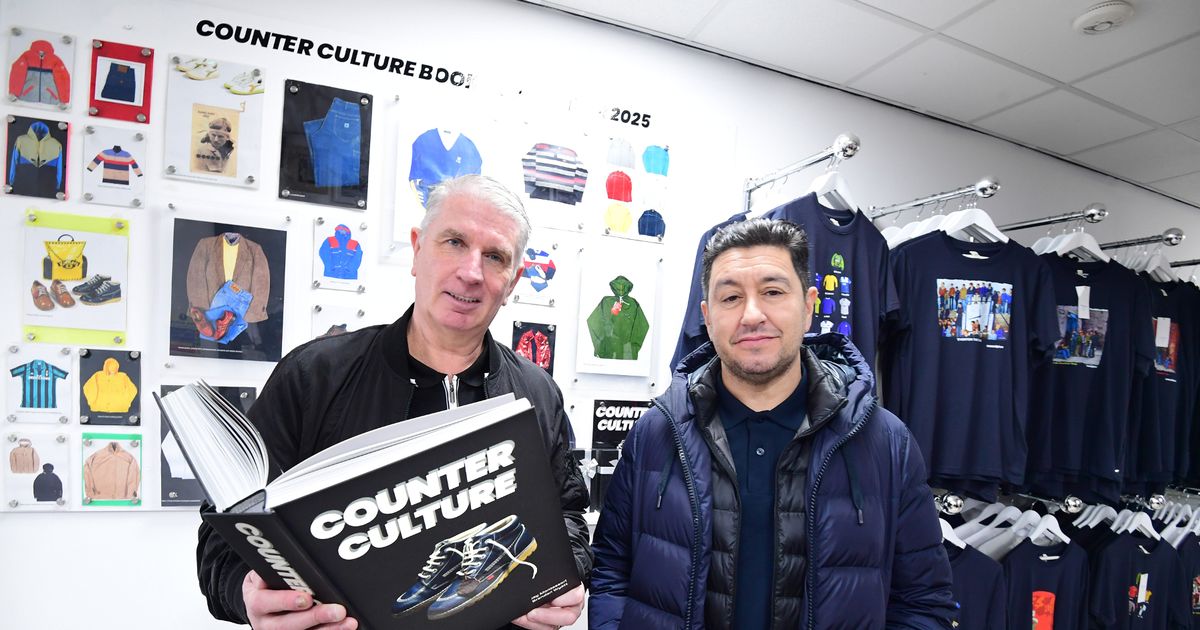
Transalpino owner Brendan Wyatt spoke to the ECHO about his new book Counter Culture and why Liverpool was at the forefront of the movement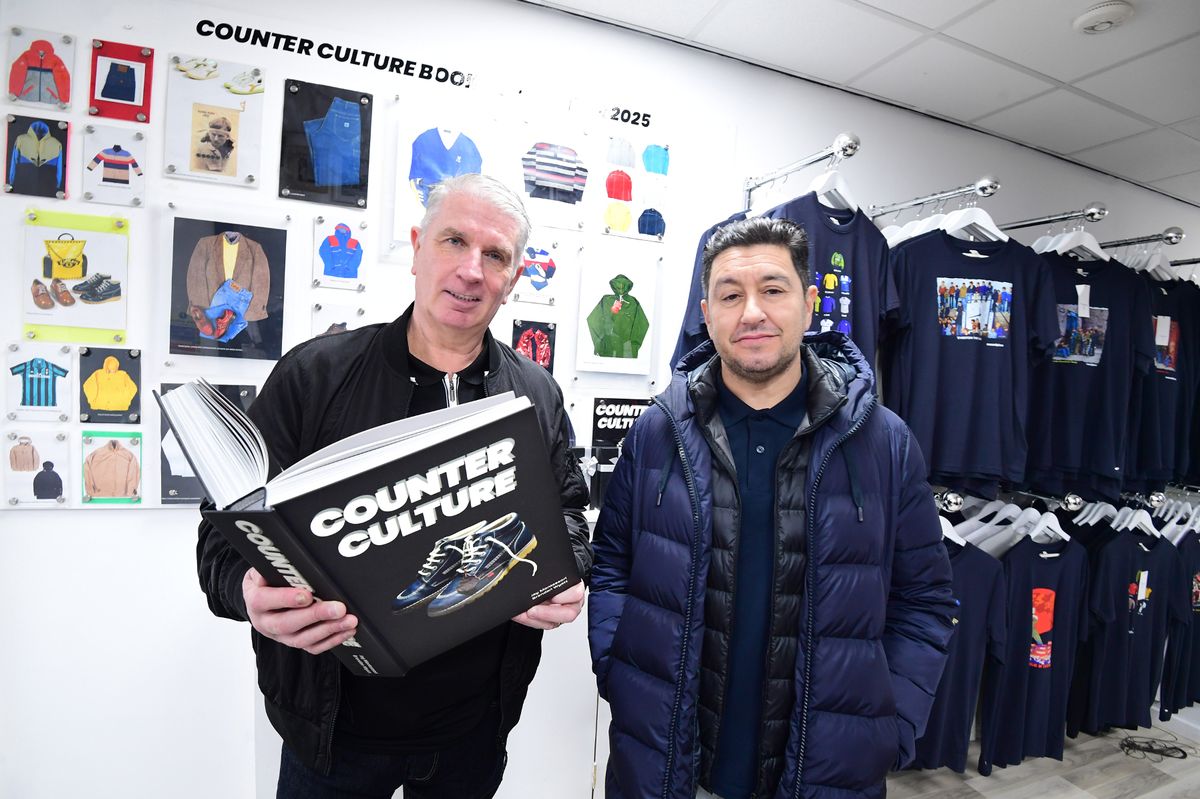 Brendan Wyatt (left) and Jay Montessori’s new book documents the story of the Counter Culture fashion movement (Image: Andrew Teebay Liverpool Echo)
It was Liverpool FC’s match against Manchester United in the 1977 Charity Shield when it become clear things were changing on the terraces. Kenny Dalglish made his Reds debut in the season’s annual curtain raiser, but this game does not stick in anyone’s mind for what happened on the pitch, as the rivals played out a forgettable goalless draw that saw them share the trophy.
Although the actual football was insignificant, those in attendance at Wembley pinpoint the game as a landmark moment that indicated how the trajectory of working class culture was about to change forever. Up until this point, how you dressed and what you wore wasn’t a hugely important part of going to the game.
The typical look of the matchgoing fan on the terraces would be nothing to write home about, with outfits teaming some form of club colours with denim flares. However, this would all change with the young teenagers who travelled down South in ’77 and made wedge haircuts, straight jeans, and polo tops a central part of their identity.
A working class youth movement with its own buzz and energy was born, a revolution that was unique as it didn’t start in the traditional fashion centres of London, New York or Paris. Instead, it was the streets of Liverpool that led the way, a story that is captured in a new coffee table book from Brendan Wyatt and Jay Montessori titled Counter Culture.
Brendan was 11 years old in the summer of ’77 when the winds of change were sweeping across Merseyside. From his family home off Everton Valley, he had a perfect vantage point to study the evolving style where he watched fans make the trek to Anfield or Goodison Park each weekend.
He told the ECHO in an exclusive interview: “I’d be watching these fans coming in every week with these different accents and fashions and I was just obsessed with terrace culture.”
While the counter culture is synonymous with going to the game, Brendan’s first brush with the new style was actually on a holiday in Butlin’s when he witnessed a fight between lads from Liverpool and Manchester. He said: “These lads were 15/16, they had long wedge haircuts, electric blue mohair jumpers, really tight jeans and white Stan Smith.
“They were dressed very effeminately, but, God, they could fight. I went over to them and I was asking, ‘Who they were and where they were from? They were brushing me away, but then I actually got to know them and still know some of them to this day.”
Brendan’s interest in fashion was piqued and he was soon buying a pair of Gola trainees and modifying a pair of jeans to make them a slimmer “drainpipe” fit. This love would go on to shape the rest of his life as he now runs fashion brand, Transalpino, based on Great Homer Street, which is incredibly popular with matchgoing fans.
It’s unsurprising Brendan’s designs strike a chord with people who go to the game as his fashion education took place on the terraces when he was travelling home and away with Liverpool. He said: “I was going in the Annie Road and the Boys Pen in 77/78 and you look up to your peers.
“You look up to the older lads and you start to copy them. It was in the Park End [at Goodison Park] and the Anfield Road End, as opposed to the Gwladys Street and the Kop, where the older lads stood with the longer hair and the denim flares.”
The new style had its roots in punk music so it’s perhaps no surprise Liverpool was one of the pioneers of the movement. Legendary live venues such as Eric’s were ideal places for likeminded people to meet and new ideas to foster and flourish. However, Brendan thinks Liverpool’s trendsetting nature goes deeper than that as it is a core part of the Scouse identity.
He said: “I’ve got a theory that it goes way back to the Cunard Yanks who were doing a similar thing to the kids in the late 70s and 80s. They were going abroad and bringing these new brands back. Their dads were doing it in the 50s and the 60s, when they worked on the Cunard line.
“They were going to New York and places around the world and coming back with vinyl and new instruments and clothes that weren’t found on these shores. People from Liverpool have got that wanderlust in our blood and a strong urge to travel.”
Liverpool and Everton’s success in Europe during this time was also key to the evolving trend as fans were able to access brands not available on these shores, such as adidas Trimm Trabs. He added: “The Germans wouldn’t supply the UK market because of the recession here in the late 70s and 80s.
“They couldn’t sell so they weren’t supplying the UK market. They produced adidas footwear for sport, not for fashion and it was these kids who created a revolution on the High Street, by turning a sports item made only for training into a fashion item on the street.”
Although this became the dominant look for football fans and continues to shape how people dress for the match to this day, Brendan laughed there was initial resistance from other places in the UK when a group of fashion forward Scousers arrived in their city to watch a game of football.
He said: “I went to Birmingham one year and they were all singing about us looking like Spandau Ballet because we all had wedge haircuts. Another time we went somewhere else and they were singing, ‘Scousers, where’s your scarves?'”
However, the rest of the UK later realised Scousers were right all along as they soon followed suit. However, Brendan explained they were still always behind as Scousers were already moving the look forward while other cities were playing catch up. He added: “Manchester caught onto it a bit quickly but not as en-masse as the Scousers did. London was 2/3 years later. We’d already moved on by this point.
“When the Cockneys turned up dressed to the nines, looking like Ronnie Corbett or something on Wimbledon’s Centre Court, we’d started dressing down by this point, with suede jackets and adidas leisure shoes, as opposed to all the sportswear.”
The Counter Culture story is documented in the 600 page coffee table book that is available now and features a foreword by Farm frontman Peter Hooton. Brendan and Jay and have been building the book for many years and it features hundreds of images of items of clothing from 1977 until 2002, which Brendan considers the movement’s natural end point.
He said: “I think fashion lost its individuality then. It went on to big fashion.” The Transalpino owner cites the rise of the internet and social media as a reason for the changing habits, as trends develop differently to how they used to, when the social scene of the match was key to determining tastes.
He said: “If someone wants something nowadays, they can just go on the internet and they’re not doing the hard yards anymore. Everything is at your fingertip. In my day, you had to get up off your backside and go and look for it.
“The thing about going the game back in those days was the terraces were a meeting point and you had to get out. You were mixing with kids from other areas of Liverpool, who I’m still friends with today. Kids from Croxteth, Norris Green, Huyton.
“Getting up at silly o’clock in the morning and travelling all around Europe. Sleeping on train station floors, it was all part of the comradery. If you wanted to see what was going on, you’d have to go into town on a Saturday afternoon. That was the social media at the time.”
However, not everything has changed as Brendan said the Scouse spirit that made the city the pioneers of the counter culture movement in the 70s remains alive and well today. He pointed to the current style in the city as the reason why he is confident Liverpool will always be at the cutting edge of fashion, as embracing new trends is part of the Scouse identity.
He said: “Look how many brands are popping up in Liverpool and Scousers are always jumping on it. Just like with Lacoste, Scousers jumped on it en-masse. Montirrex now, same with Hugo Boss and Nike 110s.
“We’ve got a certain swagger and a certain attitude. Just like the Cunard Yanks, one uncle went to sea and the next thing they’re all going to sea. We’ve got that entrepreneurial spirit where we’ll get up off our a**e and go and grab the world by the horns.” Counter Culture is available to buy now from the Transalpino website