In 2025, Ukraine lived two parallel realities: one of diplomacy filled with staged optimism, and another shaped by a war that showed no sign of letting up.
The other was the world experienced in the queues for generators and the nightly ritual of checking the phone for air-raid alerts: a relentless drumbeat of missile and drone strikes that made political language about “de-escalation” seem far fetched.
The pattern was set in February, when U.S. and Russian envoys met in Riyadh for the first major talks of the year even as Russian attacks continued to pound Ukrainian cities.
Thua it became the year’s defining rhythm: negotiations announced in daylight, explosions after dark. The talk of settlement and the practice of escalation existed together, not as a contradiction to be resolved but as a method.
Leverage, both sides implied, could only be created through pressure, and pressure was measured in damage inflicted, not statements issued.
This disconnect bred mistrust and hardened expectations. In Kyiv, each new “initiative” was assessed against the hard arithmetic of interceptor stocks, repair crews and the predictable cycle of strikes.
In Moscow, diplomacy functioned as another front—useful for testing Western unity and probing what might be conceded without changing the fundamentals of its campaign.
In European capitals, early 2025 offered an uncomfortable preview of a conflict in which political theatre could continue even as the violence became more systematic. By spring, it was clear that the year would not be defined by a single breakthrough, but by the widening gap between the language of peace and the reality of war.
The Washington rupture and Europe’s coalition
If February established the broader pattern, it also delivered the political shock that reshaped it.
A White House encounter intended to project unity instead exposed fracture. Presidents Trump and Zelenskyy clashed openly over U.S. strategy, turning what should have been a private dispute into a public rupture with immediate strategic consequences.
A critical minerals deal—anticipated as a sign of long-term economic and security alignment—was left unsigned, and the symbolism mattered as much as the paperwork.
It suggested not merely disagreement over tactics, but uncertainty about whether the relationship itself still had a shared destination.
The aftermath landed quickly. Within days, the United States suspended military aid. For Ukraine, the practical meaning was stark: fewer deliveries, tighter rationing, and a growing sense that the country’s ability to hold the line was being negotiated as much in foreign capitals as on the battlefield.
For allies, the message was equally blunt: Washington’s support could no longer be treated as automatic, predictable, or insulated from domestic political turbulence.
European governments moved to fill the gap by assembling a ‘Coalition of the Willing’. The phrase captured both urgency and improvisation: a willingness to act, paired with an admission that the previous architecture of support had become unreliable.
The coalition could mobilise finance, training, and certain categories of equipment, but replacing the scale, speed and logistical depth of U.S. assistance was daunting.
It also brought politics to the surface. Decisions about what to supply, how quickly and at what risk became sharper, more public and more contested.
The year’s diplomatic track never truly recovered from this rupture. Every subsequent attempt to stabilise talks carried the imprint of that February moment: a reminder that Ukraine’s external backing had become more contingent, and that the balance of the negotiation was being shaped by uncertainty about the West itself.
Pressure at the front and strikes in the rear
While diplomats searched for formats and forums, the war evolved in intensity and method. The UN confirmed that civilian casualties surged in 2025, driven by two intertwined tactics: sustained long-range strikes against cities and harsh, grinding pressure along the frontline.
The result was escalation that did not always produce spectacular breakthroughs, but steadily increased the human and material cost of holding territory.
Russia’s approach fused attrition with stand-off power. Missiles and drones reached far beyond trench lines, shaping daily life in urban areas and forcing Ukraine to spread finite air defence resources across an enormous geography.
Meanwhile, infantry and armour pressed in the east with a persistence designed to exploit fatigue, manpower gaps and the cumulative wear of a long war.
Even modest gains—villages taken, road junctions threatened, ridgelines contested—could be presented as momentum, reinforcing the narrative that time was on Russia’s side.
Ukraine responded by extending the war’s reach in the other direction.
Long-range drone operations targeted Russian military airfields, and strikes hit oil refineries and infrastructure far inside Russian territory.
These campaigns served multiple aims: disrupting the platforms used to bombard Ukraine, imposing economic friction, and signalling that the war could not be contained to Ukrainian skies alone.
They also carried risk. Each deep strike sharpened Russia’s retaliatory logic and increased the danger that civilians would be punished for military calculations.
By late 2025, the conflict looked less like a single campaign and more like overlapping contests: siege-style pressure in the east, a nationwide struggle for air defence in the rear, and a fast-moving drone war that blurred the boundary between frontline and homeland.
In military terms, it was a contest of endurance. In political terms, it was a battle over whose suffering would translate into leverage first.
Civilians in the crosshairs: Ternopil, Pokrovsk and the return of ‘energy terror’
The most painful constant of 2025 was not movement on the map but the widening circle of civilian harm. As the months passed, the distance between “military targets” and the infrastructure that sustains ordinary life grew thinner.
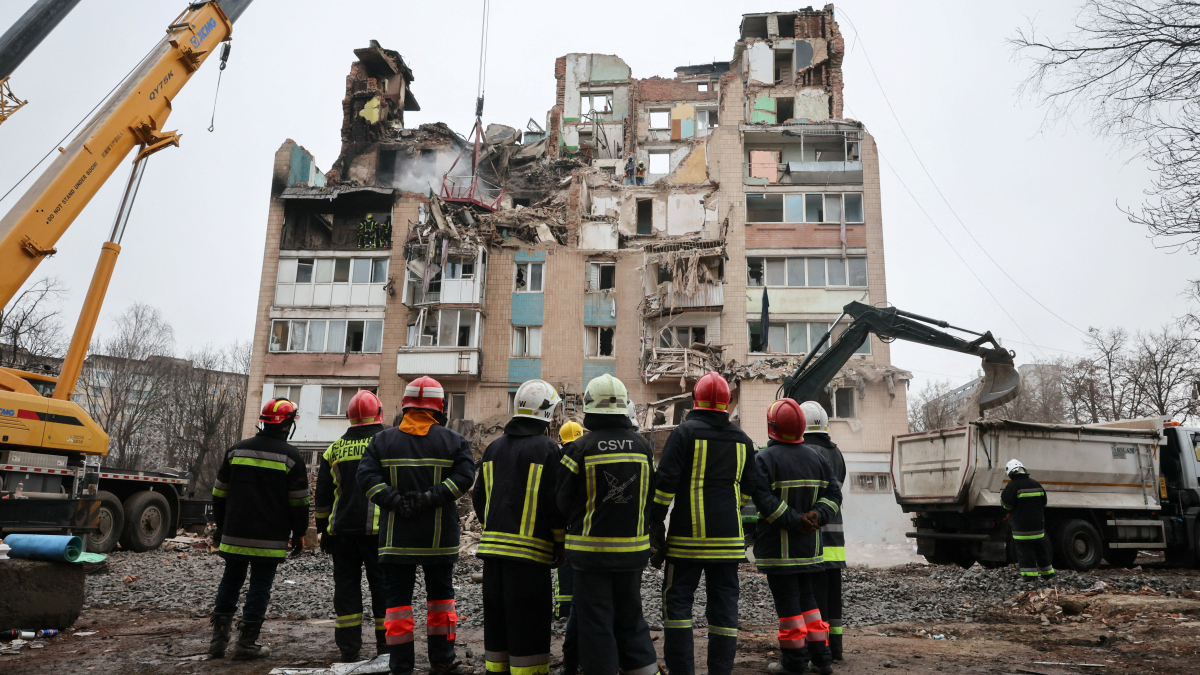
A November strike on Ternopil, killing at least 38 people, was reported as the deadliest single attack on civilians in more than two years. For many Ukrainians, it reinforced a bleak lesson: safety could not be assumed, even far from the front.
At the same time, Russia intensified pressure in the east, besieging Pokrovsk and turning another city into a focal point of both military and psychological warfare.
Sieges work by compressing choices. They force civilians to decide between displacement and deprivation, overwhelm local governance, and convert evacuation corridors and supply routes into life-or-death arguments.
Each threatened city becomes a symbol, and symbols can distort decision-making, making compromise harder even when it might save lives.
Then winter arrived, and with it a renewed campaign that Ukrainians described as ‘energy terror’. Strikes on civilian infrastructure plunged millions into blackouts at the moment heat and water became matters of survival.
By mid-December, a systematic wave of attacks had destroyed roughly two-thirds of Ukraine’s power generation capacity.
The consequences were immediate and visceral: hospitals running on contingencies, factories idled, homes dark and cold, and repair crews working under the threat of repeat strikes.
In the Odesa region alone, more than one million people endured a days-long total blackout—without electricity, heating or running water.
These attacks did more than damage grids. They attempted to dismantle the conditions of civilian resilience, turning winter itself into a weapon and making the “home front” an explicit battlefield.
The November peace plan and the shape of stalemate
Against this backdrop, November brought a high-profile effort to force diplomacy back into relevance: a U.S.-presented 28-point peace plan.
Its terms demanded Ukraine renounce NATO membership, accept territorial losses, and hold swift elections. The proposal was framed as a route to stop the fighting; in Kyiv it was characterised as a ‘U.S. vision’, not a negotiated settlement, and widely viewed as a blueprint for capitulation dressed in the language of realism.
The episode underlined a hard truth about peace plans: they are rarely neutral. They encode a judgement about power and endurance—who is expected to concede, who is expected to guarantee, and whose security is treated as negotiable.
For Ukraine, the dilemma was existential. Concessions on sovereignty and alliances would not merely conclude a campaign; they would shape the country’s vulnerability for decades, particularly if Russia retained the means and incentive to return.
For Russia, any arrangement that rewarded territorial acquisition risked validating the method and inviting repetition.
For Western backers, the plan exposed a central tension: the desire to end the war colliding with the fear that ending it on unfavourable terms could create a larger crisis later.
Meanwhile, the military reality continued to grind. A short-lived March ceasefire focused on energy infrastructure was repeatedly violated, reinforcing scepticism about limited agreements without enforcement.
A much-trumpeted Trump–Putin summit in Alaska later ended with no deal. And as winter deepened, Ukraine’s immediate priorities narrowed to the basics: intercept what can be intercepted, repair what can be repaired, and keep as many people as possible warm and safe.
2025 closed in a concrete stalemate. Russia held new ground in the east. Ukrainian households fought for heat and light.
And the most prominent peace offer on the table was one Kyiv saw not as a bridge to security, but as a map of surrender.
In the end, the year’s competing realities did not merge into a single story—because neither diplomacy nor the battlefield proved strong enough to end the other.
Tags
