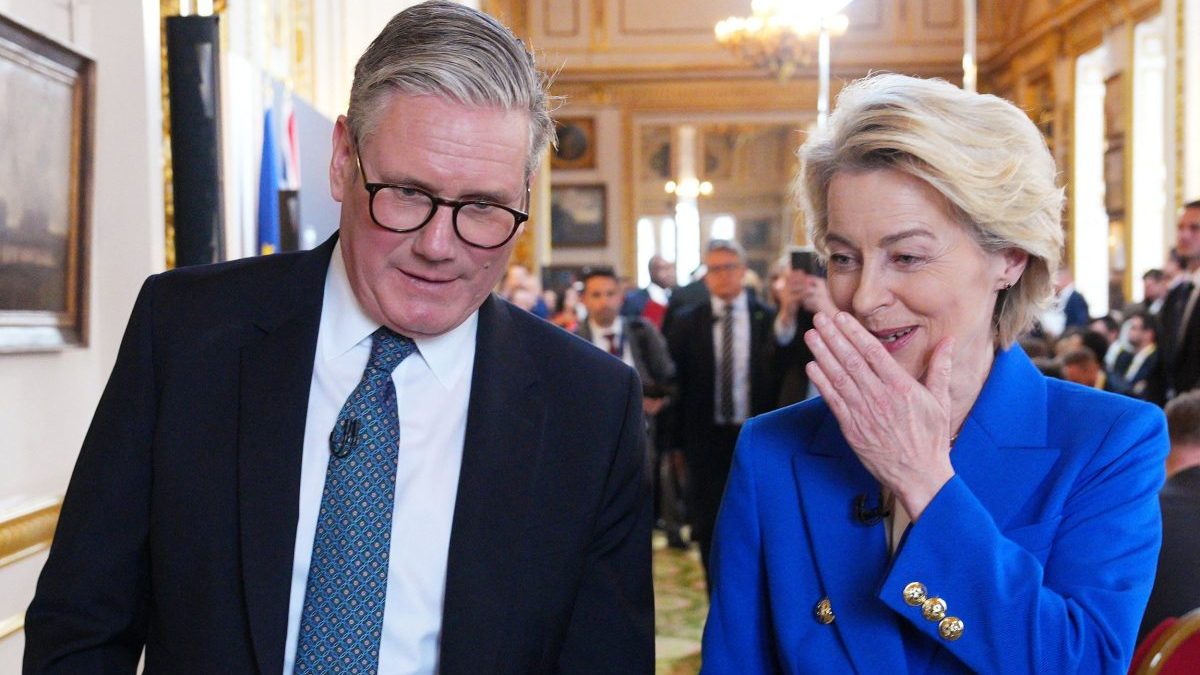
The two leading figures in the Brexit reset negotiations have said they are confident of reaching an agreement on youth migration despite differences remaining over how to regulate the numbers coming to the UK each year and university fees.
EU ambassador to the UK Pedro Serrano told The i Paper the bloc could favour an emergency brake rather than a hard cap on the number of people allowed to access any new under-30s visa to allow freer travel over the Channel.
He pointed out that the two sides agreed in May’s Brexit reset summit that a new youth experience scheme should be “balanced” and “on terms to be mutually agreed”.
New FeatureIn ShortQuick Stories. Same trusted journalism.
But Serrano said balancing the number of people accessing the scheme “can be done in a variety of manners”, including a hard cap as favoured by the UK, with 50,000 one figure mooted, but also potentially a “monitoring mechanism that allows you to restrict additional permits [visas] once you’ve reached a certain level”.
Numbers have to mutually acceptable
His comments follow reports that the EU, which favours a totally uncapped scheme, was pushing for the latter, which would amount to an emergency brake to be activated if there was a surge in the number of visas being granted.
The wrangling over a cap comes after the UK initially voiced scepticism about the scheme, which would allow young people to travel, work and study in both Britain and the EU for a time-limited period, due to concerns over previously record levels of net migration.
Asked whether the gap between the UK and EU over a cap was bridgeable, Serrano told The i Paper: “There’s an agreement already in the Common Understanding as regards numbers that are mutually acceptable, and that can be done in a variety of manners.
“And I think we all want to stick by that agreement that numbers have to be mutually acceptable, whether you do it through a capping mechanism or a monitoring mechanism that allows you to restrict additional permits once you’ve reached a certain level, or whatever formula is agreed by negotiators.”
Serrano also reiterated calls for the UK to lower university fees for EU students, charging them domestic rather than international rates, which are much higher.
The ambassador made the point that UK citizens going to the EU on the scheme will benefit from “subsidies” by European governments which mean university is cheaper on the continent.
“The issue is basically ensuring that British universities will continue to remain accessible for normal EU citizens and here, the situation is different in continental Europe, where most of the universities are subsidised by the state,” he said.
Despite the differences between the two sides, Serrano said: “I think this is going to happen, that we’re going to have an agreement with the youth experience scheme.”
Gaps remain between the two sides
But in a sign of the gaps that remain between the two sides on the issue, Brexit reset minister Nick Thomas-Symonds appeared to reject the idea of an emergency brake in a separate interview with The i Paper.
He pointed to the UK’s existing youth mobility schemes with countries such as Australia, New Zealand and Canada, which include hard quotas for the number of people who can obtain visas to come to the UK.
Asked by The i Paper if the UK could accept an emergency brake, Thomas-Symonds said: “No, it is the way that it is set out in the Common Understanding with a limit and it is also in the context of the 13 youth mobility schemes that already exists, that is what the Common Understanding says, that is what I have always said.”
The minister also insisted demands to lower UK university fees for EU students is “not something that’s up for discussion, it’s not in the Common Understanding”.
But he stressed: “I am always optimistic that we can make progress.
“I’m very much looking forward to the political debate on this.”
The two leading figures spoke as the UK and EU prepare to conclude negotiations on the youth experience scheme, a food and drink deal to ease trade and help with the cost of living, and linking carbon markets by the next summit between the two sides, due before the end of the year.
New plan to make life easier for touring artists
The next summit, as last May’s did, is also expected to set out new ambitions for the UK-EU relationship after Sir Keir Starmer said last month that “we have to keep moving towards a closer relationship with the EU” due to the damage caused by Brexit.
Thomas-Symonds said this would not involve any kind of customs union with the EU, despite the Prime Minister’s own economic adviser and Deputy PM David Lammy appearing to favour that approach.
“That is ruled out,” Thomas-Symonds said.
Instead, the UK will use the summit to push for the EU to make life easier for touring artists and recognise British professional qualifications for work in Europe in the next phase of the Brexit reset.
“There will be annual summits for new issues and two of those that I would highlight would be around the cultural sector, around touring artists, can we make more progress on that, on services – the Trade and Cooperation Agreement (TCA) obviously neglects services – we want to move forward on mutual recognition of professional qualifications,” Thomas-Symonds said.
Serrano said Brussels is “ready to make progress” on professional qualifications but said the rules must work both ways, for example so neither side can ask for “additional exams” to recognise people’s qualifications.
The ambassador warned that movement on touring artists would not be “simple”, because it cuts across many regulations including around movement of vehicles, movements of merchandise as well as customs and visa regulations, adding: “It’s a complex issue, it’s not something that you can just with one brush stroke sort out.”
Food and drink alignment by the end of 2026
Meanwhile, the UK’s first focus is introducing legislation in “the early part of the year” to make dynamic alignment with EU rules on food and drink and emissions trading a reality by the end of 2026.
Your next read
“You are going to see us making the case for dynamic alignment in those areas, in the national interest, with an independent arbitration panel, that’s exactly what we’ll be doing in Parliament,” Thomas-Symonds said.
“This is the framework I am negotiating in – no customs union, no single market, no freedom of movement.
“What I say is this – I am actually delivering here that closer UK-EU relationship that’s in the national interest and I think you have seen proof of that in recent days.”