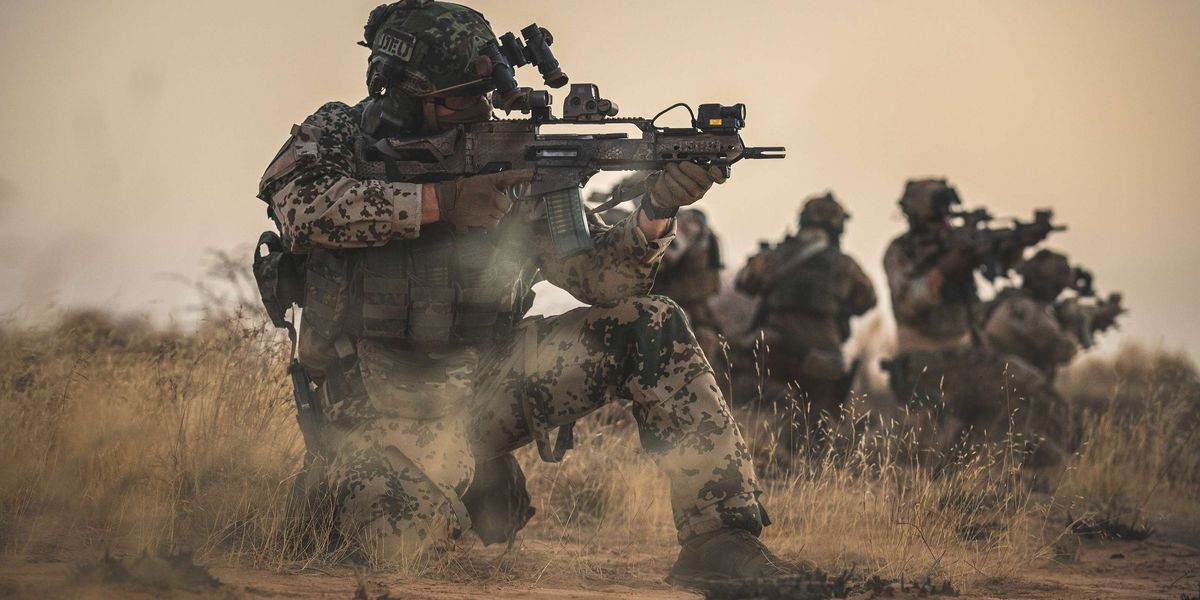
German Defense Minister Boris Pistorius is investing billions in European and international systems, from Czech pistols to American fighter jets. Why aren’t these weapons being purchased from German manufacturers?
Germany spent 24 billion euros on military procurement in 2025, focusing on European suppliers while relying on American systems, where domestic capabilities are not sufficient in its effort to modernize — and quickly.
The force procurement balance for 2025 shows that modernization has progressed despite high demand, mainly due to simplified procedures and numerous Bundestag resolutions.
Financed mainly through the special fund, the Bundeswehr implemented 149 procurement projects.
Many new systems have already been delivered or are currently being introduced, writes € news.
One focus was the military, with further deliveries of the Puma infantry fighting vehicle, produced by German defense companies KNDS Deutschland and Rheinmetall Landsysteme.
However, not all weapons systems for the Bundeswehr are manufactured in Germany.
The majority of procurement contracts will be awarded to European manufacturers, with only about 8% to be purchased from the US.
Where Germany’s capabilities reach their limits
Weapons systems not manufactured in Germany include the F35 fighter jet, the P-8A Poseidon maritime surveillance aircraft for the Navy, and Tomahawk cruise missiles from the US.
But purchases are also being made in Europe, such as replacing the Bundeswehr’s P8 pistol with the Czech CZ P13.
In addition to German air defense systems such as IRIS-T, the Bundeswehr has purchased the Arrow-3 missile defense system, which was developed in cooperation between the US and Israel.
These systems are of great importance to the Bundeswehr, such as the F35 fighter jet, which cannot be produced outside the US due to the highly complex and confidential technologies involved.
In addition, specialized manufacturing facilities, legal export controls, such as the International Traffic in Arms Regulations (ITAR), and strategic interests hinder fighter aircraft production abroad.
It has already been debated whether European fighter jets, such as the Swedish Gripen, could replace the F-35.
But even this is not as easy as it seems: according to reports, the F-35A — the model that the Bundeswehr will also receive — has been certified to carry the American B61-12 nuclear bomb.
This means the aircraft is capable of carrying both conventional and nuclear weapons and is seen as a potential successor platform to older aircraft capable of carrying nuclear weapons, such as the Tornado, as part of NATO’s nuclear weapons sharing program.
Another option was the Franco-German-Spanish Future Combat Air System (FCAS), which aimed to redefine “future air combat”, while maintaining independence from non-European partners.
However, the project remains at a difficult stage: although all three countries remain politically committed to it, ongoing industrial conflicts, particularly between Airbus and Dassault Aviation over leadership roles and divisions of labor on the next-generation fighter jet, are delaying progress.
The purpose of FCAS is not a single fighter aircraft, but a networked “system of systems” that includes a piloted fighter aircraft and accompanying unmanned drones.
The first flight of the new airship is expected to occur around 2030, at best, with operational readiness most likely by 2040.
However, it is unclear whether the schedule and costs can be met.
Political balancing act
Although approximately 80% of defense equipment is purchased in Germany, full independence is also challenging to achieve at the political level.
At a NATO meeting in early December, US Deputy Secretary of State Christopher Landau criticized European countries for placing their defense industries above American suppliers.
He called on Europe to transform its defense spending into operational capabilities and not exclude any American company from the market.
The recently released US National Security Strategy also states that “from military alliances to trade relations and beyond, the United States will insist on being treated fairly by other countries.”
“We will no longer tolerate, nor can we afford, free travel, trade imbalances, predatory economic practices, and other impositions that undermine our nation’s historic goodwill and harm our interests,” the strategy said.
Ben Hodges, a retired general of the United States Army, said that “where Germany buys its defense equipment should depend first and foremost on what gives the Bundeswehr the best capability.”
However, he acknowledges that there are systems that Germany is currently unable – or unwilling – to produce.
Standardization of European defense capabilities
Another reason for European procurement is the desire for greater standardization and improved cooperation between the continent’s armed forces.
The EU is promoting joint procurement of defence equipment to standardise the highly fragmented European equipment market and reduce duplication.
If several armies use the same or compatible systems, joint operations become much easier.
Therefore, programs such as EDIRPA and the European Defence Industry Program (EDIP) aim to encourage member states to stop isolated national purchases and invest collectively.
The goal is a better coordinated European defense industry and technically harmonized weapons systems.
In the long term, according to the EU strategy, this will not only strengthen efficiency and solidarity, but also Europe’s military integration and the capacity for common defense. /Telegraph/