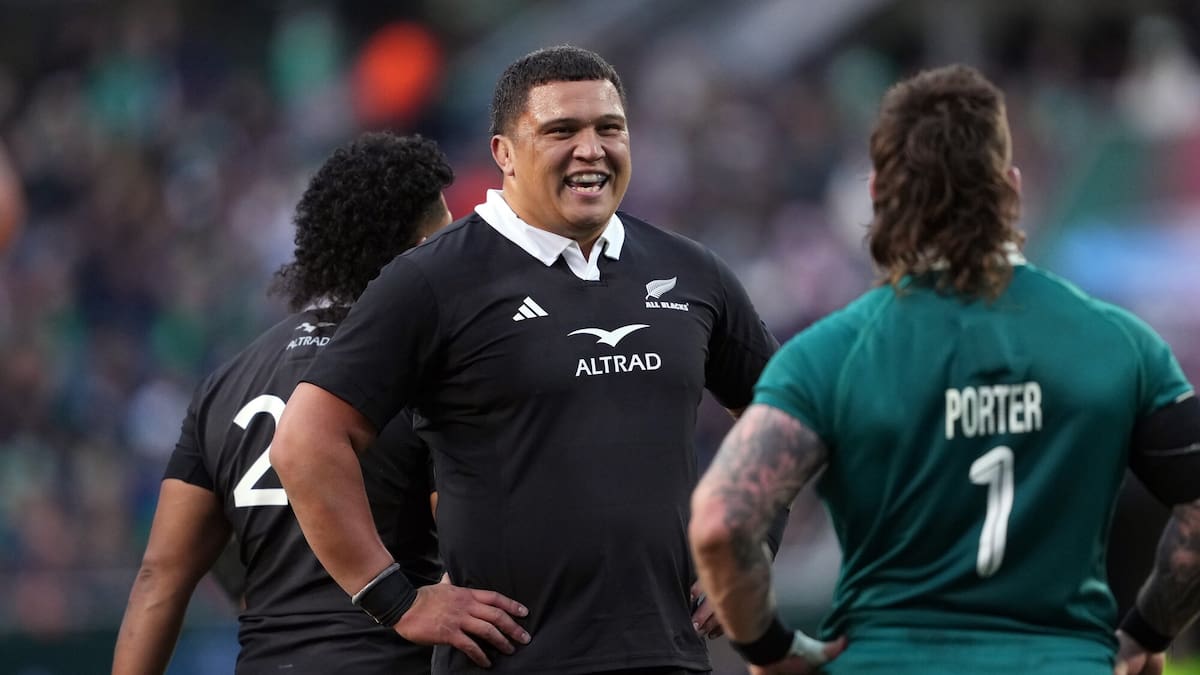
“Personally, coming into the end of the Super season with an injury was something I had to learn. I got a lot of gold from that,” Williams told the Herald.
Tamaiti Williams: “Being a dad, a husband: that was good to experience.” Photo / Photosport
“Mentally preparing to put your body out there when you know you’re not at 100%… I love the red and black jersey. I had a lot of trust in the management to make a call and see whether it was ethical or not, and if I was helping the team or taking away.
“I was stoked to get the championship, especially after last year.
“Going under the knife for the first time was a whole learning experience for me as well. Not being in the All Blacks, being at home rehabbing an injury, being a dad, a husband: that was good to experience.”
Williams returned to the All Blacks off the bench in the second test loss to the Pumas in Argentina this year – and he has largely retained the impact role. His subsequent start against Wales was his second in nine tests this season, with de Groot’s scrummaging strength regaining the first-choice loosehead mantle.
While impact from the bench grasps increasing influence in the modern game, Williams’ role reversal from starter to finisher could be painted as a setback or regression.
Williams, though, views this year through a development lens.
“I started a lot last year, but with my role [this year] coming off the bench I’ve learnt how important that is. Everyone wants to start, but I’m a full believer in team first so it’s been a bit of a ride.”
The All Blacks’ bench impact this season mirrors their inconsistent form. On the Grand Slam tour the bench propelled the All Blacks to defining late surges against Ireland and Scotland but they couldn’t replicate those efforts at Twickenham.
“One thing I’ve learnt is when you get an opportunity you’ve got to take it. I’ve got it right at times but I’ve also got it wrong. I’ve taken a lot of growth out of that.
“I feel like my game is evolving. Earlier in my career, I played loosehead and tighthead, but I’m at loosehead at the moment. The demand on the prop nowadays to 20 years ago is a lot different. The way we want to play the game is a lot different.
“I’ve been challenged in ways that caught me off guard. There’s been some big moments in games, like the scrum against England last weekend, and also how I can help people around me so I’m still developing.”
Props, generally, mature in their late 20s, early 30s, which casts the 25-year-old Williams as a figure who will feature prominently for the All Blacks for many years to come.
He’s not alone in that bracket, either.
While England humbled the All Blacks to expose familiar flaws, their forward pack, with loose forwards Peter Lakai and Wallace Sititi, locks Fabian Holland, Josh Lord and the injured Tupou Vaa’i and hooker George Bell, join Williams in setting solid foundations for the long-term future.
“I hope it goes that way. One thing I’ve learnt in rugby is there’ll never be a time that this team will be together again after this week. You never know what next year brings.
“You’ve got Codie Taylor, Scott Barrett and Ardie Savea who have been here for a decade but then I’ll sit next to Fabian. I remember watching his under-20s for the Highlanders in Ashburton and that feels like yesterday.
“It’s a real strength of ours. We have a lot of different athletes and ages.”
Liam Napier is a Senior Sports Journalist and Rugby Correspondent for the New Zealand Herald. He is a co-host of the Rugby Direct podcast.