Distinct from many of the other items which will be displayed, is a clear plastic raincoat from the 1960s. It was designed by another of the Queen’s couturiers, Hardy Amies, who later went on to create space-age get-ups for Stanley Kubrick’s 1968 film, A Space Odyssey.
Like the transparent plastic umbrellas that later became her trademark on official engagements, this raincoat also allowed people to see the Queen’s brightly-coloured dresses in all weathers.
Colours mattered, says de Guitaut, and it was important that members of the public who turned out to see her actually could. “So even if you’re 10 deep in the crowd, you can see a figure in a bright yellow coat or whatever it happens to be… You’ve seen the Queen,” she says.
The futuristic coat – modish in the 1960s – is also indicative of how the Queen was in sync with the times. Kwei points out that “she didn’t want to be known as a fashion icon”.
But de Guitaut points out that alongside all the subtle messaging, trends had also been key to many of the Queen’s outfits in her younger years.
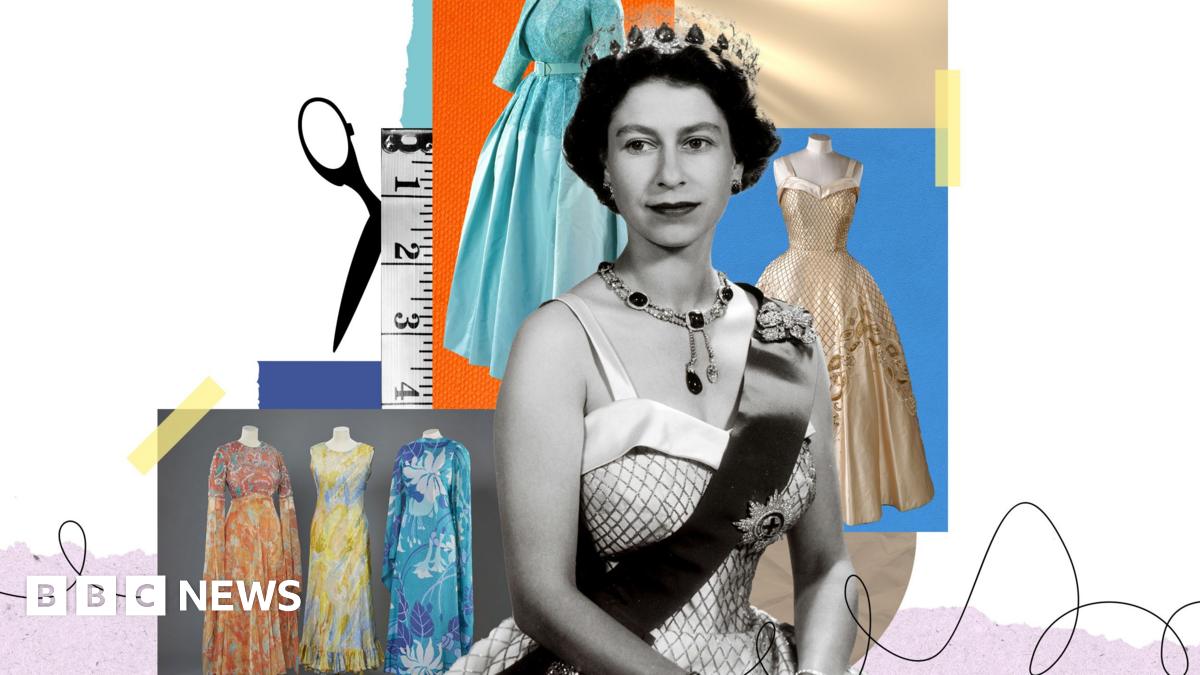
In the 1940s, the influence of Christian Dior’s New Look cinched waists were apparent, then in the 1950s, references to Spanish fashion house Balenciaga’s more voluminous style emerged in the Queen’s clothes, says de Guitaut.
“In the 60s she was wearing some quite short hemlines, little tailored suits, the colours – everything really speaks to that era,” she adds.
By the 1970s, even the Queen was wearing looser-fitting evening gowns with drapey arms and “swirly whirly” patterns.
Though encompassing fashion trends, the Queen’s instantly recognisable style remained “very elegant, quintessentially British and restrained”, says de Guitaut.
What threads each decade together, she adds, is that sartorially, the Queen “always made the right choice” – ever appropriate for the occasion.
“For someone who was on the world stage for 70 years, it’s quite impressive.”
Queen Elizabeth II: Her Life in Style is at the King’s Gallery from 10 April 2026