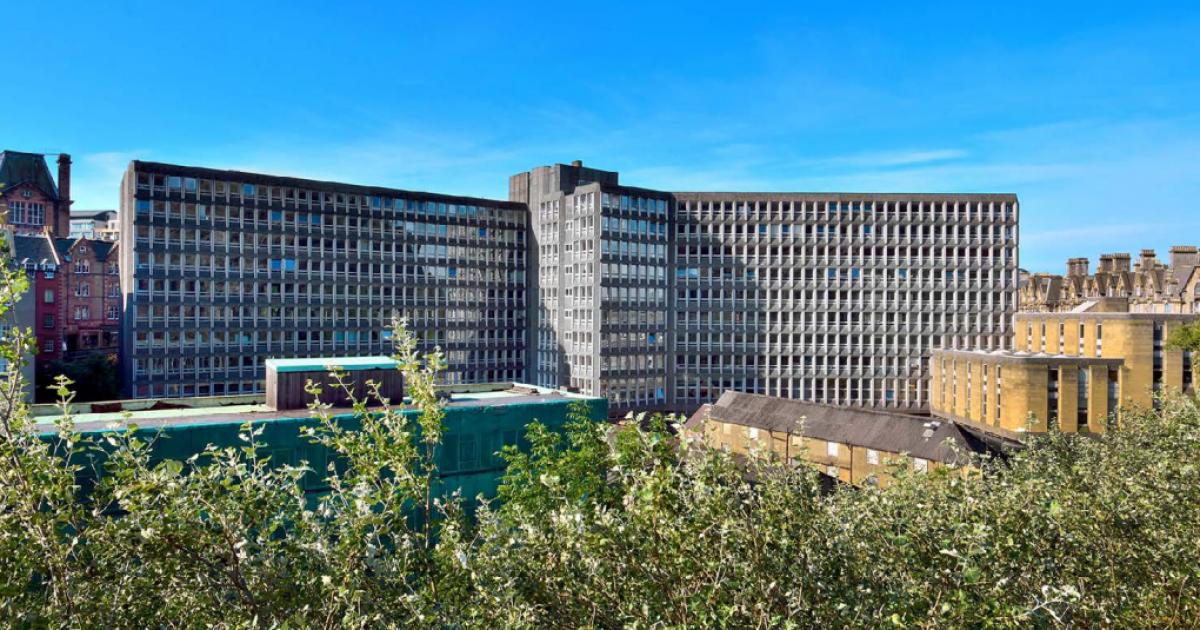
That is, until such polarising structures face demolition, redevelopment, or other threats, at which point the voices of those championing character, conservation and the importance of quirks on the city’s famous skyline grow louder.
Read more
This was the case when, in November, proposals emerged to tear down a brutalist office block in the city’s Old Town, which sits in the shadow of Edinburgh Castle.
Argyle House is home to dozens of tech start-ups but is better known to the world as the police headquarters in Dept. Q, since Netflix released the hit detective drama set in Edinburgh earlier this year, already green-lit for a second series.
Small screen fame for the angular, 11-storey concrete-clad block some consider to be Edinburgh’s “ugliest” building may have earned it some new fans. But the outline plans to level Argyle House and replace it with a mixed-use development including flats, a hotel and offices has sparked a wider debate about the value of the city’s brutalist architecture.
That debate is expected to run for years, with developers hendersonherd confirming recently that plans were being considered in advance of the lease from owners PGIM to Telereal Trillium expiring in 2033 “to ensure that the site can be regenerated and continue to deliver economic benefit to the city”.
The Edinburgh-based property business is not proposing to demolish Argyle House because of its incongruity amongst the Old Town’s historic façades, but rather, it says, because it is “coming to the end of its usable lifespan and no longer meets the needs of the modern occupier”.
To many, this will not be seen as a sufficient justification for complete demolition, rather than taking a more preservation-focused approach to redevelopment. After all, the building is less than 60 years old and, as Edinburgh’s heritage watchdog the Cockburn Association pointed out, many brutalist buildings “were constructed with durable materials and generous structural spans, making them strong candidates for adaptive retrofit”.
Writing recently, the Cockburn Association’s assistant director James Garry said structures like Argyle House “need not be relics” but rather “catalysts for renewal, providing affordable workspaces, cultural hubs or new forms of housing that respect the city’s skyline while reusing what already exists”.
He said: “In Edinburgh, the contrast between the city’s classical skyline and its post-war experiments has long divided opinion. Argyle House, on Lady Lawson Street, is perhaps the capital’s most striking and controversial example.
He continued: “In Edinburgh, a city celebrated for its Georgian order and medieval texture, the exposed concrete of Argyle House and Cables Wynd House appears almost defiant. But to dismiss these works as “ugly” is to miss the wider story they tell: a time when architects believed that design could help build a fairer, more cohesive society.”
Others echoed this sentiment, including renowned Edinburgh architect Malcolm Fraser, who in an open letter to “politicians, Amenity Group Leaders and general Edinburgh Worthies” called the proposal “madness, given the seriousness of the Climate Emergency and the ocean of waste that we condemn to landfill, to knock down a sturdy, solid and useful building, condemning huge amounts of embodied carbon”.
The letter added: “Argyle House has nurtured two unicorn companies – ie now capitalised at over a billion dollars. Do we really think it’s progress to put them out onto the street for more hotels and executive flats?
“Argyle House is a distinguished modernist building, in a city that continues to erase its recent heritage. In its sturdy, grey monumentality it is characteristically Edinburgh; plus in placemaking it does a nice thing in stepping back from the tight junction at the head of West Port, a move that Patrick Geddes, doyen of Town Planning and Edinburgh Hero, would have surely approved, given his adage of “letting some light in”.”
But for Richard Murphy, another celebrated architect based in the Scottish capital who undertook a study on converting Argyle House into a hotel several years ago – but could not find a developer willing to take the project forward at the time- the focus is less on protecting brutalism.
Mr Murphy told The Herald: “I have no love of that era of architecture. People go on about “Brutalism” as being wonderful architecture to be preserved. It rarely is and I’d be happy if the facades of the building were completely reclad.
“However I can’t understand why it makes sense to throw away the structure. It’s has the perfect plan and sectional dimensions for a large hotel – of which there are many similar examples of recladding and reusing office buildings: the Apex [hotel] in the Grassmarket, the Resident” in Drumsheugh gardens, Premiere Inn York Place.
“Complete demolition makes no economic sense aside from any environmental considerations.”
Mr Murphy highlighted that the front of the building “has space for a port-cochere entrance” and the rear “has potential car parking and servicing,” while “at least 50% of the rooms would look straight at the castle”.
He added the hotel could also feature “an amazing roof top bar”.
In consultation documents, hendersonherd said Agryl House was “built in such a way that makes alteration and recovery of materials complicated,” however added there “may be opportunities for some of these elements to be demounted and re-used”.
“A deconstruction process would seek to salvage as many of these elements for reuse as possible, reducing the need for new materials and upfront embodied carbon.
“The design team have begun cataloguing materials and elements which may have the potential to be salvaged and re-used.
“Further assessment is required to ascertain the structural, and commercial viability of re-using any materials.”