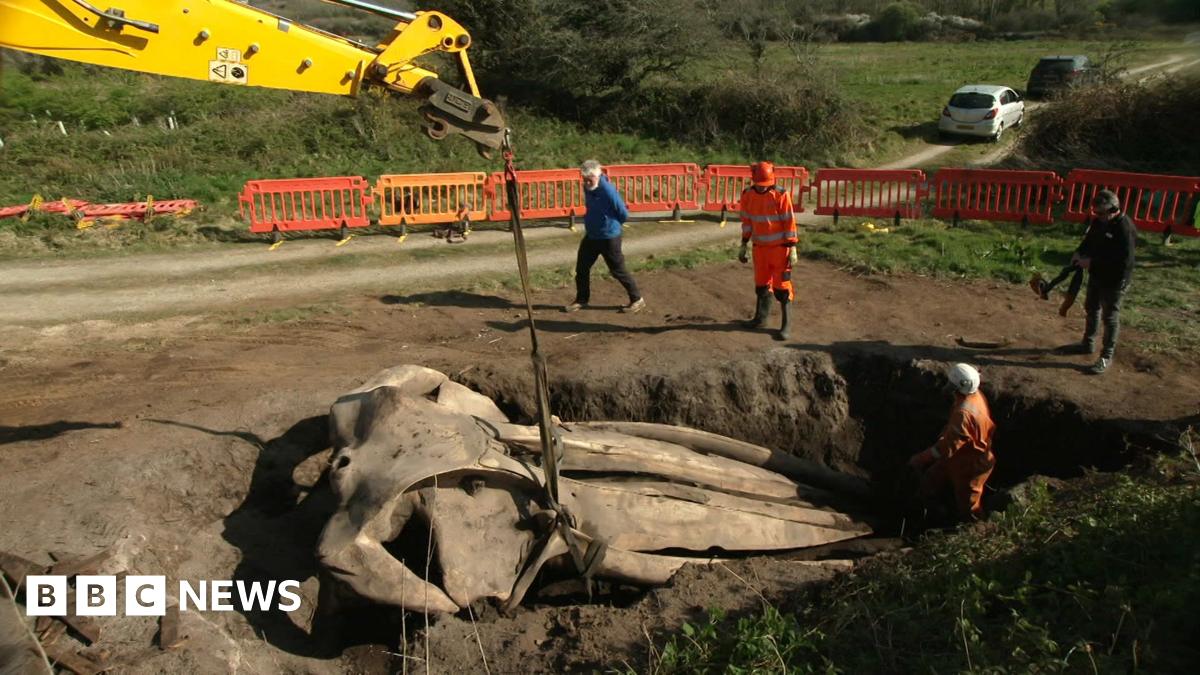
When plans were submitted for a wind farm in the field outside Falmouth where the head was buried, Prof McDonald started to look at how best to retrieve it.
However, he got a new job out of Cornwall before being able to do it, leaving the university with a two-tonne whale’s head under its premises, and nobody obvious to deal with it.
Stuart Bearhop does not know much about digging up whales, and he is not a whale biologist but the job of excavating it had to fall to someone, and the university decided it would be him – probably because he had been the one who started asking questions, on my behalf.
Left too long in the ground the bones would start to break down.
To help with the sizeable task was Paul White, a former Royal Marine who usually works excavating live electricity cables and utilities.
Also on hand were Johnny Nicolas, who lays slabbing for housing developments, and David Hatton who is a digger master.
They had with them a vacuum excavator usually used for working around live electricity cables and gas pipes.
A huge lorry would suck up all the soil from around the skull, making it easier to then be winched out on a digger arm.
Over the course of the next 10 hours I watched as the team, with great care and precision, painstakingly extracted the whale’s head from its resting place.