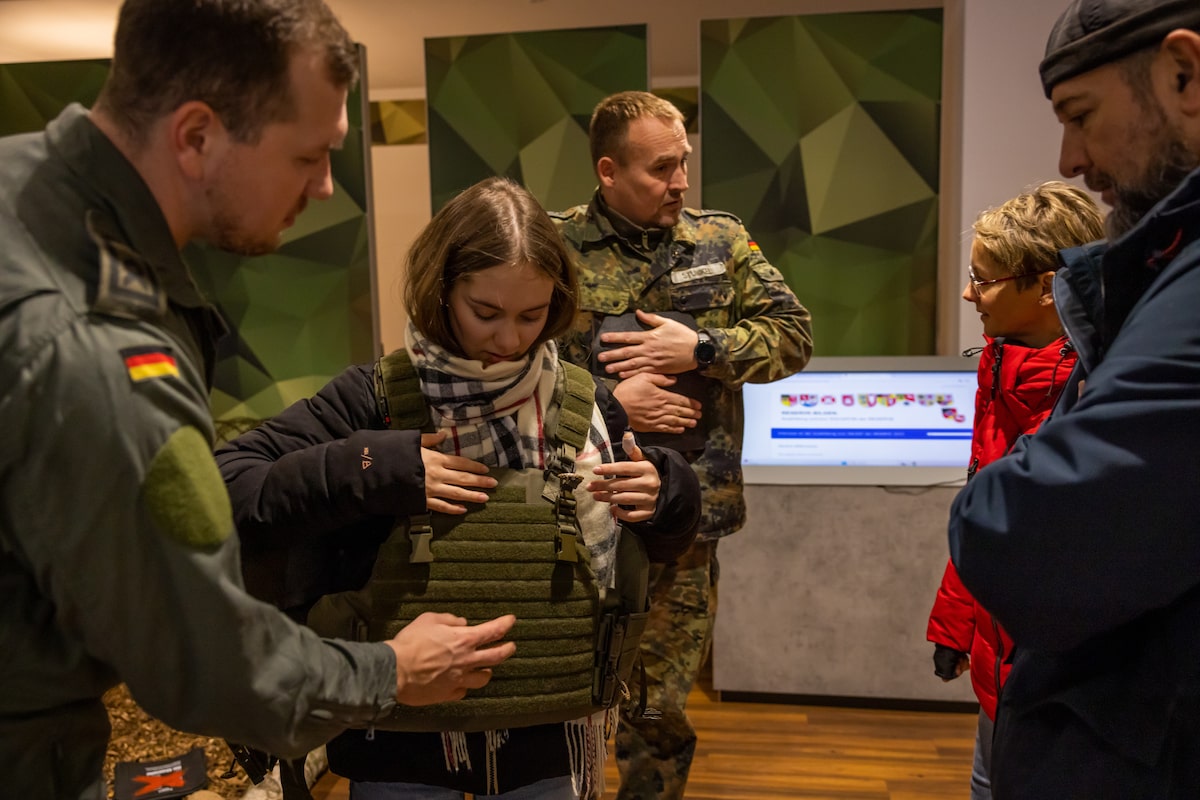
Tamara Feedler, 16, tries on a bulletproof vest at a pop-up recruitment centre for the German military in a shopping mall in Wolfsburg. The military is trying to modernize its recruitment strategy and appeal to the younger generation.Anna Liminowicz/The Globe and Mail
Berlin high-school student Matti Brunner doesn’t turn 18 until next September, but he’s already worried about a new German law that will put him and every other 18-year-old male in line for military service.
As of Jan. 1, Mr. Brunner will be among the first cohort of German boys who will be required to fill out a questionnaire once they come of age to determine their suitability to serve in the armed forces. Starting in 2027, they’ll also have to take a physical exam. For now, the questionnaire is optional for women.
Anyone who volunteers for at least six months will earn €2,600 a month, or about $4,200. If they sign up for a year, they’ll also receive a subsidy toward the cost of a driving licence, which can cost as much as €3,000 in Germany.
The military, known as the Bundeswehr, hopes to attract 20,000 volunteers annually at first and double that by 2031. But if those targets aren’t met, the government has said the service will become compulsory. And that’s what worries Mr. Brunner and so many other teenagers.
“I am anxious already,” Mr. Brunner said as he joined a student rally in downtown Berlin on Dec. 5, the day the law was adopted by the German parliament, known as the Bundestag. “If they get enough volunteers, it’s perfectly fine. But there’s this fear that there are not going to be enough volunteers, and that I am going to get drafted anyways.”
Germany embraces militarism for the first time since the Second World War
The new law is part of a major shift in German defence policy, and it follows a trend across Europe of governments spending record amounts on weapons and manpower.
The debate in Germany is particularly sensitive given its haunting history of the Third Reich and the decades of demilitarization that came after the Second World War.
Ever since German reunification in 1990, successive governments have embraced the benefits of a peace dividend. The size of the Bundeswehr, which was created in 1955 under the guidance of the Allies, has fallen from around 500,000 troops during the Cold War to 184,000 today.
Mandatory military service for civilians, which was introduced in 1956, gradually eased from 18 months before reunification to six months in 2009. Two years later, the government of Angela Merkel scrapped compulsory service altogether.
Young people rally in Berlin on Dec. 5 to protest the new law.Anna Liminowicz/The Globe and Mail
Russia’s full-scale invasion of Ukraine in 2022 and U.S. President Donald Trump’s disinterest in NATO have led to a rethinking of European security and prompted Chancellor Friedrich Merz to re-engage the Bundeswehr.
Last March, Mr. Merz announced plans to spend €650-billion over the next five years on the military. The annual defence budget will increase from €86-billion this year to €153-billion by 2029, bringing it close to 3.5 per cent of gross domestic product. The number of active troops in the Bundeswehr is projected to rise from 184,000 to 270,000 by 2035, and the reserve force will more than double to 200,000.
“In view of the threats to our freedom and peace on our continent, the rule for our defence now has to be ‘whatever it takes,’” Mr. Mertz said when the plan was announced.
A push for voluntary military service is in step with many other European countries. Bulgaria, Belgium, France, Poland and the Netherlands have adopted similar programs. Ten other countries have reintroduced compulsory service, and Serbia plans to follow suit next year. Canada’s Defence Minister, David McGuinty, is considering expanding the country’s total military reserve force to 400,000 from less than 30,000 currently.
NATO’s eastern flank is deploying a new weapons system to defend against Russian drones
Some experts question whether a voluntary scheme will do much to increase the size of the German army.
“If you see the development in recent years, the former goal was 200,000 active troops, and they didn’t even get an increase of 20,000 on a voluntary basis. So if you don’t get 20,000 volunteers, it’s not quite realistic to expect you get 80,000 volunteers,” said Thomas Wiegold, a German defence policy expert.
Retired colonel Patrick Sensburg voted against ending mandatory service in 2011 when he was an MP, and he has called on the government to reintroduce 12 months of compulsory training for 18-year-olds.
“We have to explain to young people that the threat is out there and that the only way to ensure peace is by having a strong deterrence,” said Dr. Sensburg, who is president of the Association of Reservists of the German Armed Forces.
The military also needs to modernize the program with better training and educational offerings, he added.
Hanno Koloska, 55, who himself had to go through 18 months of mandatory service after high school, has urged his 20-year-old son to register as a conscientious objector.Anna Liminowicz/The Globe and Mail
Mr. Trump’s isolationism and the rise of populist parties in Europe, which often side with Russia, make it harder for young people to feel motivated to join the military, said Lukas Mengelkamp, a political scientist at the University of Hamburg.
“In the Cold War, you had some kind of overall Western consensus on what we were defending and what we would be fighting for. And I don’t see this kind of consensus currently in the West,” he said. “It’s not convincing simply to just say, ‘The Russians are the bad guys, and we have to defend against them.’”
The Bundeswehr has tried to become more enticing to young people. It has modernized its recruitment strategy through pop-up “career lounges” in shopping malls, slick social-media campaigns and personalized postcards sent to 16- and 17-year-olds outlining the educational opportunities in the forces.
Members of the military were on hand at the mall pop-up to talk about career opportunities.Anna Liminowicz/The Globe and Mail
On a recent Saturday afternoon in Wolfsburg, Captain Patrizia Leicht offered a warm greeting to the steady stream of people who wandered into a temporary recruitment centre next to the City-Galerie mall.
The centre opened in April and was due to close at the end of 2025, but Capt. Leicht said it will now stay in place through 2026. “This is the first time in Germany for an American-style pop-up store for recruiting,” she said, adding that about 350 people have joined the forces so far.
Each week, a different branch of the military is highlighted. On this day, the Air Force was front and centre. The small storefront was filled with two helicopter engines and a mannequin dressed as a fighter pilot. Videos of air force jets patrolling the skies played on giant television screens, and samples of military hardware lined a wall.
Tamara Feedler, 16, stopped by out of curiosity and tried on a bulletproof vest. “It was really, really tough to wear it because it was so heavy,” she said afterward.
She wasn’t interested in a military career – “I think I’m too scared” – and she’s worried about how the military service program will affect her friends, many of whom turn 18 in 2026. “I think a lot of them are hoping that they will not have to go,” she said.
Britain unveils military overhaul, pledging increased defence spending
Over in another corner, Torben Prang, 23, checked out the helicopter engines and expressed his support for the government’s defence buildup. “It’s probably better to be prepared than not to be prepared in the West,” he said. “If I have to sign up, I would. I would do the military duty.”
The recruitment campaign has been a success for young men such as Marc Guth-Schleuter. He joined the army two years ago at the age of 20 and is training to become a military paramedic. He’s worried about rising insecurity in Europe and believes Germany must be better prepared.
“It’s necessary, really necessary,” he said as he waited for a ride outside Berlin’s main train station. “The last 30 years, we have fallen back with the military stock, and now we have to buy everything.” He welcomed the voluntary service program, but he wasn’t convinced that it should become mandatory. “Military service is not for everybody.”
That view was shared by many teenagers on the streets of Berlin during a noisy protest against the law on Dec. 5.
Young protesters demonstrate against military conscription on Dec. 5 in Berlin. German lawmakers have approved a government plan to sharply boost military recruitment as the country seeks to strengthen its forces.Maja Hitij/Getty Images
Politicians “don’t really care about us. They just want us at the front. And apart from that, they’re not doing anything for our schools, not anything for our universities, colleges, nothing,” said Thorben Schwalbe, who is 16.
He and many others are exploring how to apply for conscientious objector status, which would exempt them from training with weapons. They’re getting help from the German Peace Society, a non-profit organization that has hundreds of volunteers across the country who offer tips on how to apply.
“The volunteers talk to the young people. They look through what they have written, and they tell them what else they need to hand in, because it’s a very complicated process,” said Yannick Kiesel, a policy officer with the organization.
Last year, the society helped around 3,500 teenagers with their applications, and it’s on track to assist 5,000 this year. Once the questionnaires start rolling out in 2026, Mr. Kiesel expects that figure to rise to 20,000.
Hanno Koloska, 55, would urge every teenager to avoid serving, and he has encouraged his 20-year-old son to file as a conscientious objector.
Mr. Koloska grew up in East Germany and did 18 months of mandatory military service, but he refused to carry a gun. “The sense to be in the army is to cross out your own brain. I think it’s very unhealthy. It destroys young people,” he said as he watched the student protest.
“There are only losers in a war. Nobody wins. So why can’t we say no to war?”