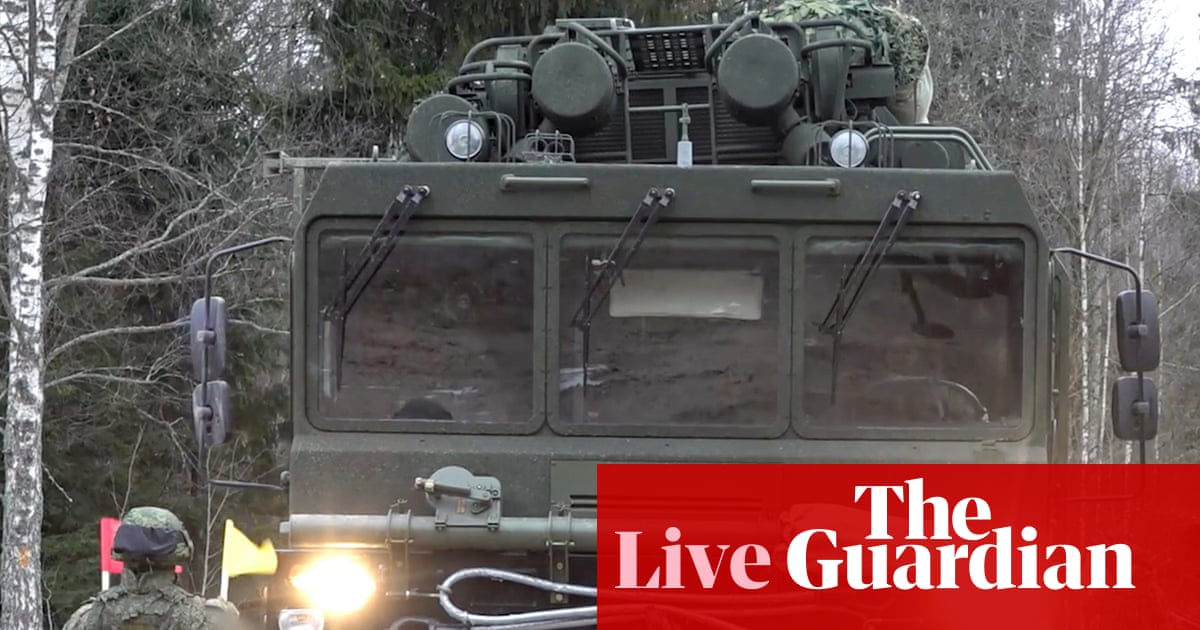
Russia says it has moved Oreshnik missiles into Belarus
Russia has released a video declaring its nuclear-capable Oreshnik missiles have entered active service in Belarus, its neighbouring ally which also shares a border with Nato countries Poland, Lithuania and Latvia.
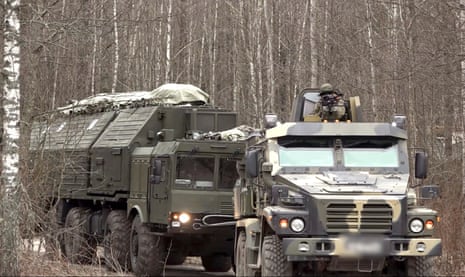 A still from the Russian Defence ministry video purporting to show a unit equipped with the Russian ‘Oreshnik’ mobile ground-based missile system that began combat duty in an undisclosed location in Belarus. Photograph: Russian Defence Ministry Press Service Handout/EPA
Putin has claimed the weapons are impossible to intercept because the missile speeds are supposedly more than 10 times the speed of sound.
The move could feasibly allow Russian nuclear missiles to reach European targets faster, if stored at a base in Belarus. Intermediate missiles have a range of around 5,500km (3,415 miles) which mean they could strike anywhere in Europe or the US’s west coast from Russia.
The video released by both Russian and Belarus defence ministries on Tuesday didn’t specify where the missile systems are being placed in Belarus- but it showed them being transported into forests and being camouflaged with netting.
“The Oreshnik missile division began performing combat duty tasks in designated areas in the country,” Belarus’s defence ministry said.
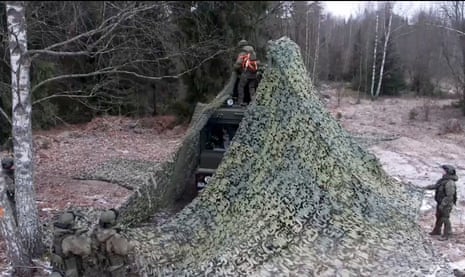 The video showed troops putting camouflage and netting over the systems. Photograph: Russian Defence Ministry Press Service Handout/EPAShare
Updated at 13.11 EST
Key events
Show key events only
Please turn on JavaScript to use this feature
We’re closing our live coverage for now, thank you for reading along. I’ll leave you with my colleague Luke Harding’s report on Russia’s claim that it has deployed its latest nuclear-capable missile system in Belarus.
ShareNo White House comment after Zelenskyy brings up ‘faked attack’ on Putin’s residence with Trump
Further to our earlier post, Ukrainian president Volodymyr Zelenskyy has said that Kyiv was discussing with Washington a possible presence of US troops in Ukraine as part of security guarantees, and also raised the attack Russia alleges on Vladimir Putin’s residence, which Ukraine and its allies have said there is no evidence for.
Reuters reports that Zelenskyy told media in a WhatsApp chat that Kyiv was committed to continuing talks on how to end the war triggered by Russia’s 2022 full-scale invasion and he was ready to meet Putin in any format.
Zelenskyy said a US troop presence in Ukraine would be a major security boost for Kyiv.
Of course, we are discussing this with President Trump and with representatives of the coalition. We want this. We would like this. This would be a strong position of the security guarantees
The White House had no comment for Reuters on the issue of dispatching US troops to Ukraine under any peace settlement with Russia.
Zelenskyy also said he was willing to meet Putin despite the deep lack of mutual trust he underlined on Monday.
I told President Trump, European leaders I am ready for any format of meeting with Putin. I am not afraid of any format … The main thing is for Russians not to be afraid.
Volodymyr Zelenskyy and Donald Trump in Florida on Sunday. Photograph: Alex Brandon/AP
Russia claimed yesterday that Kyiv had targeted a presidential residence in the Novgorod region with 91 long-range attack drones, all of which it said it had intercepted.
The Kremlin provided no physical evidence of the alleged incident, saying it would retaliate and review its negotiating stance but would not quit talks on a possible peace deal.
And as we’ve been reporting, in Paris, a source close to French president Emmanuel Macron said there was no substance to corroborate Moscow’s accusation of an attack on Putin’s residence.
Zelenskyy said earlier on Tuesday:
This alleged ‘residence strike’ story is a complete fabrication intended to justify additional attacks against Ukraine, including Kyiv, as well as Russia’s own refusal to take necessary steps to end the war. Typical Russian lies.
According to Reuters, the White House declined further comment on the reported attack on Putin’s residence after Zelenskyy said he brought it up with Trump, who yesterday said he was informed of the matter by Putin and was angry about it.
Asked if there was evidence of such an attack, Trump said: “We’ll find out.”
Updated at 13.22 EST
Further to that, the Institute for the Study of War has this insight:
Russian opposition outlet Sota published an investigation into the alleged strike on December 29, reporting that Valdai residents did not hear air defenses operating overnight, even though Russian air defenses would have had to operate to down up to 91 Ukrainian drones.
Sota reported that drones launched from Ukraine’s northern border would have to cross into heavily protected Russian airspace, including multiple installations of Strategic Missile Forces facilities, air defense units, military aviation, and other assets that would either be under heavy air defense protection or themselves act as the Russian air defense umbrella.
Sota concluded that Ukraine would have been able to strike Putin’s residence in Valdai through a “miracle” or deliberate Russian military negligence. Radio Free Europe/Radio Liberty (RFE/RL)’s Russia service reported in August 2025 that Russia increased the number of air defense systems defending Valdai from two to 12 from 2022 to August 2025.
Share Frances Mao
War analysts note no typical evidence of a Ukrainian strike into Russia regarding alleged Putin residence attack
The Institute for the Study of War has also published some useful insights in assessing if the claimed attack on Putin’s residence actually happened. As we’ve been reporting, Moscow hasn’t shown a shred of evidence for the attack which supposedly involved 89 drones.
“The circumstances of this alleged strike do not conform to the pattern of observed evidence when Ukrainian forces conduct strikes into Russia.” ISW analysts say, noting that confirmed Ukrainian strikes in Russia typically generate evidence observable in open sources.
-
Evidence would normally be footage of air defence operations, explosions, fires, or smoke plumes near the target
-
A Ukrainian attack often can also be picked up in statements from local Russian officials, typically downplaying successful strikes as “debris” from downed drones
-
There are also usually reports in local media of fire or damage to the targets
“ISW has not observed any such footage nor local or regional reporting about Ukrainian strikes near Putin’s residence to corroborate [Foreign Minister Sergei] Lavrov’s claim,” the analysts say.
They added that the detail about 89 drones being downed over Novgorod oblast was “inconsistent” with the Russian defence ministry’s own tally of 47 Ukrainian drones being downed by their defences on the night of 28 December.
“The Kremlin has offered no evidence to support its claim that Ukrainian forces targeted Putin’s residence on December 29.”
Updated at 11.52 EST
Zelenskyy has also told reporters that Ukraine’s allies have been able to verify that the alleged drone attack on Putin’s residence in Valdai was fake.
“Regarding the attack on Valdai, our negotiating team connected with the American team, they went through the details, and we understand that it’s fake. And, of course, our partners can always verify thanks to their technical capabilities that it was fake,” Reuters reports Zelenskyy saying.
Share Shaun Walker
Is claim Ukraine deal ‘95% done’ just another overoptimistic, empty assertion from Trump?
Despite the rounds of diplomatic talks and stated “progress”– there are still major differences between the two sides, chief among them Ukraine’s refusal to capitulate any territory to Russia.
So despite the recent Trump-Zelenskyy meeting, where the US president claimed a deal is “95% done”, my colleague Shaun Walker writes how it we are still very far from the end of the war:
Throughout every round of talks, the basic facts have not changed. Russian officials repeatedly state that the war will end only when its “root causes” have been dealt with, a vague formulation that involves Russia retaining some form of military or political control over Ukraine’s future.
Ukraine is facing its toughest winter yet and many are ready for difficult compromises, but things are not yet so bad that capitulation is an option. Meanwhile, Putin shows no sign of stepping away from those maximalist goals and Trump shows no sign of being willing to put pressure on him to do so. Until one of these factors changes, it is hard to see how a lasting deal could take shape.
The diplomatic dance performed by Ukraine’s European allies focuses on keeping Washington engaged with Kyiv and not letting Trump cut off US assistance, such as intelligence sharing, that remains crucial to the Ukrainian war effort. Zelenskyy’s European friends have also been pushing US-backed security guarantees, which are meant to boost the standing of Kyiv in the aftermath of the elusive peace agreement.
Trump announced progress on these security guarantees over the weekend but a lot remains vague and it is unclear how the guarantees would work in practice.
Some more detail emerging too of the security guarantees Trump and Zelenskyy discussed at their Mar-A-Lago meeting on Sunday.
Kyiv had discussed the possible presence of U.S. troops in Ukraine, Zelenskyy has told media in a WhatsApp chat, Reuters reports.
He revealed yesterday that the US had committed to security guarantees of 15 years although Ukraine would like them to endure for 30-50 years.
Updated at 11.19 EST
Zelenskyy’s meeting with European leaders next Tuesday in France will come as the fourth anniversary of Russia’s full-scale invasion creeps up.
Despite the flurry of diplomatic activity – fighting has carried on with Moscow raining strikes down on Kyiv post-Christmas.
At least one person was killed in the strikes on Kyiv this past weekend and Ukraine is expecting more now in the wake of this claimed drone strike on Putin’s residence.
Aa house destroyed after a Russian strike on Kyiv, Ukraine, on Saturday. Photograph: Evgeniy Maloletka/APShare
Updated at 11.23 EST
No evidence Ukraine targeted Putin’s residence, source close to Macron tells Reuters
Further to that, there is no evidence to corroborate the accusations made by Russian authorities saying Ukraine targeted Vladimir Putin’s residence, a source close to French president Emmanuel Macron has told Reuters.
“Ukraine and its partners are committed to a path of peace, while Russia has chosen to continue and intensify its war against Ukraine. This is in itself an act of defiance against President Trump’s peace agenda,” the source added.
ShareGermany shares Ukraine’s concern over possible Russian escalation
The German government has said it shares Ukraine’s concern that Russian allegations of a drone attack on a Russian presidential residence could be used as a pretext for further escalation in the conflict.
The German government pointed to Ukrainian president Volodymyr Zelenskyy’s rejection of the Russian claims and his warning that Moscow might exploit the accusations.
“We share this concern,” a German government spokesperson said in a statement quoted by Reuters.
The Kremlin has threatened to toughen its negotiating stance after accusing Ukraine of the attack, and yesterday US president Donald Trump appeared to take Vladimir Putin’s word over the alleged attack, saying it made him “very angry”.