
The former Prime Minister was critical of the performance of Wales’ devolved government, newly-released cabinet papers show
16:54, 30 Dec 2025Updated 20:00, 30 Dec 2025
 Former Prime Minister Tony Blair(Image: Netflix)
Former Prime Minister Tony Blair and his cabinet were critical of the performance of the devolved administration in Cardiff Bay and opposed to giving it further powers, recently-released cabinet papers show.
The former Labour leader thought that devolution under his government had “lanced the boil of separatism” in Wales and Scotland, but his cabinet felt that devolution in Wales “had in practice not worked well”.
Blair’s cabinet were discussing the findings of the Richard Commission in 2004, which had been set up by the Labour/Lib Dem coalition in Cardiff Bay to look at the powers and electoral arrangements of what was then the National Assembly for Wales.
The Assembly, which was set up after Blair’s government held a referendum in 1997, was made up of 60 politicians, who had responsibility for a £7bn budget. It no primary law making powers and debate raged about whether the powers it had to run the NHS, education and councils were sufficient.
The Cardiff Bay administration did not get the power to make laws until March 2011, when David Cameron was Prime Minister and Welsh voters backed direct law-making powers by an overwhelming 63.5% to 36.5%.
However, newly released papers from the National Archives show that in July 2004 Blair’s cabinet thought the Richard Commission had gone too far in calling for primary law-making powers for Wales and believed the people of Wales would not want it.
The commission, chaired by Lord Ivor Richard, also called for an increase in the size of the then National Assembly.
The cabinet papers summed up the discussion by cabinet members who agreed that the Government had not been consulted about the setting up of the Richards Commission and “was not bound by its findings”.
The consensus of the cabinet was that “some of the more far-reaching proposals were not acceptable”.
The minutes said: “Even in Wales, opinion on some of the proposals was strongly divided. It should be made clear that any decision to change the devolution settlement for Wales was a matter for the UK Government, not for the National Assembly of Wales.”
Cabinet members believed that substantial powers had already been transferred to Cardiff Bay and there was a “strong case for the Government to take stock before going further”. They feared that “there could be implications for Scotland” as well as the English regions if the Richard commission recommendations were accepted.
The minutes record cabinet agreeing they needed to “regain the initiative and to steer the public debate away from the Richard proposals”.
Members thought that “what Wales needed was better administration not extra powers for the National Assembly”. They supported then Welsh Secretary Peter Hain’s approach of a more modest programme of developing devolution, believing the call for more powers was from politicians in Wales who wanted to use the powers to “slow down reform”.
The cabinet feared that if the Welsh administration had law-making powers, Parliament in Westminster might be come to be seen as an English parliament “and that had to be avoided”.
Lord Hain said that his plan was a “minimalist solution and the least worst available” if the UK government was to head off a severe split among its supporters in Wales.
Members also expressed their concern that there was “a bigger underlying issue about the propensity of the devolved administrations to promise more than they could deliver within their budgets and to blame underfunding by the UK Government”.
The cabinet was concerned about “spending without responsibility”, which members felt it would need to return to in future. And Blair’s later summing up of the discussion indicated he might support some form of tax-raising powers for Wales to provide that resonsibility.
The minutes further say: “It was unhelpful that the debate in Wales concentrated on questions of structures and powers rather than on resolution of the social and economic issues facing the people of Wales. Although devolution in Wales had in practice not worked well, the UK Government had not aired its views on this and this put it in a difficult position.
“It was not desirable that Wales should move towards the Scottish devolution model: the political tradition in the two countries was quite different”.
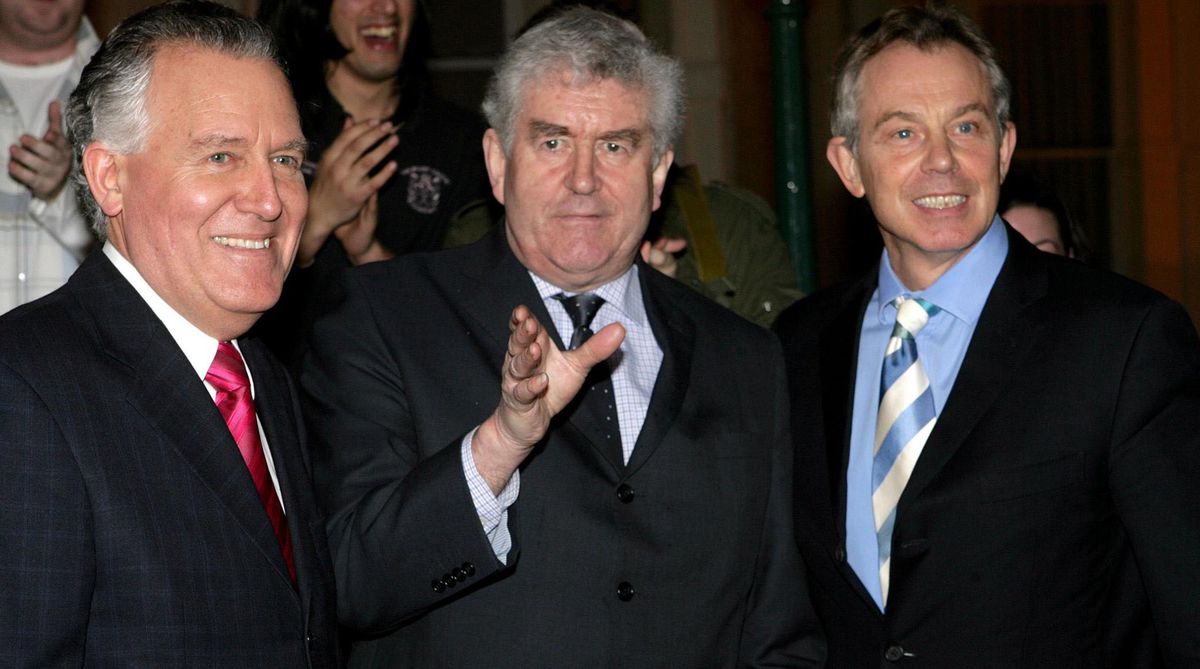 Then-Prime Minister Tony Blair (right) meets Peter Hain (left) along with Rhodri Morgan(Image: Daily Post Wales)
The note shows Sir Tony summed up the debate by saying the cabinet had rejected the commission’s “more far-reaching proposals” of allowing Wales to make primary legislation.
“There was no appetite in Wales for a further referendum on devolution and this provided a brake on such a radical change most people, both in Scotland and Wales, were satisfied with the devolution settlement, which had lanced the boil of separatism,” he said.
He said there was “longer term questions around devolution and in particular about getting a better alignment between spending powers and responsibility for raising the necessary taxation”.
The minutes say the cabinet “took note” of Blair’s summing up of the discussion.