Angie Brown,Edinburgh and east reporterand
Cameron Buttle,Edinburgh
 BBC
BBC

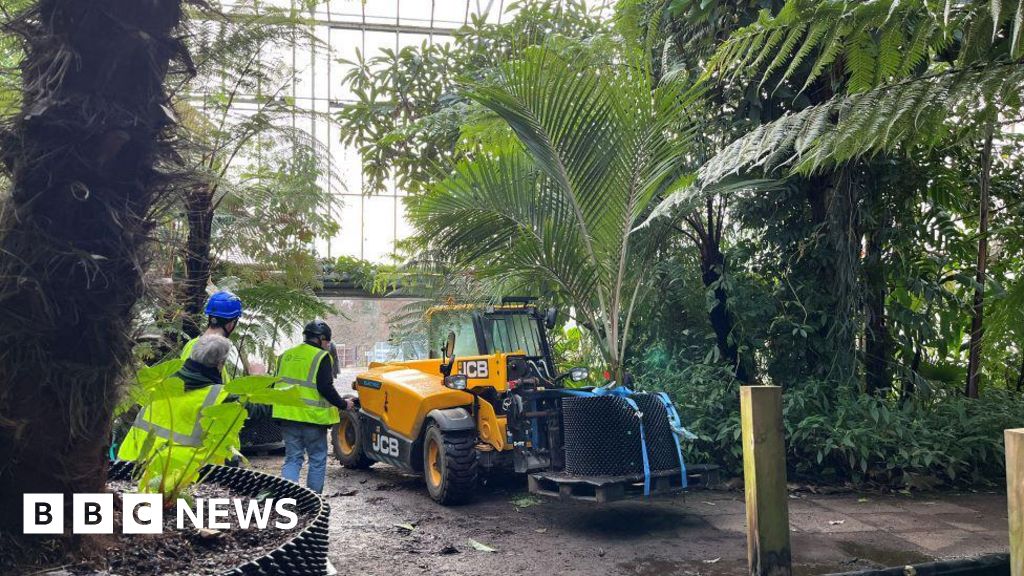
It is hoped the palm house will be reopen by September
For almost 200 years the glass houses at the Royal Botanic Garden in Edinburgh have been home to some of the world’s most varied and endangered species of plants and trees.
However, during that time the Scottish wintry weather has been able to get in through gaps and leaks, causing problems for the tropical plants.
Now, after four years of renovation work, the first 600 specimens are being put back, protected behind thousands of panels of specialist glass.
It is hoped the palm houses will reopen by September.
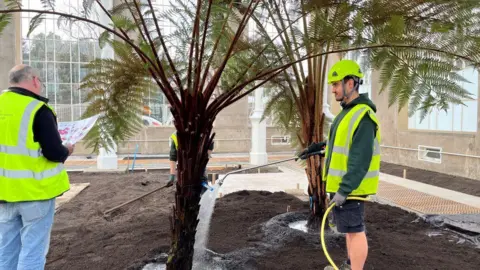
There are at least 600 plants and trees being installed back in two palm houses
The plants had been stored in another hot house for the last few years while two palm houses were being renovated.
Now horticulturists are using pioneering techniques along with traditional practices to carefully lift plants and trees back into their permanent home.
Sadie Barber, research collections and project manager at the Royal Botanic Garden Edinburgh, told BBC Scotland News it was “quite a complex task” her team had because some of the palms were about 24ft (8m) tall.
And she said people would notice changes to the cast iron hot houses.
“A major difference for the first time for anyone who’s alive today will be to see the two houses open together,” she said.
“When they were first built, they were built in different decades and there was a partition for as long as we remember.
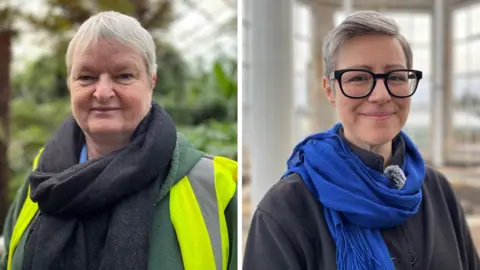
Fiona Inches and Sadie Barber are heading up a team of horticulturists replanting the palm houses
“And dating back to the late 1800s, that partition has been removed and what’s happened now is we’ve got this beautiful, huge open airy space.
“So that’s as it was originally intended and I think that’s what’s going to be most striking when people come in.”
New laminated and toughened glass has been installed to withstand the impact of storms, while deeper gutters and extra downpipes are better able to cope with flash flooding.
Fiona Inches, horticulturist and glasshouse manager, said the new, clean glass lets in more light now.
“There were cracked panes of glass and the iron work was down to a kind of skeleton, really, really in poor condition,” she said.
“We’ve now got every single pane of glass is replaced. It now shines.
“All the iron work has been restored, repainted, and the stone work has been reconditioned.”
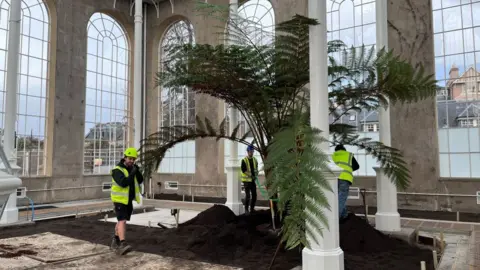
5,000 panes of glass have been restored during the £20m restoration of the two palm houses
She said 5,000 panes of glass had been restored during the £20m restoration of the two palm houses.
“This has been one of our flagship restorations,” she said. “It’s an iconic building in Edinburgh.
“The metalwork has been taken back to bare metal.
“All of the glass has been replaced and the stonework has had a conservation approach.
“Just seeing through the glass, I can’t tell you what different it is. It’s bright, it’s airy.
“And you can see the outside world, which you couldn’t do before, because the glass was so badly etched with pollution and it was so old.”