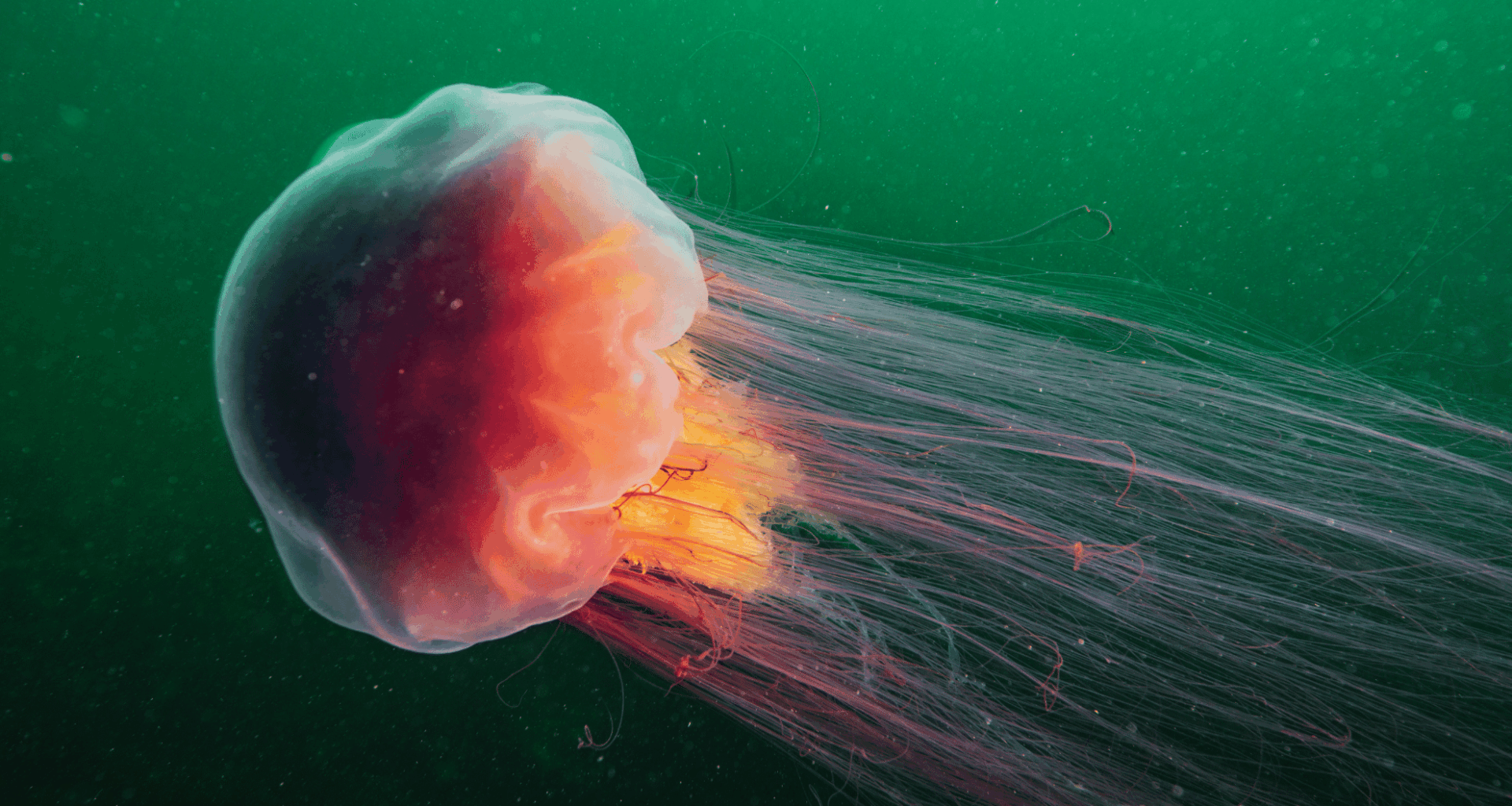
The lion’s mane jellyfish (Cyanea capillata) isn’t just one of the strangest-looking creatures in the ocean, it also holds some of its most jaw-dropping records. Known for its flowing, colorful tentacles and enormous size, this species has stunned scientists and divers alike with its colossal dimensions.
A Deep-Sea Phantom: Longer Than a Blue Whale, Heavier Than a Bison
Few ocean creatures inspire as much awe as the lion’s mane jellyfish, a mysterious invertebrate that haunts the cold waters of the North Atlantic and Arctic Oceans. While blue whales are often cited as the largest animals to have ever lived, this jellyfish offers serious competition, at least in terms of sheer length. With tentacles that can extend beyond 36 meters, the lion’s mane jellyfish dwarfs nearly every other known marine species in this dimension.
This creature’s body consists of a bell-shaped dome, often measuring up to 1 meter in diameter, surrounded by hundreds of stinging tentacles that can trail like massive underwater cables. These tentacles are arranged in eight clusters, each holding up to 150 strands, which it uses both for capturing prey and for movement. The jellyfish uses its trailing tentacles to trap plankton, small fish, and even other jellyfish, relying on its nematocysts, or stinging cells, to immobilize its food. It drifts slowly, making use of ocean currents and pulsations of its bell to navigate.
Spotted mostly in colder waters, particularly off the coasts of the United Kingdom, Canada, and the northern United States, these jellies are especially visible during the summer months, when they approach shallower waters. Their vivid coloration, ranging from pale peach in juveniles to deep crimson in older specimens, makes them hard to miss for the lucky few who encounter them in the wild.
Record-Breaking Weight
While length is already an impressive stat for the lion’s mane jellyfish, it’s not its only jaw-dropping figure. According to Guinness World Records, this species is officially recognized as the heaviest jellyfish on the planet. In one case, a specimen of Cyanea capillata was estimated to weigh as much as 1 metric ton, approximately the same as a fully grown American bison (source
).
This weight estimate comes from rare encounters with mature individuals, most of which are never collected or weighed due to the logistical challenges of handling such a delicate and massive organism. Jellyfish are composed primarily of water (over 95%), making accurate weighing difficult without damaging the specimen. Despite this, the scale and massiveness of the lion’s mane jellyfish are enough to earn it a unique place in marine biology and the record books.
Its closest rival in terms of size, the Nomura’s jellyfish (Nemopilema nomurai), is heavier per individual due to a larger bell diameter, sometimes reaching 2 meters across. But the lion’s mane jellyfish wins the battle in overall length, giving it a unique distinction that continues to fascinate marine scientists and nature enthusiasts alike.
Not Just A Giant, But A Sting You Won’t Forget
Despite its size, the lion’s mane jellyfish isn’t considered a major threat to humans, though it’s far from harmless. While fatalities are extremely rare, its stings can be painful and occasionally dangerous for swimmers. Contact with its tentacles can trigger intense symptoms such as nausea, sweating, muscle cramps, headaches, and even temporary paralysis in sensitive individuals.
In some parts of the world, lifeguards regularly post warnings during jellyfish “blooms,” when large numbers of these creatures appear close to shore. One of the biggest concerns is their tentacle fragmentation: even a small piece of a tentacle, detached from the main body, can still sting. That makes them one of the few marine creatures where simply swimming nearby, or in their “wake”, could cause problems.
Nonetheless, their presence in the ecosystem plays an important role. These jellies help control plankton populations, and they are preyed upon by creatures like sea turtles, sunfish, and some species of large seabirds. Their life cycle also reflects a fascinating biological process, involving both asexual reproduction in the polyp stage and sexual reproduction in the medusa (adult) stage.
Where To Spot The Ocean’s Longest Invertebrate
For anyone eager to witness the lion’s mane jellyfish in its natural habitat, a trip to the North Sea, Scotland’s western coasts, or Alaska’s icy waters might offer the best odds. These jellyfish are most commonly found in temperate to polar waters, particularly during the warmer months when they approach the surface to feed and breed.
They are especially active in July and August, making them a regular sight for sailors and researchers working in colder oceans. While not every lion’s mane reaches monstrous proportions, even smaller individuals, with bells around 50 cm in diameter, are impressive and easy to identify due to their distinctive trailing tentacles and fiery hues.
With more awareness around marine biodiversity and record-breaking animals, the lion’s mane jellyfish is increasingly becoming a subject of public fascination. As climate patterns shift and ocean conditions evolve, researchers are also keeping a close eye on jellyfish populations as indicators of broader environmental changes.