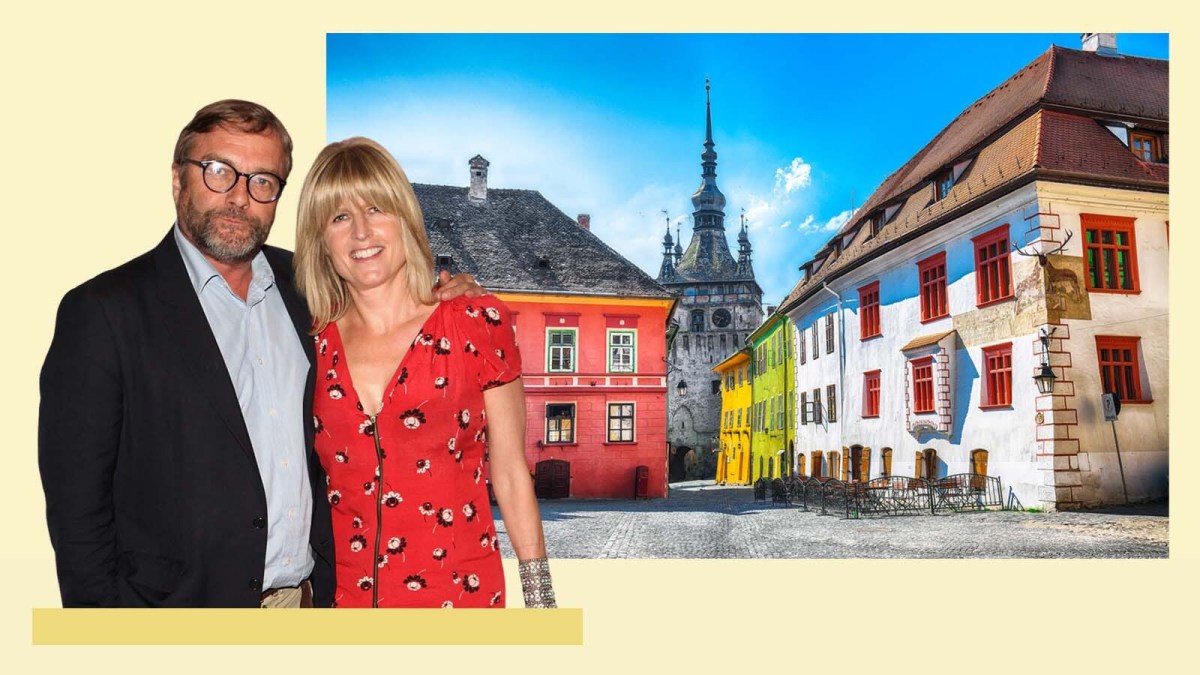
My glass seldom more than a quarter full, I was already regretting joining my hyperactive wife, Rachel, on a five-day cycling tour of Romania’s celebrated Saxon villages, writes Ivo Dawnay.
Under louring grey skies our party of 11 set out in our white van down EU-funded highways past Ceausescu-inspired architecture. Two hours later, we swung off the main road up a small valley into Copsa Mare, a village of potholed streets and run-down houses.
A pack of flea-ridden dogs barked desultorily to greet us — a performance they encored most of the night. Luckily, our digs were delightful throughout. Behind a hole-in-a-wall doorway, we stepped into a wooden guesthouse, walked tentatively up some oak stairs and into an attic-like room as woody and cosy as a ship’s cabin, a well-appointed bathroom with all mod cons next door. Each evening that followed we looked forward to discovering our new room, with our luggage awaiting, delivered by charabanc before us.
The next day the first glimmerings of an answer to the question “What on earth are we doing here?” began to emerge. As cocks crowed, we visited the 14th-century fortified church, and from its bell tower looked down on the sleeping village, skeins of blue smoke rising from kitchen chimneys. Medieval cute.
Our guide, Sergiu Paca, now supplied the history. Transylvania was, still is, an island of gentle meadows, hills and forests, surrounded by the Carpathian Mountains. In the 12th century King Geza, a Hungarian, persuaded a large population of Germans to occupy the land as a bulwark against Mongol and Ottoman attacks — lured by free land and judicial autonomy.

A suite at Copsamare Guesthouses, where Rachel and Ivo stayed
ALEXANDER BARLOW
For 800 years they lived largely undisturbed on their modest strip farms, building fortified churches for times of trouble. A tight-knit Saxon culture of hardy self-sufficiency was born. But today, after mass emigration back to Germany in the early 1990s, only a few thousand remain — their 200-odd villages left to rot. Most are now semi-deserted, or squatted by the local Roma and their children, horses and carts. The the villages are not without charm but are perhaps not as well preserved as they would be by tidy German housewives.
• The captivating city known for its charm, history … and vampires
Enter the Brits. In the late 1980s a small but determined group of anti-communist academics got wind of the Romanian dictatorship’s plan to bulldoze the picturesque villages and rehouse their residents.
What you need to knowWhere is it? Transylvania is a region in central Romania with the Carpathian Mountains at its heart How to get there Wizz Air flies to Cluj-Napoca and Brasov from London Luton, but book well in advance as the flights can fill up quicklyInsider tip You’ll want to prepare by reading Dracula of course; and The Balkan Trilogy by Olivia Manning, charting life in the region at the start of the Second World War, is worth your time
The campaign to save them was made easier by the collapse of the Ceausescu regime in December 1989 and the later impassioned support of the King, when he was Prince of Wales. Today, Charles has lovingly restored two properties and has been at the forefront of international efforts to preserve not just the buildings but also what remains of a lifestyle that harmoniously integrates man and nature.
Our Slow Cyclist tour was, in its small way, a part of that effort — spinning off tourist dollars into the local economy and showcasing a way of life that would have been familiar to all our forebears.
Cycling for all abilities
So what of the trip? After its slow-burn beginnings, the magic took hold. Our eclectic group ranged from superbikers who had climbed the Tour de France’s Alpe d’Huez to sluggards like me — teachers and techies, managers and media types — and the road bonded us.
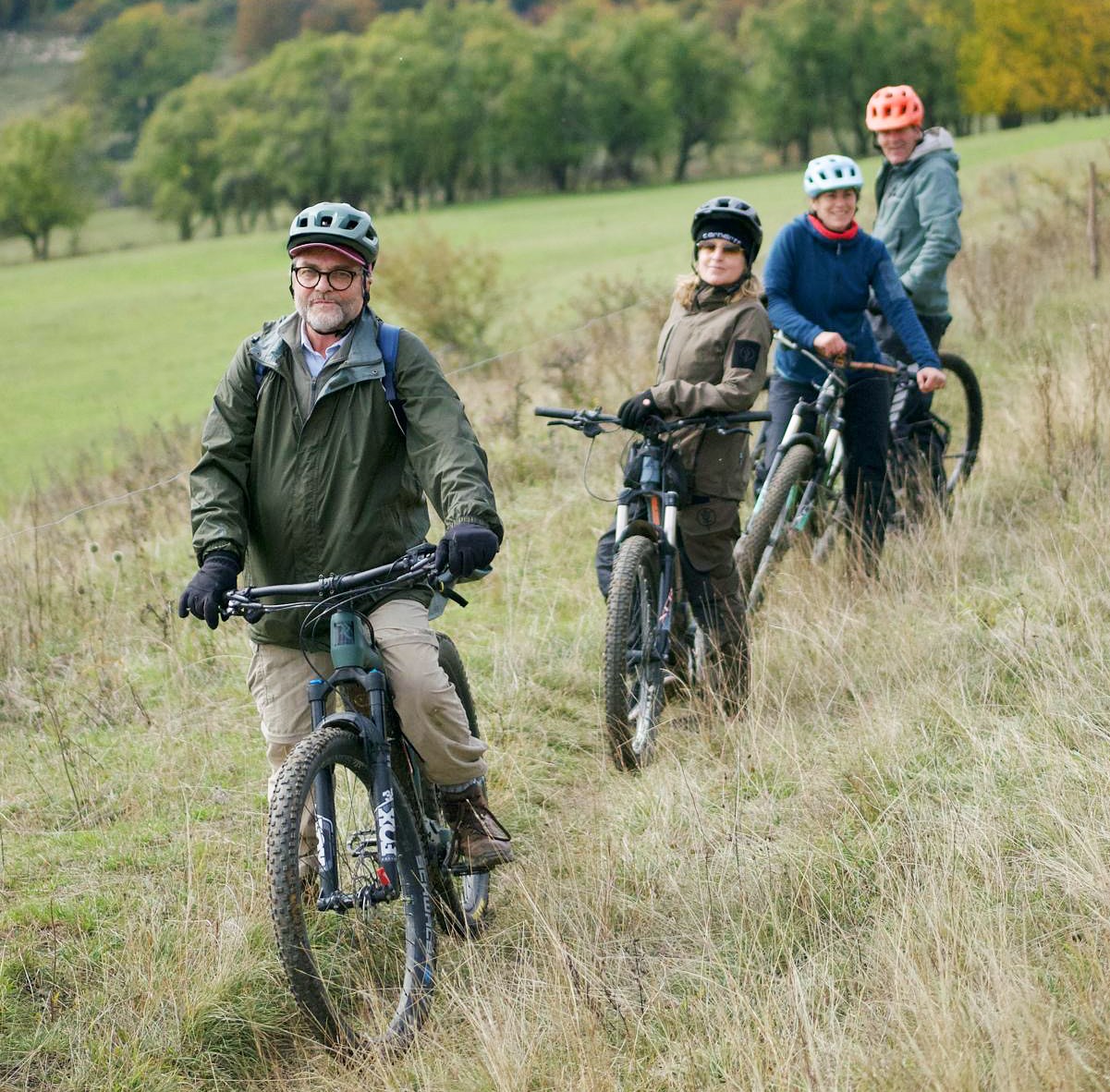
Ivo, far left, and Rachel, second from left
By the end of day one we had sped on easy roads via a schnapps-fuelled lunch to a great 17th-century manor house in Malancrav, lovingly restored by a who’s who of starry London designers and local craftspeople.
In the afternoons, as Rachel sweated up mud tracks, I skived off to gemütlich micro-farms, with Germanic architecture of oak, brick and tiles, the sturdy barns and cobbled courtyards filled with fruit presses, clucking geese, orphan puppies and free-range horses.
• Discover our full guide to cycling holidays
Every village offered a carless main street and a fortified church, its russet-tiled watchtowers surveying the broad horizons, each surpassing the one before.
We lunched at a semi-ruined Hungarian castle on bortsch and beer and dined in private houses on goulash and wine, and on our second night slept in the master bedroom of a meticulously restored manor house — one of the first conservation triumphs of the English-led cultural invasion. This was followed by our first and only night in a comfortable beamy hotel in sensational Sighisoara, which is fully deserving of its Unesco world heritage status. The medieval citadel we toured in the morning was a location manager’s dream of a walled central European city — all spooky towers and Baz Luhrmann high-colour kitsch, yet real and lived in.

The Slow Cyclist tour explores the hills, meadows and forests of Transylvania
ALEXANDER BARLOW
On our fourth day the sun finally came out and I bit the bullet, and my ordeal by cycle began — a 27km, arse-busting ride up hill and down dale, aided only a little by the ebike. Slow cycling it was not. We sped through forests, our guides occasionally hooting to ward off bears, then burst out into broad sun-filled meadows to a rolling landscape of Tolkien charm, lacking only elves or hobbits. Our guides charmingly nannied me along, more calling than bullying (though after lunch I returned to the comfort of the van).
And on our final day, powered by the previous night’s boozy barbecue, I managed a three-hour walk of 20,000 steps through forest glades where Gheorghe Silian, a sturdy truffle hunter, and his trusty hounds sniffed out a fistful of the squidgy black diamonds, which we shaved onto our lunchtime pasta.
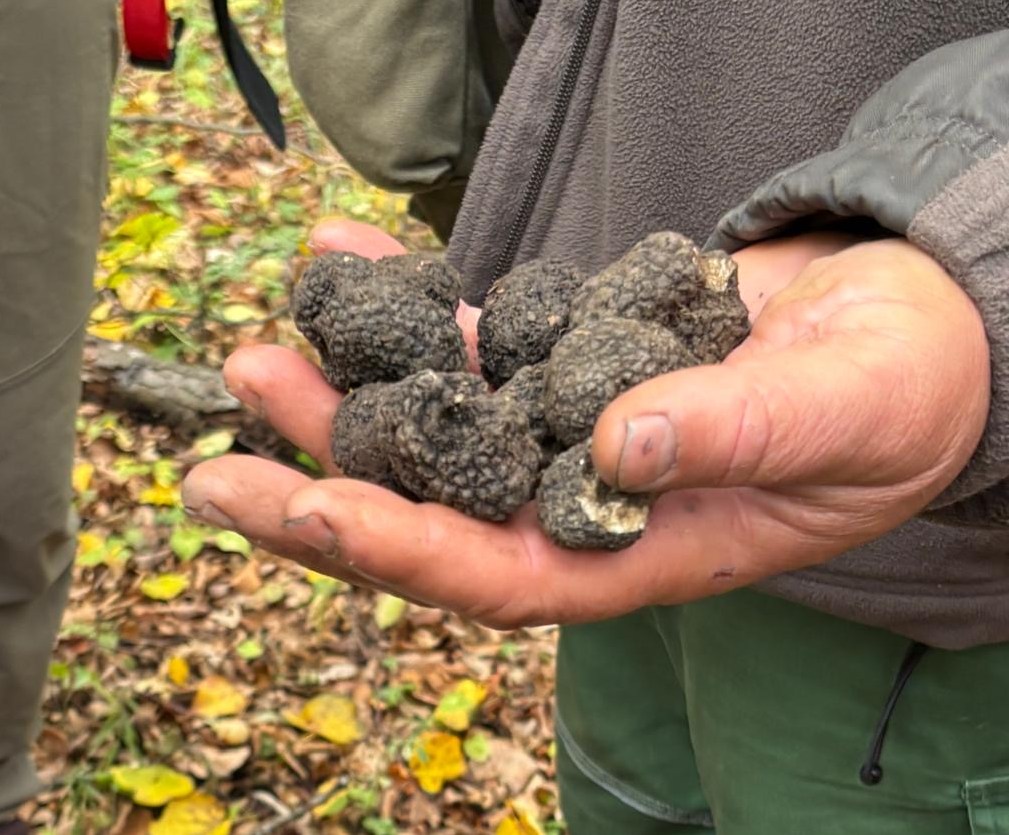
Truffles were used in the group’s lunch
It felt at times like an earthly paradise; sometimes though a little melancholy too — as we observed the few elderly villagers eking out a paltry living in their beautiful but largely deserted streets.
“My guess is that in 20 years’ time each of these houses will be expensively restored and a BMW will be parked outside by gentrifying weekenders,” I said to Sergiu.
“Perhaps,” he replied, “but better that than it all being swept away.”
So go, I beg you, go and see it now, before the asphalt comes.
Rachel’s view
When I signed up for a cycle ride across Transylvania with the Slow Cyclist, the off-the-beaten-track outfit that bespokes (geddit?) tours for people like us, to celebrate its tenth anniversary, I didn’t even mention it to Mr Dawnay.
There would be “hiking” (like “wild swimming” and “camping” this is a term I disdain after a feral childhood where you were forced to swim or walk on holiday) and other crafty and foodie surprises, as well as a chance to tramp the Via Transilvanica, which runs from Putna in the north to Drobeta-Turnu Severin in the south, although it can be done in either direction. The VT is the latest addition to the collection of caminos that competitive step-counting pilgrims can boast about bagging. We would get a chance to walk an enchanting stretch of the Terra Saxonum section.
Ivo, you see, had treatments this year down there. Bumping across the highlands of Romania, even in padded pants, I reckoned, would not be on his bingo card.
It was, however, very much on mine. I’d make new friends! I’d see a new country! I’d get away from it all!
When I asked chums if they wanted the unique opportunity of sharing my bedroom on this exceptional and original jaunt, I was stunned to discover that literally everyone I asked had already done it.
“The Slow Cyclist, Transylvania? Yah, amazing, but I’ve just done it/did it last year,” the reply came from Miranda, Catherine, Katie etc, who all told me to make sure I saw the cows coming home from the hill at Viscri, the medieval village where King Charles has a blue-painted show farm in the shadow of a multi-turreted fortified 12th-century white church.
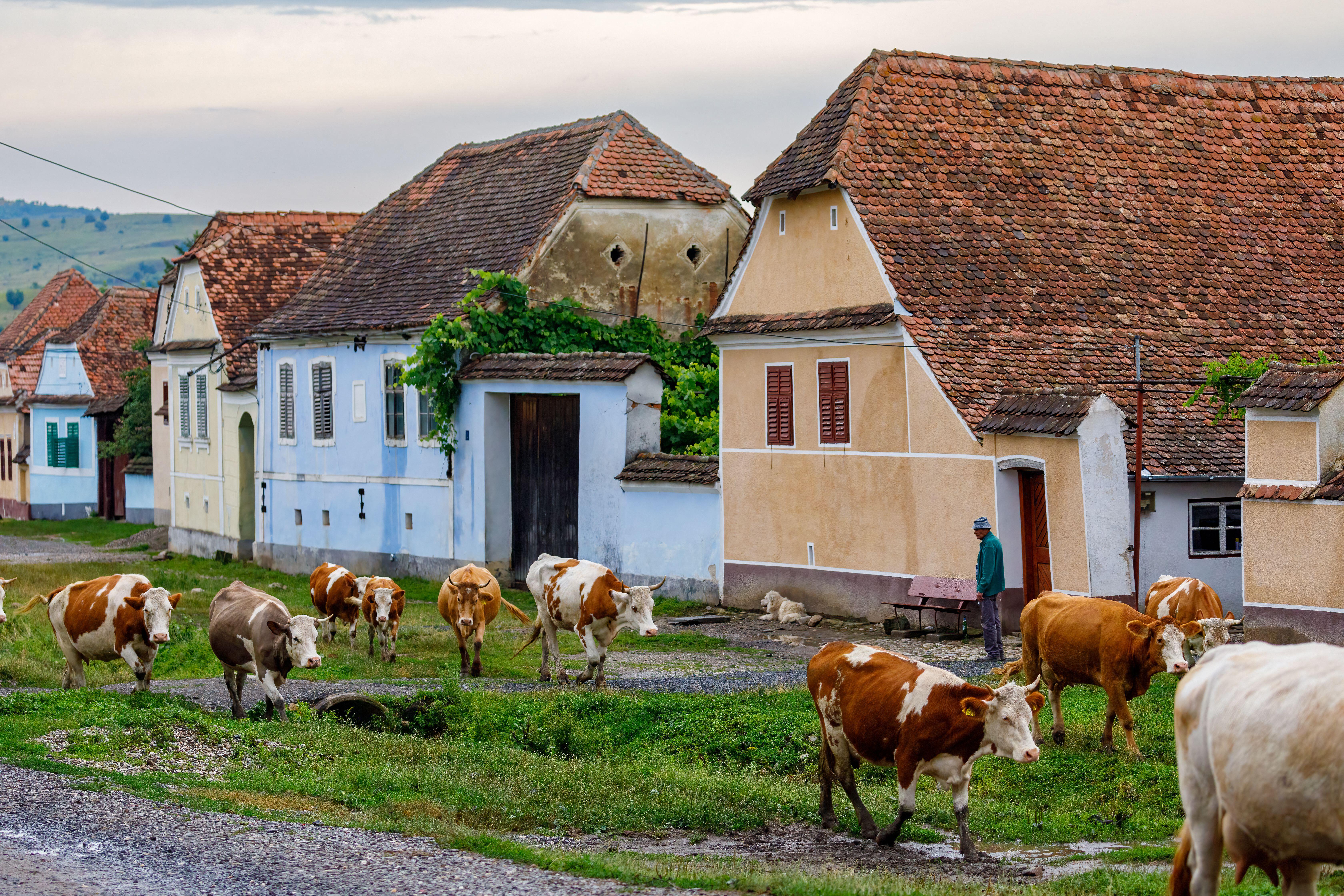
Friends told Johnson to look out for the cows coming home to the village of Viscri
ALAMY
And then the bombshell. After establishing there would be three options for getting from A to B — biking, hiking or going in the van with the bags — Ivo said he was coming.
There’s no point in going through the itinerary of a packed five days as it’s tiring even to write it down, but I have no hesitation in describing Transylvania as a top destination and not for the reasons you might think. It’s famous for Dracula, wild dogs, orphanages, the Ceausescus, Vlad the Impaler etc, but that is like saying France is famous for shooting songbirds and Britain for Andrew Mountbatten-Windsor.
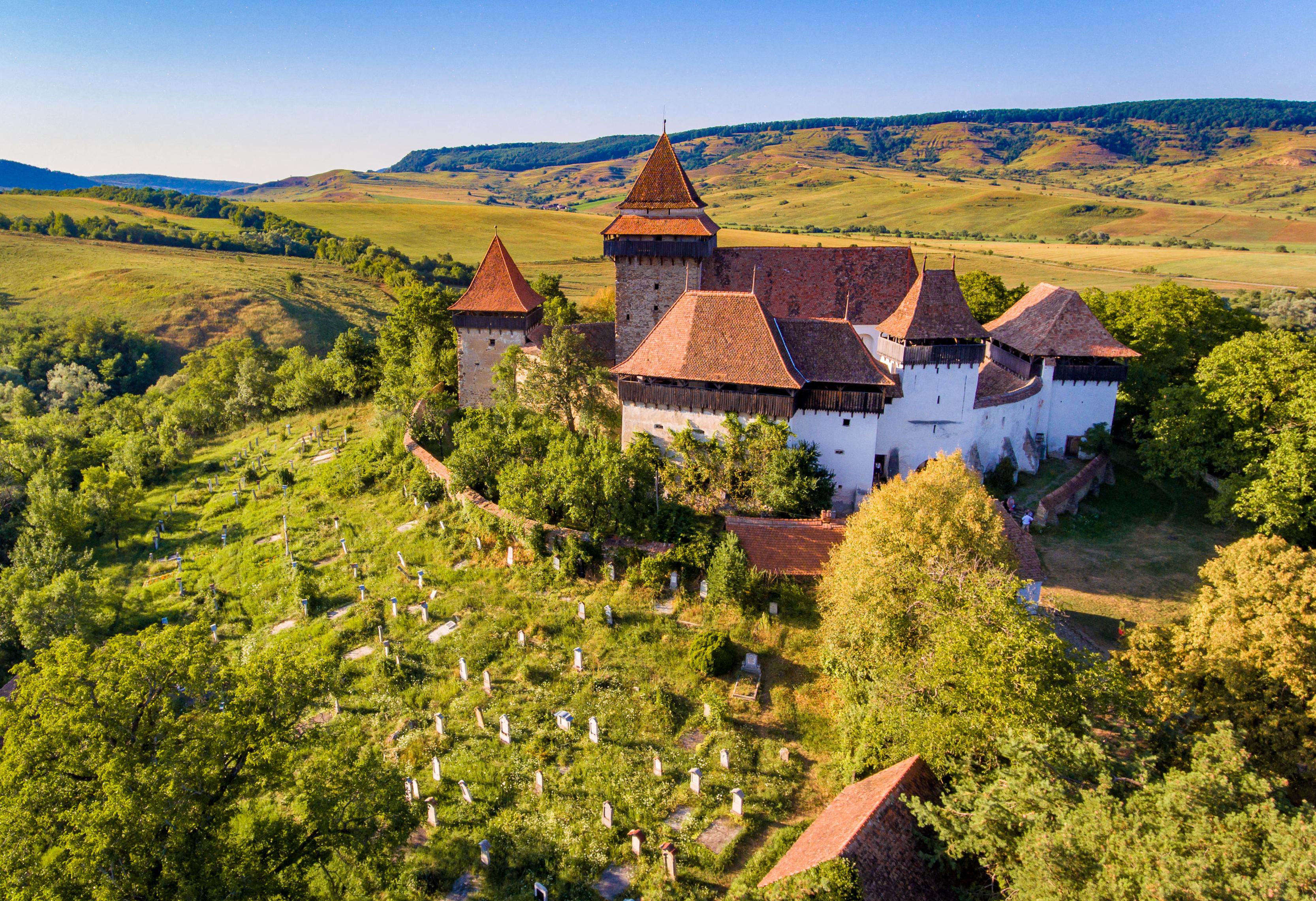
The 12th-century white church in Viscri
ALAMY
You’ll drink a lot of fruit brandy
As well as pelting about 50km a day across peerless landscapes and winding forest paths, we saw restored fortified Saxon churches, drank decent local wines, ate local produce including cheeses, jams, compotes, salamis and goulashes aplenty, stayed in the most charming guesthouses with cloudy beds and cosy tiled stoves in the bedrooms, we went truffle hunting in the forests, and rambled through unspoilt medieval towns that looked even more like Harry Potter sets than Harry Potter sets.
Cobbled Sighisoara, for example, is an immaculate medieval gem of colour-washed burgher houses surrounded by nine towers, and was the birthplace of Vlad Dracula, also known as Vlad the Impaler, ruler of the province of Wallachia from 1456 to 1462, and the inspiration of course for the second most popular fictional character in the world after Santa Claus.
But I know you’re longing to know how Ivo managed. The biking. The hiking. The chatting. Well, you know the principle that anyone who went to Eton finds prison a doddle? That applies here. He extracted as much from his Trek ebike as he did from the traditional 50 per cent proof fruit brandies offered at every turn — that is to say, a lot — and was the darling of our little group (it was supposed to have been led by Oli Broom, the Slow Cyclist founder, but he broke his leg so we had to make do with Lorand Peter and Sergiu Paca, two of the fittest men in central Europe).
It is obvious to me now why the King has long been obsessed with Romania (the admiration is entirely mutual, as he swooped in to save the Saxon villages when the German-speaking population all but vanished after the toppling of the communist regime). It is a magical place of pristine landscapes cupped by the white-capped, steepling Carpathian Mountains, where people live close to and love the land, where you are just as likely to see a horse and trap as a white van, where hens cluck and cocks crow, and there’s always a pig in the back garden being fattened for Christmas.
It’s like going back 500 years without time travel. Yes, the village dogs bark all night (earplugs are high up on the packing list), but in the morn the caravan of ebikes always moves on.
The hardest of recommendations from us both — even if my undercarriage may never be quite the same again.
Ivo Dawnay and Rachel Johnson were guests of the Slow Cyclist, which has five nights’ full board from £3,195pp, including wine and beer with meals, activities, electric bike and helmet hire, transfers, support vehicle, luggage transfers and guides (theslowcyclist.com). Fly to Cluj-Napoca and return from Brasov