Labour must guarantee Shamima Begum is never allowed to return to the UK after European judges came to the ISIS bride’s defence, the Tories have warned.
British-born Begum was 15 when she and two friends travelled from Bethnal Green, east London, to the Middle East to join the Islamic State terrorist organisation in 2015.
Begum, who married an ISIS fighter and had children, was found in a Syrian refugee camp in 2019 and her citizenship was immediately revoked by then-home secretary Sajid Javid on national security grounds, kickstarting her lengthy legal challenge.
But the European Court of Human Rights (ECHR) this week formally asked the Home Office whether it broke human rights and anti-trafficking laws – after Begum was stripped of her UK citizenship.
The latest intervention has sparked a major backlash, with Home Secretary Shabana Mahmood vowing to defend the Government’s decision at the time.
Conservative MP and Shadow Home Secretary Chris Philp said he will ask Ms Mahmood for guarantees in the House of Commons that Begum will not be allowed back.
He also urged Ms Mahmood to fight the case ‘tooth and nail’.
Mr Philp called ISIS a ‘violent terrorist regime who brutally murdered their opponents and raped thousands of women and girls.

Tory MP Chris Philp has urged Labour to guarantee Shamima Begum is never allowed to return to the UK

Shamima Begum, who lived in Bethnal Green, was found in a Syrian refugee camp in 2019
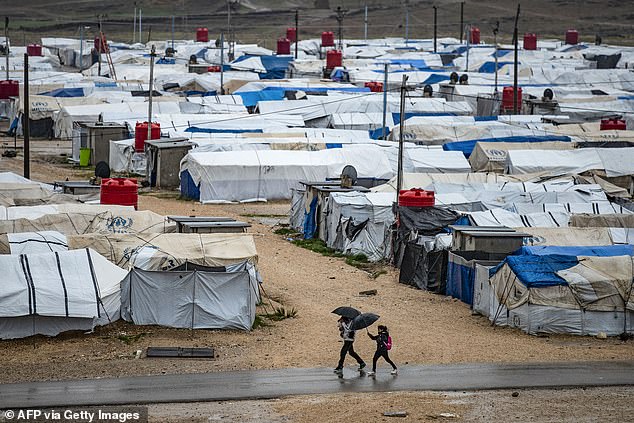
Begum is still living at the al-Roj camp in Hasakah province in northern Syria (pictured in 2021)
‘People who support that kind of organisation are not welcome in the UK,’ he told The Sun.
Mr Philp’s remarks on Begum come after the ISIS bride was given fresh hope this week in her bid to return to Britain after European judges told the UK to justify its stance to strip her of her UK citizenship.
The Home Office said Begum’s citizenship was revoked because ‘the Government will always protect the UK and its citizens’.
It added: ‘We will robustly defend any decision made to protect our national security.’
Begum, who is now 26, lost an appeal in February 2023 against the decision to revoke her citizenship after the Special Immigration Appeals Commission (SIAC) ruled this was lawful.
Begum then lost a Court of Appeal bid in February 2024, before she was most recently denied the chance to challenge it at the Supreme Court in August 2024.
However, Begum’s lawyers warned at the time that they could still take her case to the European Court of Human Rights – which they later did.
Mr Philp also tweeted earlier this week that ‘Begum chose to go and support the violent Islamist extremists of Daesh, who murdered opponents, raped thousands of women and girls and threw people off buildings for being gay.
‘She has no place in the UK and our own Supreme Court found that depriving her of citizenship was lawful. It is deeply concerning the European Court of Human Rights is now looking at using the ECHR to make the UK take her back.

Shamima Begum had her British citizenship revoked in 2019 and cannot return to the UK
Shadow justice secretary Robert Jenrick also said: ‘Shamima Begum should never step foot on British soil again. We can’t let a foreign court meddle in our national security.’
Former security minister Sir Ben Wallace, who was involved in the Home Office citizenship deprivation case, told the Express: ‘She went of her own free will to support a cause that doesn’t believe in any Western court.
‘She wasn’t a victim. She knowingly and freely joined ISIS and assisted them in the prosecution of their murderous campaign. She deserved to lose her citizenship.
‘The cheek of her going through a court system that she and the other terrorists would fundamentally want to destroy isn’t lost on anybody. She wanted to go there. She can stay there.’
Begum is still living at the al-Roj camp in northern Syria as her representatives at London-based Birnberg Peirce Solicitors continue to fight her case.
The Home Office has now been told by the European court to answer four questions about her citizenship.
One asks: ‘Has there been a violation of the applicant’s rights under Article 4 of the Convention by virtue of the decision to deprive her of her citizenship?’
Another says: ‘For the purposes of the Article 4 complaints made in the application, was the applicant at all material times within the jurisdiction of the United Kingdom, within the meaning of Article 1 of the Convention?’
Article 1 of the European Convention on Human Rights relates to ‘protection of property’, while Article 4 relates to ‘freedom from slavery and forced labour’.
A further question asks: ‘Did the Secretary of State for the Home Department’s decision to deprive the applicant of her citizenship engage her rights under Article 4 of the Convention?’.