Last week I went to the practice range at our golf club in Newmarket. Goodness knows why. When you hit the ball worse on the range than on the course, the problem may be unsolvable. Golf didn’t get to where it is by offering hope to folk like me. The afternoon was saved by a chance meeting with the Weaver boys, Max and Tyler.
Max, 22, is older than his brother and a two-times Welsh Amateur Champion (2023, 2025). He has his heart set on making the Great Britain & Ireland team for next year’s Walker Cup at Lahinch in Co Clare. Should he get there, he’s likely to find himself playing alongside his kid brother. Tyler was the top-ranked player on the team against the USA at Cypress Point in September.
Tyler is more than halfway through his four-year golf scholarship to Florida State and already he’s had some important wins. Not least was qualifying for last year’s US Open, where he missed the 36-hole cut by two shots. You may think this is nothing to write home about, and Tyler would agree, but there was encouragement in that performance.
Tyler’s 149 shots for 36 holes put him on the same number as Tommy Fleetwood and meant he outscored Bryson DeChambeau, Justin Rose, Shane Lowry, Justin Thomas and many others. He was the 20-year-old amateur playing his first major championship. Not any old amateur, because he is ranked 12th in the world and has performed well at Florida State. He was ACC Freshman of the Year in 2024 and last year played even better.
Max said he wanted to play a few holes and so Tyler and I continued to shoot the breeze. On a cold December afternoon, his enthusiasm, determination and intelligence felt like a breath of fresh air.
“Did you surprise the coach at Florida State by how well you played in that first year?” I ask Tyler.
“Yes, but I also surprised myself,” he says. “When you’re here, you think the best Americans are on another level. When you play against them, you realise they are not. And it’s easier to improve your world ranking when you’re playing in the US.”
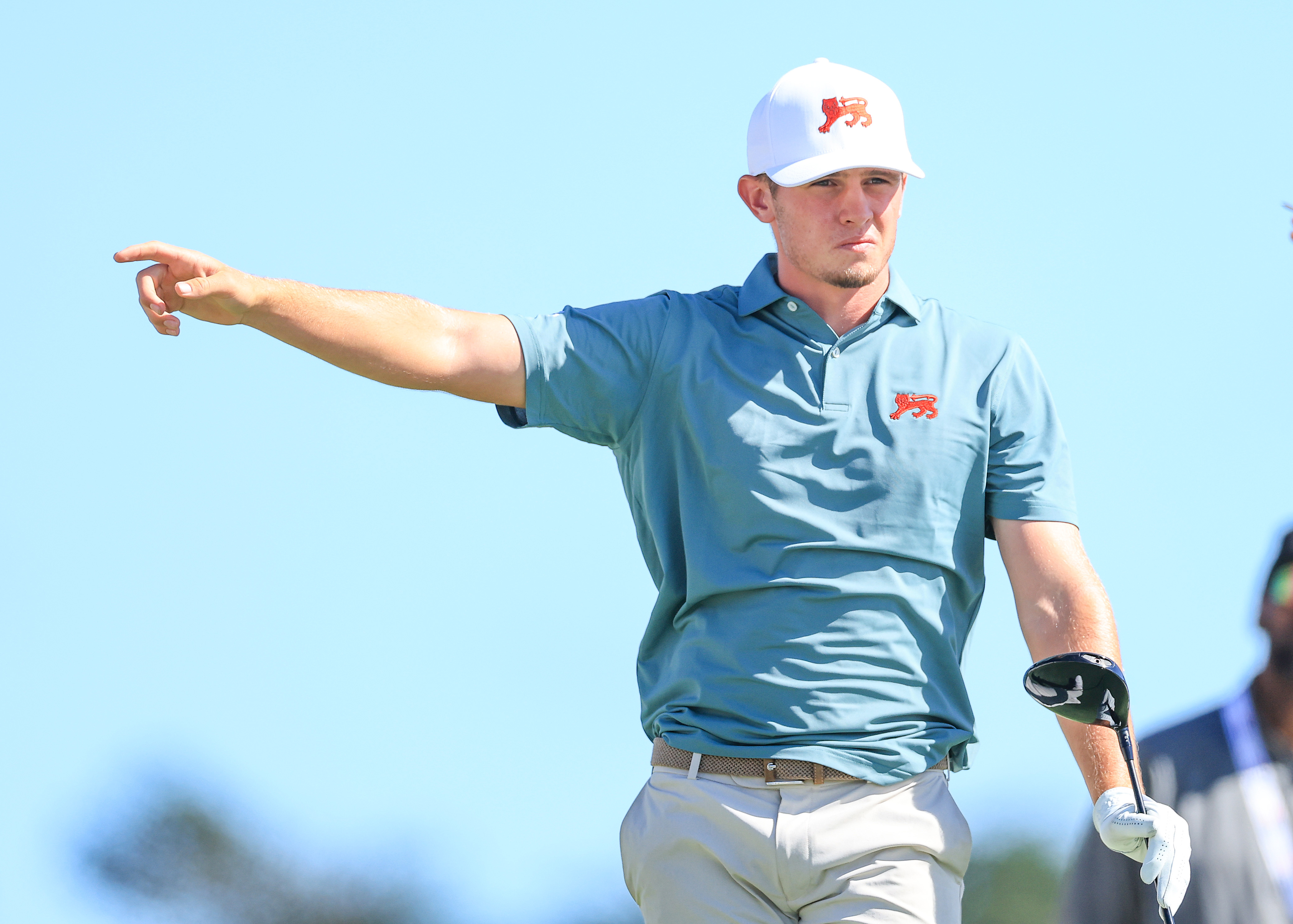
Tyler Weaver, who was the top British player in the Great Britain Walker Cup team at Cypress Point last year, said his career is about “much more” than money
DAVID CANNON/GETTY IMAGES
“You’ve had 2½ years and I’m guessing you’re going to complete the four years at Florida State?”
“Very much so. I am well able to handle the academic side because I got a good grounding at Culford School in Bury St Edmunds. As a student athlete you are really well looked after at Florida State.”
“Examples?”
“We have our own fitness coach and physiotherapy whenever we need it, and perfect practice facilities. You should see the gym that we’ve got.”
“What is the plan?”
“After my four years at Florida State, I want to play on the PGA Tour. Every year the top two players in collegiate golf get a PGA Tour card. My ambition is to get one of those in 2027. Whatever happens, I see myself playing on the PGA Tour.”
“When do you head back to Florida?”
“Tuesday,” he said, “same day as my 21st birthday.”
“Ten hours in a flight across the Atlantic doesn’t sound like the perfect 21st?”
He smiled quietly, as if to say it’s a small price to pay.
We spoke also about Mito Pereira, the Chilean former golfer, and Brooks Koepka, who was once in Tyler’s shoes at Florida State. Pereira’s case is uncommonly interesting. Just before Christmas he announced his retirement from professional golf. He is 30 and has no health or injury issues. Yet he has walked away from a game he could play professionally for another 10 or 15 years.
Too much travelling, he said. Too many nights in hotels, too many hours in airports. Chile was where he belonged and he was going back to spend more time with his wife, Antonia, and his family. He is entitled to do as he chooses and yet it’s hard not to conclude that the sporting life hasn’t measured up to what Pereira hoped it would be.

Pereira takes his LIV millions into early retirement without knowing how good he could have been
MARK BRAKE/GETTY IMAGES
Three-and-a-half years ago he stood on the 18th tee at Southern Hills Country Club in Oklahoma needing a par to win the 2022 PGA Championship and become the first rookie pro to win a major championship since Keegan Bradley claimed the same major in 2011. On that tee, Pereira believed he was going to hit his ball in the fairway. Golf does that to you, lulls you into thinking there’s no need to worry. Instead Pereira hit his ball into a creek and made double bogey.
He finished tied third but had played so well for 53 holes, you thought he would grow from that point. This was a rookie, five months into his PGA Tour career. Nine months later Pereira joined the exodus to LIV, taking the Saudi money and doing what he thought was best for him. He and the others were entitled to do that, but as fans we weren’t prepared to follow them. Into the wilderness they went.
You could say it worked out for Pereira. He got his signing-on fee, and in his three years on the LIV tour he earned another $17million (£12.6million) in prize money. So he can now afford to move back to Santiago and not worry about electricity or gas bills. The question for him was the same for every other LIV player: were they trading their chance to find out how good they could have been? I think so.
After three years with LIV, Pereira thought: “I’m not enjoying this and as I’ve got enough money, I’m out of here.” What about the boy who once dreamt of winning majors?
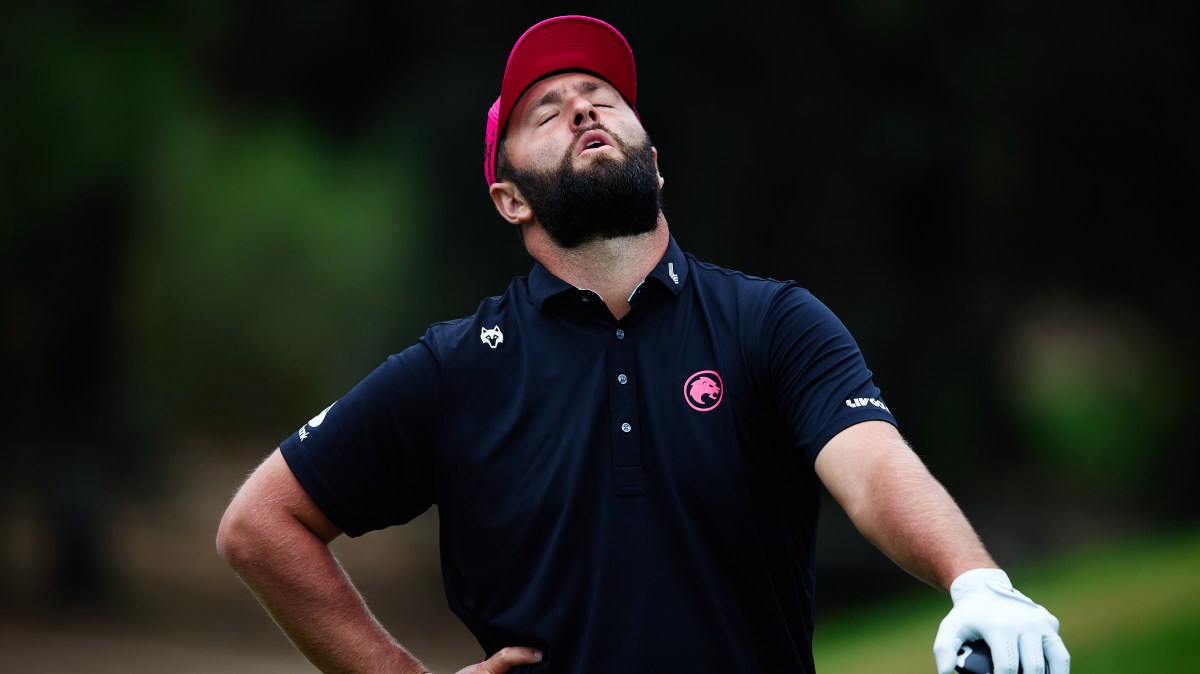
I’ve been intrigued by Jon Rahm and what he gave up. He had, still has, the talent and the competitive streak to be the best in the world. He was the one who believed no money would be enough to take him away from the best tour.

Rahm may have won two major titles but there could have been many more had it not been for the lure of the LIV riches
ALVARO MEDRANDA/QUALITY SPORT IMAGES/GETTY IMAGESY
“Yeah, money is great,” he said a year before joining LIV, “but when this thing first happened, Kelley [his wife] and I started talking about it. Would our lifestyle change if I got $400million? It would not change one bit. If truth be told I could retire right now with what I’ve made, live a very happy life… I’ve never really played the game for monetary reasons.”
That was the Jon Rahm we admired and, probably, the authentic Rahm, I believe — but then for a lot of money, almost certainly more than the $400million he mentioned, he betrayed his true self. He probably believed that the PGA Tour and LIV would join forces and he would have the best of both worlds. That’s not how it has played out. There is now Scottie Scheffler, Rory McIlroy and the chasing pack. Rahm is not even in that pack.
Pereira, I imagine, got bored on the LIV tour and realised he had enough money to walk away. My guess is that Rahm, DeChambeau and Tyrrell Hatton crave a return to the PGA Tour but are not ready to make the same decision as Koepka, who recently departed LIV and will spend a year on the sidelines before being allowed back by the PGA Tour. It looks the right decision.
I asked young Tyler Weaver about LIV and he joked that they were no longer paying as much as they used to. Then he got serious. “What I’m trying to achieve is just not about money and never has been,” he says.
Long may it remain so. Rahm could have been the greatest player of his generation. Now he is a cautionary tale.