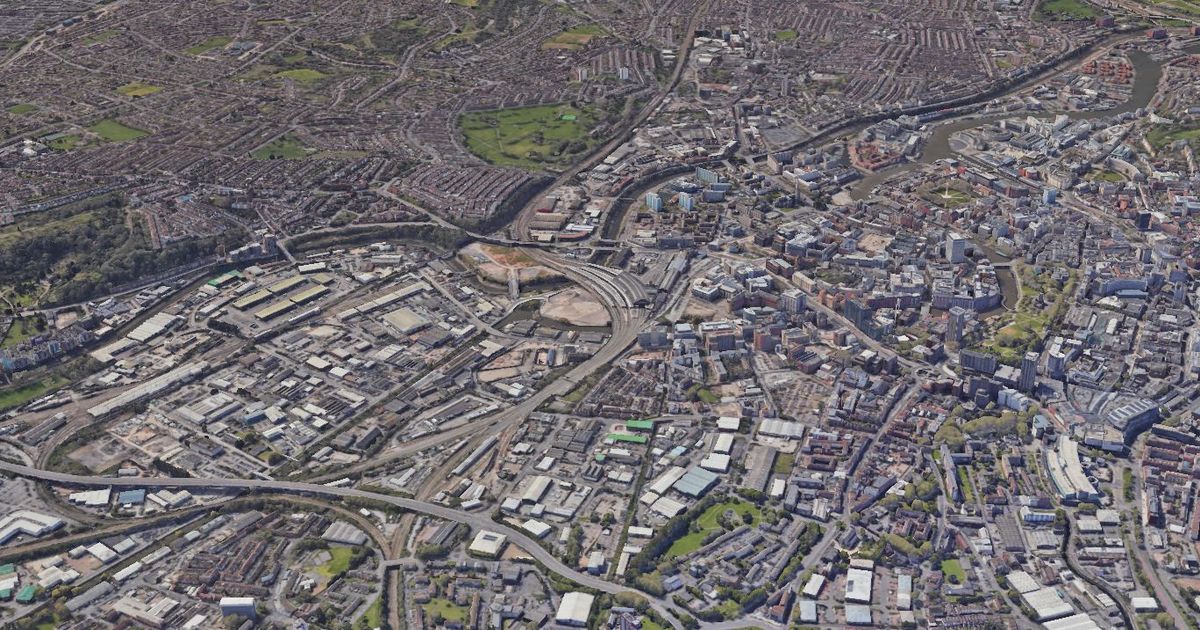
From St Pauls round to Bedminster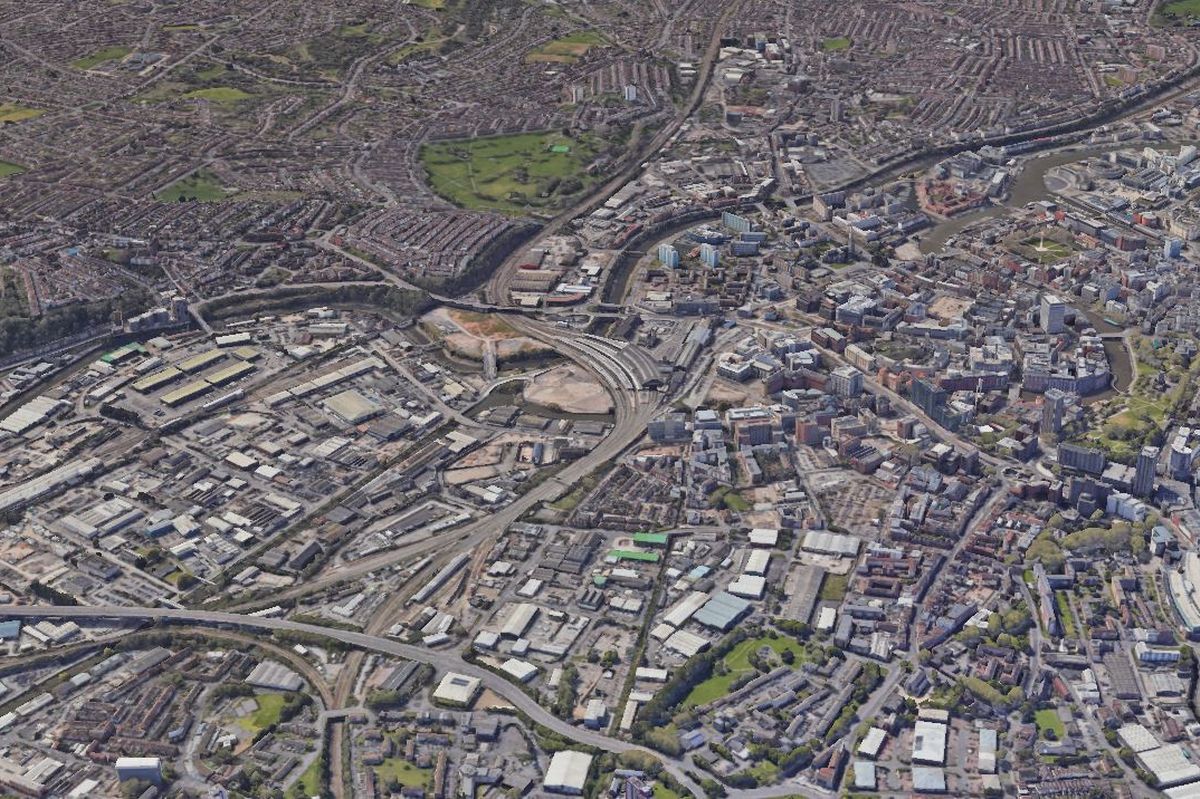 Bristol’s east and south ‘inner industrial arc’ stretches from St Pauls on the right, across St Judes to St Philips and Lawrence Hill, bottom left, then up to Temple Meads and Bedminster beyond in the top left. The area semi-circles the city centre and was turned into a series of industrial estates after the war. Now, in the second half of the 2020s and into the 2030s, it’s going to be transformed again(Image: Google Earth)
It’s been a year since Bristol Live announced that the ‘biggest change to Bristol‘ is coming – the biggest since the aftermath of the Second World War – and most people don’t know too much about it. But is the transformation of Bristol under way already, and what has happened in the past year?
The change involves a huge swathe of the city, from St Pauls, across the M32 to St Jude’s, Lawrence Hill, St Phillips, Temple Meads and around to Bedminster, is on the cusp of being transformed so much, it will be unrecognisable to Bristolians in just five years’ time. That area forms an inner city arc of industry that’s clearly visible from space, in between the city centre and the Victorian terraces of the residential city beyond.
And the transformation raises huge questions which are so far going largely unanswered about where people in a city like Bristol work, what kind of jobs they have, where they live and what kind of homes they have? The transformation has its origins in decisions taken ten or more years ago, and is already starting to get underway.
Most of Bristol already know that major change is coming to the city centre – with Broadmead, the Bearpit and the Galleries seeing a huge amount of development heading its way in the next few years. But this is even bigger than that, will affect more people, a larger area and have even more impact.
After the war, those in charge of rebuilding a bombed-out city took the opportunity for a complete change. The tightly-packed terraced streets that ringed the east and south east of the city centre were cleared away, the residents were generally sent to live in new communities of council estates on the outskirts of the city, and a new Bristol was born – a network of dual carriageways and huge roundabouts, industrial estates, warehouses and factories ringed the city centre.
This was city planning on a grand scale. The idea was that people would live in nicer, modern homes with gardens in places like Hillfields or Knowle, and commute in to work in the industry of Bristol’s inner core, in the factories of Bedminster’s Malago Road, the heavy industry of St Philips Marsh or Lawrence Hill and the industrial estates of St Jude’s.
It was a vision that has lasted about 60 years – until now. For now, the post-war inner city industrial estates are being, or about to be, swept away even more quickly than they were created. Every other week during 2024 and 2025 seemed to see a new major planning application trouble the city council’s planning department, or a new consultation launched by a large-scale developer. Where is this happening – the list is a long one. Let’s start at the northern tip of this inner city industrial arc.
St Pauls
In St Pauls, an entire area of the city from St Nicholas Road to Portland Square was originally terraced homes, and schools. Victorian maps show long-lost terraced streets with forgotten names – Lake Street, Cabot Street, St Lawrence Street. They were cleared and factories built close to the M32 motorway. Now, that industrial area has gone too, and plans for hundreds of new homes to fill in the gaps have been proposed for a long time.
Read more: New plans for 350 homes in centre of Bristol – but only 20 per cent ‘affordable’
St Judes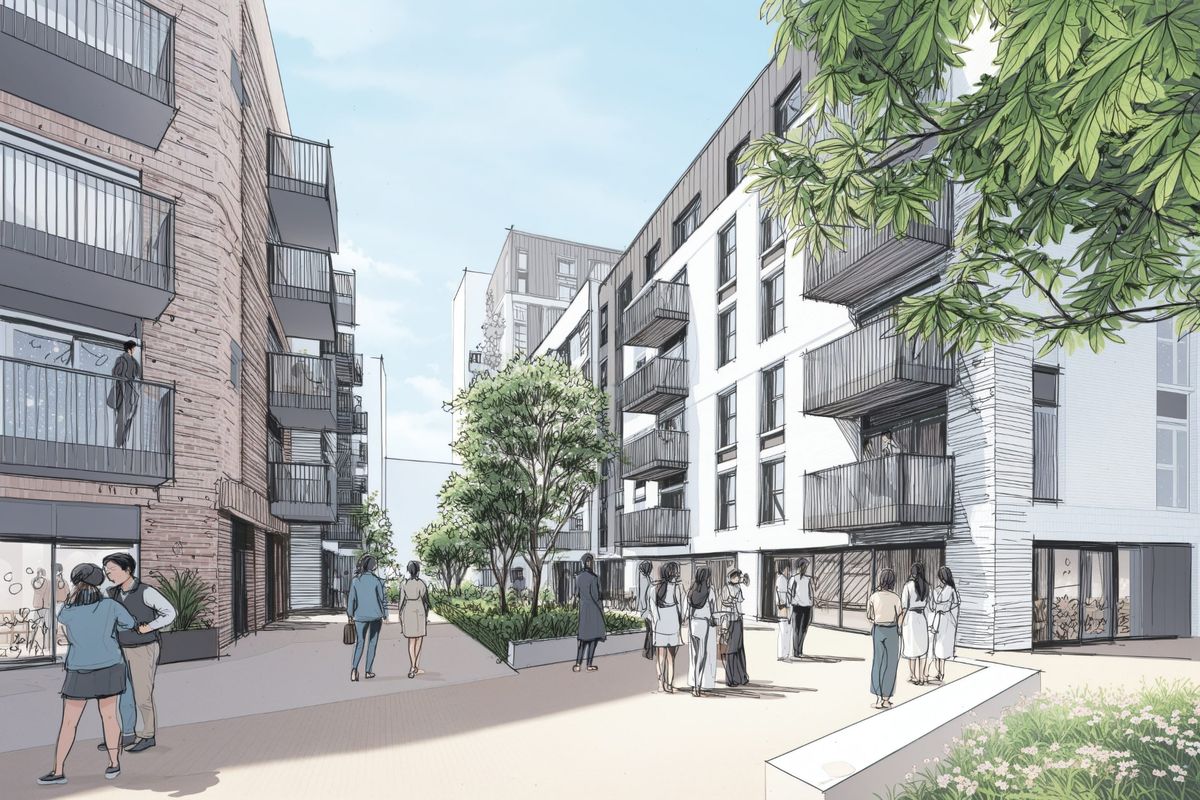 Plans for 430 new homes on Pennywell Road in St Jude’s(Image: Investin)
On the other side of the River Frome and the great divide created by the M32, St Jude’s is about to change fast. St Judes has long been a warren of warehouses, factories and storage yards, ever since the post-war planners cleared the terraced slums and replaced them with low-rise industrial buildings.
But there’s now a plan agreed by the council for it to be transformed again, into something called the Frome Gateway. No sooner had the ink dried on the first draft than the developers were in, submitting planning applications for student flats and build-to-rent flats, a new bridge across the River Frome and the creation of a ‘vibrant’ new residential area.
That regeneration is now edging right up to the city centre itself – the owners of Cabot Circus unveiled plans for hundreds of student flats to be built between the shopping centre car park and the Newfoundland Way junction, earlier this year.
Read more about the Frome Gateway
Lawrence Hill
Many of Lawrence Hill and Barton Hill’s terraced streets remained after the war, and those that were cleared were replaced by the vast 1960s council tower blocks that dominate the skyline here. Industry in the area was centred up and down the railway line, and dominated by the Bristol Wagon Works at the turn of the 20th century, which became the industrial estates that separate Lawrence Hill from Easton Road.
It’s early days for this, but there are proposals for thousands of new homes to be built on either side of the railway line to create a new part of Lawrence Hill.
Read more: CGIs give first glimpse of plans for major Lawrence Hill development
Read next: Lawrence Hill could get new NHS centre as part of huge regeneration scheme
St Phillips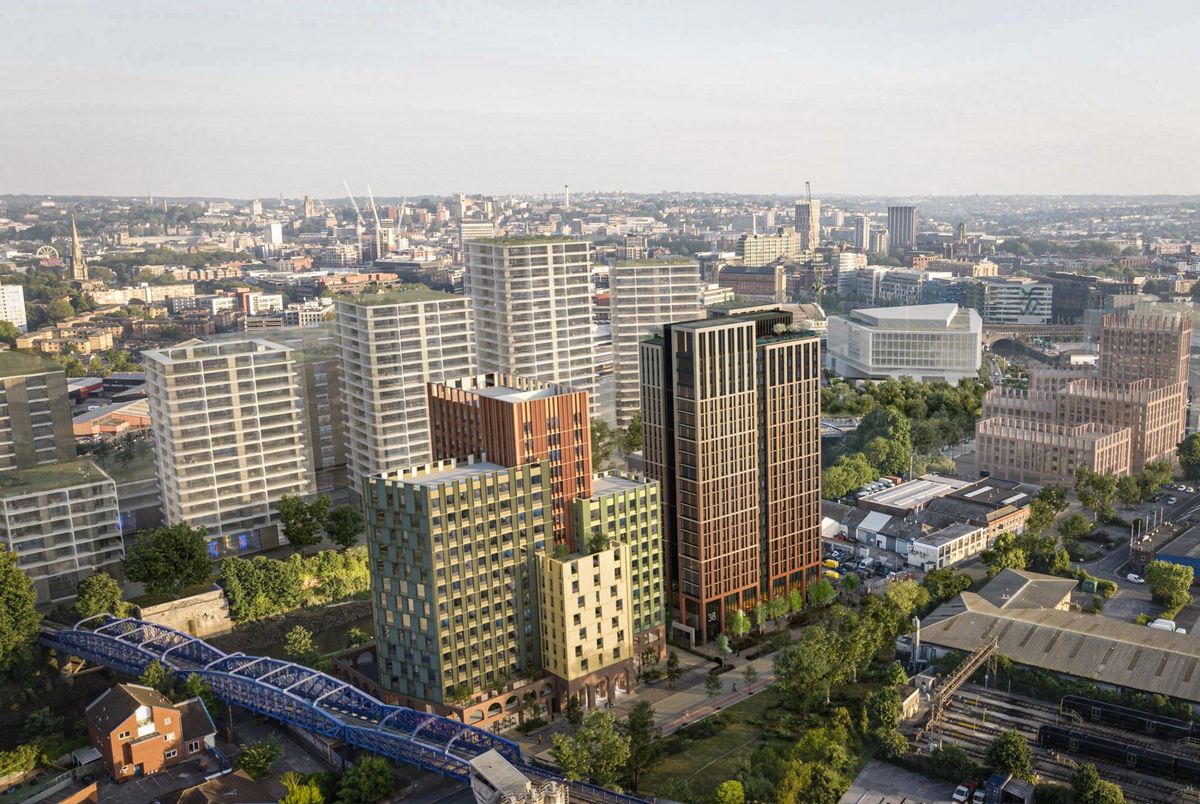 An artists impression of new student accommodation on Albert Road in Bristol(Image: Cubex)
Viewed from the air, St Philips is easily recognisable for the huge roofs of its warehouses and industrial units. It was always a tough place to live, with long lost Victorian terraced streets like Edward Street and Chapel Street bumping up against the rail yards, goods sheds and gas works. Between the railway and the Feeder, the people of the Dings have long been used to being surrounded by iron works and heavy industry.
But in the next ten years, St Philips is set to be radically transformed. It’s already happening the closer you get to Temple Meads station. If you want a vision of what this new long inner city arc of Bristol will be like in ten or 15 years’ time, take a stroll down Avon Street, where this transformation is nearing completion – a canyon of blocks of flats and student accommodation either side of a wide-pavemented road.
READ MORE: More than 20,000 extra student beds needed to cope with Bristol’s expanding universitiesREAD MORE: Transformation of iconic Bristol canal gets underway with 706 student flats
St Philips is part of the Temple Quarter regeneration scheme, a vast billion-pound project to replace the industrial landscape from Avonmeads to Temple Meads. Along the waterfront, and in pockets near Oxford Street it’s already happening, with student flats and a new university campus being created before the very eyes of the daily commuters into Temple Meads station.
And 2025 saw a major first step forward for this transformation – which is coming in the next ten years. The city council and the Temple Quarter bosses gave a first outline of what the area could look like, and consulted on different ways it will be shaped.
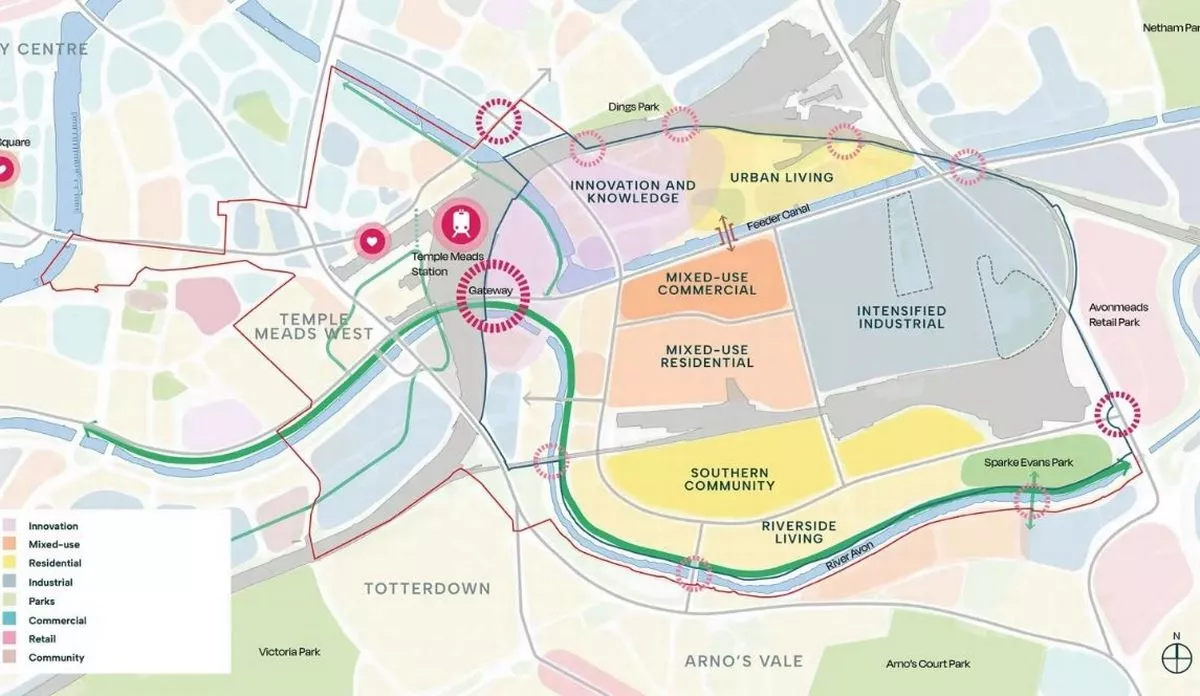 The masterplan for the Temple Quarter regeneration area is being consulted on from Monday, June 23, 2025(Image: Temple Quarter)
That feedback returned said one of Bristol’s most iconic roads – Feeder Road, the long straight road on the south bank of the Feeder Canal – should one day be pedestrianised, as people rather than industry and car dealerships, live along it.
2025 saw some progress too on the north side of the Feeder. A couple of huge new student accommodation complexes neared completion, ready for the grand opening of Bristol University’s new campus in September 2026. And work finally got underway to build the new Oasis Academy Temple Quarter secondary school.
East Bedminster
Across the river and further along the railway, there was once an area of Bedminster rich in history. Terraced streets called things like Weare Street, York Street, Nicholas Street and King Street were home for thousands of people, penned in by the railway line and the Totterdown and Victoria Park hill side to the south, the river to the north and surround by tanneries and the big Pylle Hill Goods Depot. It was out of these Victorian two-up-two-downs that Hillary Clinton’s great-grandfather grew up and eventually emigrated.
He started life on a terraced street that was cleared away by the Luftwaffe and the post-war slum clearers which, prophetically, was near Whitehouse Street. And this entire area was transformed in the 1960s into light industrial estates full of bodyshops, garages, automotive firms, printers and food manufacturers.
READ MORE: First plans unveiled for new Bristol suburb between Bedminster and TotterdownREAD MORE: Tallest building in South Bristol’s history proposed in front of Victoria Park
Now, it’s set to be transformed again. Two separate ‘development frameworks’ – one for the land to the east of St Luke’s Road and the other for the land to the west over to Bedminster Parade – have been developed, and the first plans for these sites are already being proposed. Nothing has started to be built yet, but it won’t be long.
Bedminster Green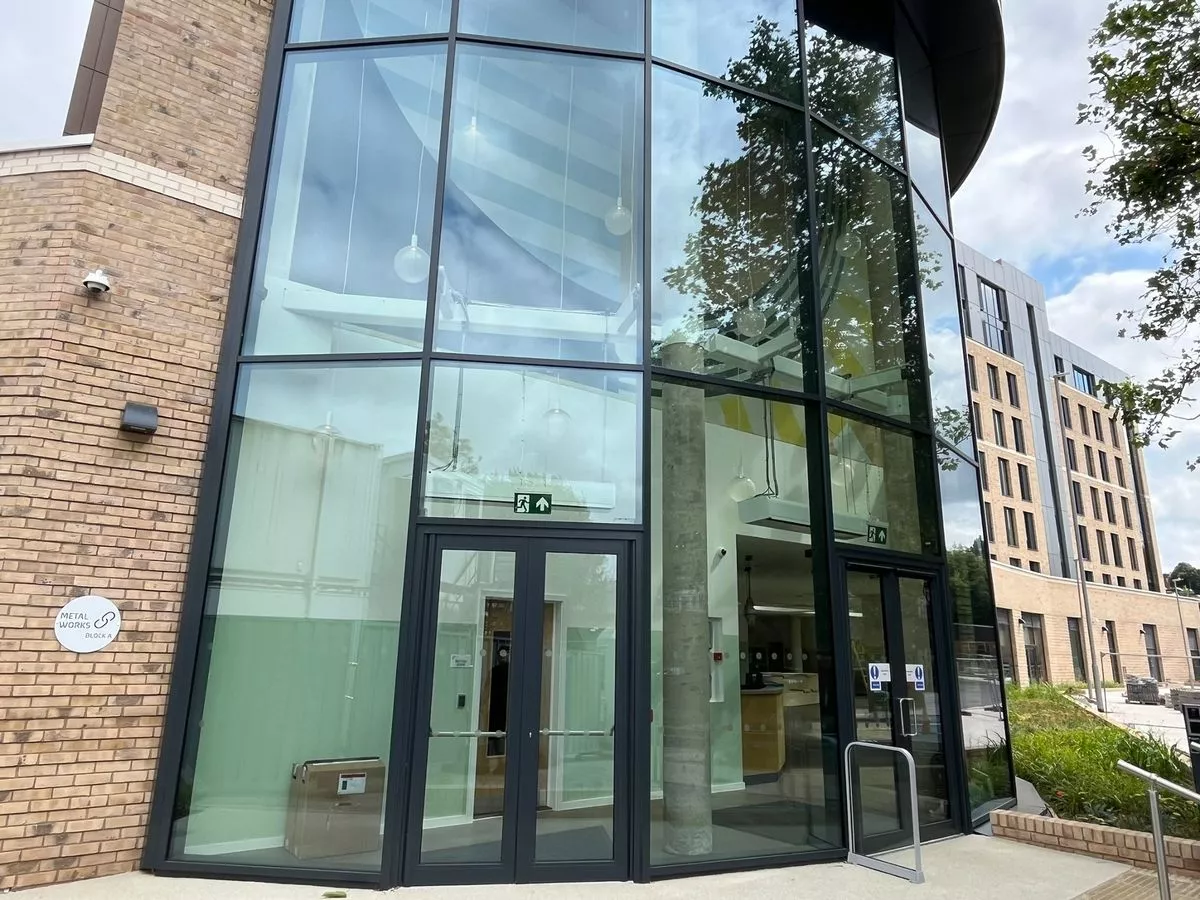 East Street, August 2024 – The Metal Works, a purpose-built student accommodation complex, which could see as many as 819 students arrive in September 2024(Image: Bristol Post)
At the southern end of Whitehouse Street is Whitehouse Lane, and another arm of industrial land that runs right into the heart of Bedminster, along the railway line. Either side of Malago Road, build-to-rent flats up to 16 storeys tall, and vast student accommodation complexes housing 819 students have already been built, and work on the second major student accommodation complex has now started. Even further south into Bedminster, empty builders’ yards, car dealerships and now an empty printworks have or are proposed to be transformed into more flats or student accommodation.
Is the transformation stalling already?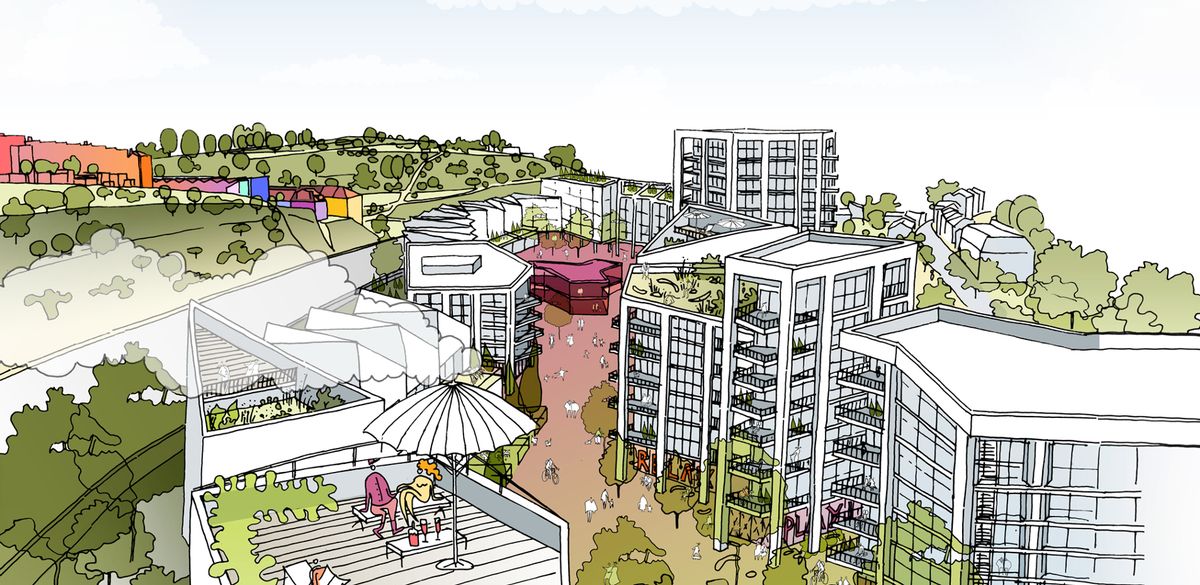 Illustrations of the 900 apartment development at Mead Street, in front of Totterdown, proposed in 2022(Image: Marina Samvelyan)
Many aspects of this transformation of Bristol’s ‘inner-city industrial arc’ are going ahead right on schedule and as planned. Where there is an economic driver in place, things are progressing rapidly. The opening of Bristol University’s new Temple Quarter campus is prompting many Purpose Built Student Accommodation developments, both in the immediate area around St Philips and Temple Quarter, but also in the city centre and in Bedminster.
But 2025 saw something of a hiccup for the first time since the Covid pandemic, to the relentless march of Build-to-Rent flats and blocks of shared housing – prompted by a number of challenges facing the building industry.
The first is that new fire safety regulations state that any new residential building over 18m tall has to have two staircases – a legacy of the Grenfell Tower tragedy. That has seen developers go back to the drawing board with their plans for developments with more than seven or eight storeys – which almost all of them are.
READ MORE: Developers behind two tower blocks overlooking River Avon want to reduce affordable homes numberREAD MORE: There’s already a row over plan for tallest building in South Bristol’s history
And that has, the developers say, hit viability. If you have to include another staircase, that’s less space for flats. Staircases don’t pay rent but the lost 20 flats would. Then, there’s the other regulations brought in as part of the Grenfell Tragedy changes. Many Bristol developments have become mired in bureaucracy and, with the costs of building spiralling, affordability issues.
Bristol’s inner-city arc is full of developments that have been given planning permission, but have not seen any work – yet. One of the most high profile is the former Robins & Day Peugeot dealership, on the corner of the Bath Road Bridge roundabout opposite Temple Meads station. Across the river, something remarkable happened in 2025 to further highlight the stalling progress of the Bristol building boom.
READ MORE: Bristol’s high-rise housing boom stopped by ‘perfect storm’READ MORE: Former mayor ‘heartened’ by crisis in Bristol’s high-rise building boom
A huge industrial estate, which Bristol City Council had drawn up plans to allow 900 flats to be built on, right in front of the famous Totterdown hillside, went up for sale. But developers wanting to get stuck into building those 900 flats to create the new ‘Mead Street Framework’ plan for flats within walking distance of Temple Meads and the new university, found themselves out-bid at auction by a landowner whose business is owning industrial estates.
Facing increased costs of building 900 flats, the residential developers couldn’t commit to spending as much up front as the firm that wanted to keep it – for now, at least – as an industrial estate, with guaranteed rents and leases from the businesses already there. The Mead Street Regeneration part of the inner-city arc is currently on hold.
What kind of new homes are being created?
The Victorian expansion of Bristol that created the inner city from St Pauls to Bedminster ended up being the slums of the early 20th century. These were overcrowded shared terraced housing with outside loos, no bathrooms and often large families on just one floor or, worse, in one room. They were pulled down from the 1930s, bombed in the 1940s and cleared completely in the 1950s, to be replaced by the light industrial estates of the 1960s and 70s of factories and warehouses.
The new vision of housing back in the 1930s was places like Knowle, Sea Mills and Southmead – large, well-built homes with big gardens, bathrooms and central heating, followed by the likes of Hartcliffe, Lockleaze, Hillfields, Withywood, Broomhill and Lawrence Weston in the 1950s and 60s.
The third wave of Bristol’s housing boom will be neither of these, and it will be very different again. Instead of houses the boom of the 2020s and 2030s will be almost entirely flats – in blocks of between six and ten storeys and towers of up to 16, 17, maybe even 20 or 22 storeys high.
Instead of homes to buy with a mortgage, they will be almost entirely ‘build to rent’, providing an all-in-one package where everything from internet connection to water supply is covered by the rent.
The ‘build-to-rent’ phenomenon sees the developers building the blocks of flats also then continue to own them, collecting rent and dealing with maintenance of the shared areas. In the Bristol of the future, tens of thousands of people will live in ‘serviced apartment buildings’, where the level of service depends on the level of rent.
As well as ‘build-to-rent’, the new explosion of building also includes purpose-built student accommodation (PBSA) and ‘Co-living’, although so far that’s a mode of housing that has so far been confined to developments in the city centre. Co-living is basically the same as ‘Build-to-Rent ’, but in shared flats that feel more like student accommodation.
The young Bristol resident of the second half of the 2020s and into the 2030s and beyond, will see the dream of buying their own home in the city go further and further away.
The PBSA and BtR combination leaves little scope for what is classed in planning terms as ‘affordable housing’. This could be anything from shared ownership to homes sold at a discount to teachers, nurses, paramedics or police officers, but in almost all cases it has been and will continue to be homes at a discounted rent.
That discount could be around 80 per cent of the rent charged on the open market, so-called ‘affordable rent’, or it could be ‘social rent’, which is normally much lower. In both cases, rented ‘affordable homes’ are taken on by a housing association and let to people on Bristol’s HomeChoice waiting list and bidding system.
How many of the new homes of Bristol’s third wave will be classed as ‘affordable’ has been a contentious issue. One of the first things Marvin Rees did as Mayor of Bristol – alongside scrapping rules which limited the height of buildings that could be built in the city – was to water down the requirements for developers to include affordable housing in their projects.
It was – and still, in theory at least, is – 40 per cent affordable homes in the city centre and 30 per cent outside the city centre. The developers told the Mayor and council chiefs that was a block to building more – the developers weren’t making enough profit to able to write off 30 or 40 per cent of their homes at a discount to a housing association.
A new bit of planning guidance in 2017 dropped that to 20 per cent, if the developers met certain criteria, and the developers have found this more favourable. At the time, the then Mayor of Bristol Marvin Rees said Bristol couldn’t let ‘the perfect be the enemy of the good’, arguing that 20 per cent of something was better than 30 or 40 per cent of nothing. Now, pretty much most projects to redevelop Bristol’s industrial arc have 20 per cent affordable as standard – apart from student accommodation, where it’s not required at all.
So the new homes of the third Bristol boom will be flats in tower blocks, not houses in gardens; rented from a private development company, not bought with a mortgage and, in most cases, at the top end of rented accommodation in the city.
What will the impact be?
The most immediate and obvious impact is that tens of thousands of new homes will be created. What, if any, effect building thousands of new homes, albeit one and two-bed flats and student accommodation, will have on Bristol’s much lamented housing crisis has been and will increasingly be the subject of strong debate.
Those advocating for the shackles to come off the planning process and the widespread building of new homes – the self-styled YIMBYs – say building thousands of new homes will see rents and house prices fall for everyone else too. They also point to the building of densely-packed new homes on brownfield sites in cities as something which could take the pressure off the edge of town greenfield sites that environmentalists and those labelled NIMBYs are desperate to protect.
There are doubts however. Rents have continued to spiral upwards in Bristol despite the much-celebrated 12,534 new homes built in the period Marvin Rees was in office as Mayor. The price of buying a home, which spiralled in the 2010s, might have stopped spiralling, but is still out of reach of most young people, who struggle to find the rent each month let alone save for a deposit.
READ MORE: The ‘co-living’ boom about to hit Bristol – solution or problem?READ MORE: How affordable are the ‘record levels of affordable housing’ being built in Bristol
As stated, these will be almost entirely privately rented, or ‘Co-Living’ or student accommodation, so the idea that the third great transformation of Bristol will help the other aspect of the housing crisis – the people on the council’s housing waiting list – appears doubtful too.
With just 20 per cent of the build to rent homes – not including the student accommodation – classed as ‘affordable’, that is 2,000 new ‘council homes’ for every 10,000 new homes built in Bristol’s industrial ‘inner arc’. The city would have to built 100,000 to find a home for everyone currently on the waiting list – and that’s not including the people who need new council flats in the coming years as the first generation of 1950s and 60s tower blocks are almost certainly and eventually condemned.
The effects on jobs
The first industrial sites to be earmarked for the great transformation have tended to be empty factories and industrial units, but increasingly, the developers are coming for places where there are perfectly healthy businesses and jobs. These are businesses often on – at most – five year leases, but many have one or two year leases or break clauses. Companies do get notice, and often have contingency plans.
In Fishponds, the huge Graphic Packaging International site is set to be transformed into as many as 2,500 new homes after the firm itself decided to up sticks and move to a new site in Yate. On the banks of the river in Bedminster, the BART Spices factory, which delighted the nostrils of the people of Totterdown or Redcliffe depending on the wind that day, shipped off to Avonmouth, leaving their site for developers.
Other businesses face an uncertain future – bosses and workers at a car garage at the end of Whitehouse Lane have been living on the edge of an eviction notice for years, and now face even longer not knowing when they will have to move – if at all – following the collapse of the deal between the city council and developers over the last Bedminster Green plot.