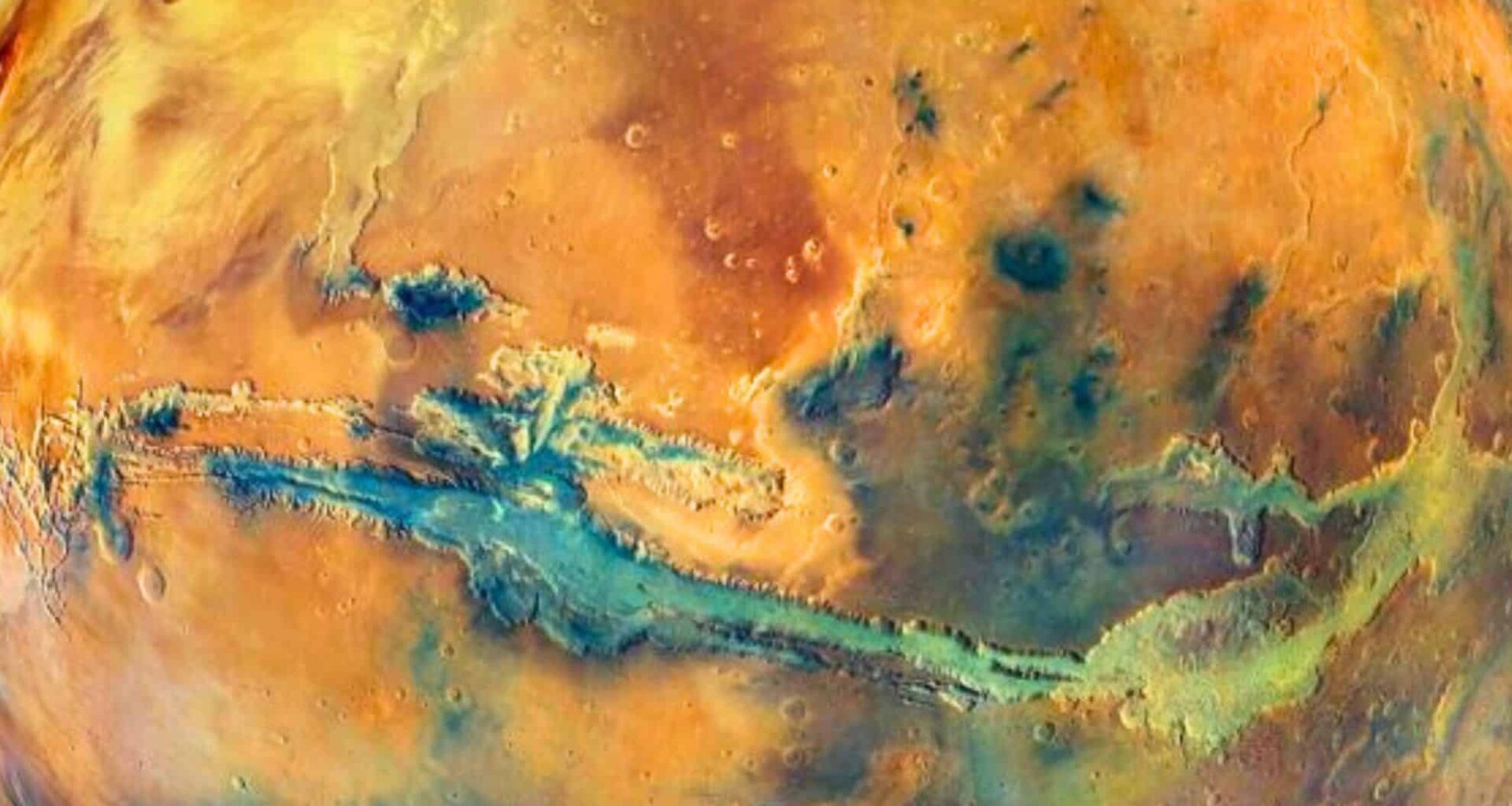
For decades, Mars has appeared in a narrow visual range: a red planet rendered in high-contrast tones that exaggerated its dusty surface. Public images reinforced this identity, while scientific tools focused more on data than photorealism. What Mars truly looks like from space has remained less clear.
A new image released by the European Space Agency (ESA) now shifts that picture. Based on data gathered across two decades of orbital observation, the mosaic presents Mars as it might appear to the human eye. The result is not an artistic reinterpretation or an infrared simulation but a calibrated view built from real colour wavelengths.
This milestone is the product of the Mars Express mission, which launched in 2003 and has remained active well beyond its intended lifespan. Aboard the spacecraft, the High Resolution Stereo Camera (HRSC) captured the surface of Mars across multiple light channels and stereo angles, building the most comprehensive visual archive of the planet to date.
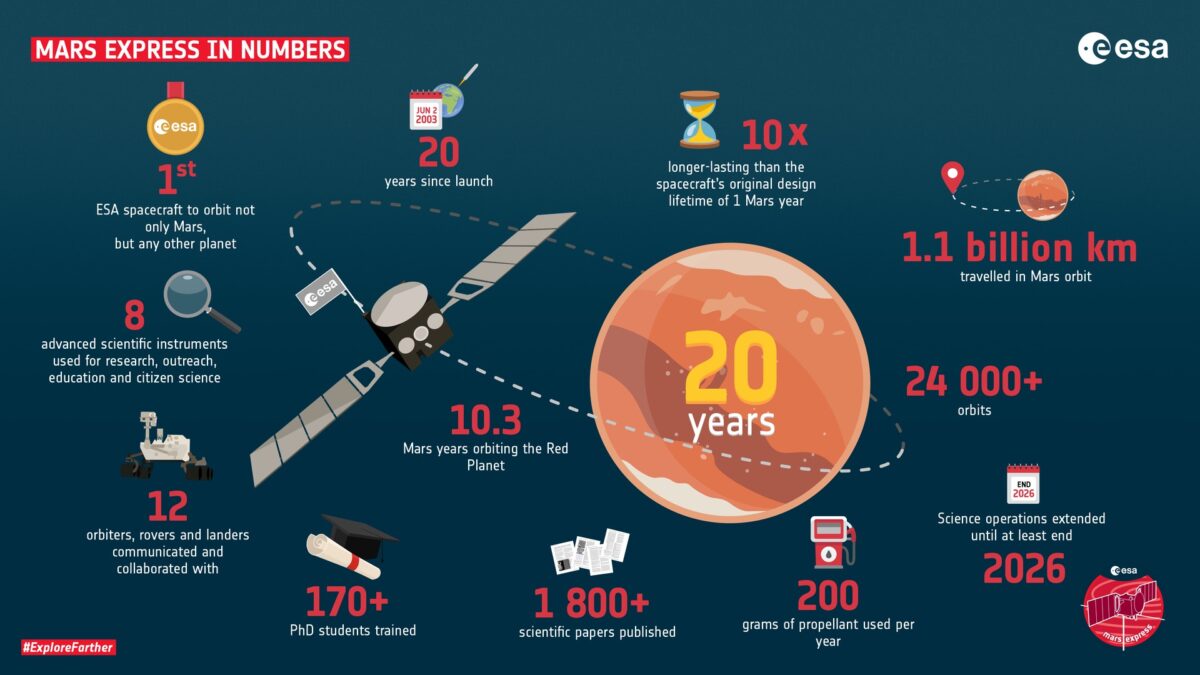 More than two decades ago, on 2 June 2003, ESA’s Mars Express orbiter launched and began its journey to the Red Planet – Europe’s first ever mission to Mars. Credit: ESA
The full mosaic, assembled from tens of thousands of individual images collected between 2004 and 2022, is not only visually compelling but also geologically revealing. Its value lies in both its scientific accuracy and its potential to support new types of planetary analysis.
A Calibrated Image Built From Long-Term Observation
The global mosaic draws on data collected during 20 years of repeated imaging by the HRSC, which uses nine CCD line sensors to capture full-colour, stereo, and high-resolution images simultaneously. This unique configuration enables the camera to construct topographic and visual datasets in a single orbital pass.
 The High Resolution Stereo Camera (HRSC). Credit: DLR/FU Berlin/ESA 2003
To prepare the image, each strip had to be corrected for differences in sunlight angles, atmospheric haze, and seasonal dust activity. The result is a seamless, colour-balanced image with consistent shading that retains depth and texture. ESA states that the average resolution across the mosaic is approximately 2 kilometres per pixel, with higher-resolution views available in select regions.
Unlike many earlier instruments that produced greyscale or false-colour outputs, the HRSC records data in red, green, and blue wavelengths. This allows for a realistic representation of Mars’ surface under natural lighting conditions. Visual features such as slopes, craters, and ridges appear with contextual shading, improving readability for geologists and researchers.
In its technical description of Mars Express instruments, ESA characterises HRSC as a “multi-sensor pushbroom instrument” capable of producing stereo and multispectral images simultaneously. A Super Resolution Channel further enhances the visual detail in selected frames.
Geological Insights Embedded in Colour Variation
The colour contrasts visible in the mosaic carry direct geological meaning. Darker regions often indicate basaltic lava plains and weathered volcanic terrain, while lighter areas, particularly those rendered in yellow or pale green, suggest clay-rich deposits formed in the presence of water.
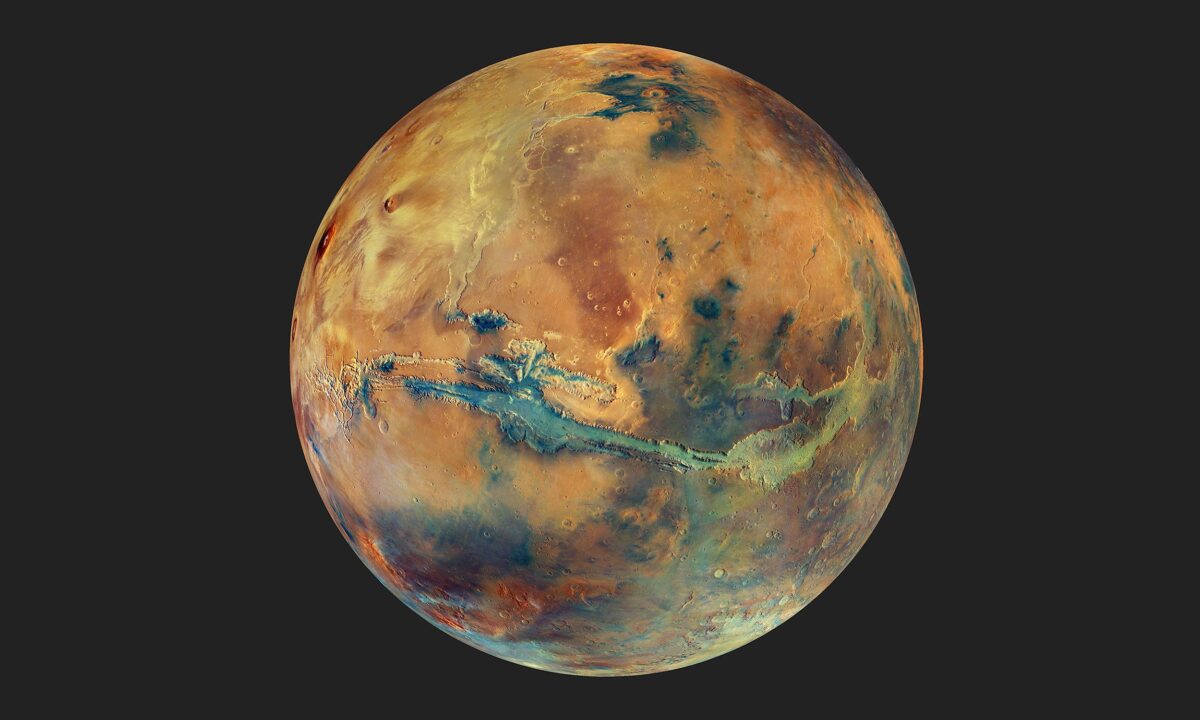 The globe of Mars set against a dark background. The disc of the planet features yellow, orange, blue and green patches, all with an overall muted grey hue, representing the varying composition of the surface. Credit: ESA
These mineral differences help researchers trace the history of volcanism, erosion, and possible water activity on the Martian surface. Clay minerals are of particular interest because they tend to form in neutral to mildly alkaline water, an indicator of past conditions that may have supported microbial life.
Additional data from other Mars Express instruments reinforce these findings. The OMEGA spectrometer, which observes the surface in both visible and infrared wavelengths, maps specific mineral groups including sulfates, hydrated clays, and iron-rich deposits. These readings support geological interpretations derived from the HRSC image.
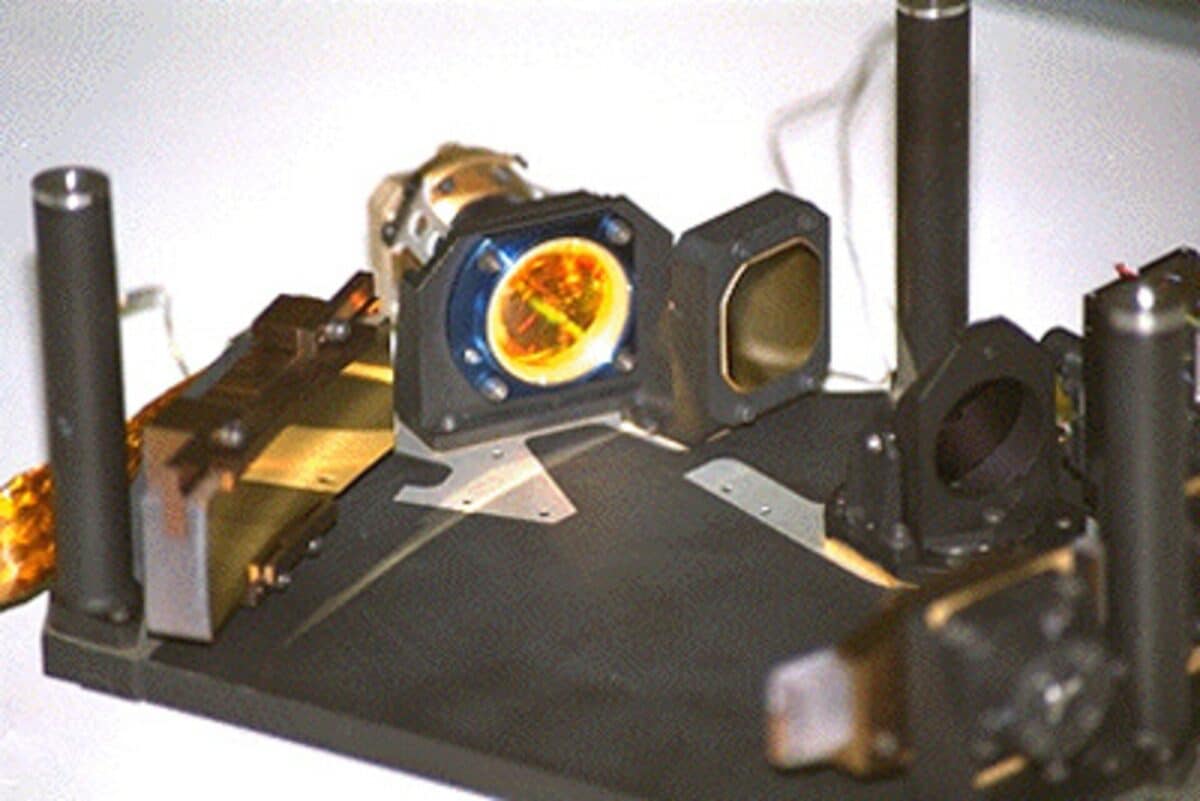 OMEGA searches for specific minerals on Mars. Credit: ESA
“We want to know the iron content of the surface, the water content of the rocks and clay minerals and the abundance of non-silicate materials such as carbonates and nitrates,” said Jean-Pierre Bibring, former OMEGA principal investigator at the Institut d’Astrophysique Spatiale in Orsay, France. “These measurements would allow us to reconstruct the history of the planet.”
Landmark Features Now Appear With Improved Clarity
Several well-known surface features appear with sharper definition and more consistent tone than in previous global views. Regions such as Valles Marineris, Tharsis Montes, and the Hellas Basin benefit from the mosaic’s combined topographic depth and colour accuracy. This helps researchers interpret their geological evolution with improved visual reference.
Earlier global images of Mars often used enhanced colour or variable brightness for contrast, sometimes at the expense of consistency. The new mosaic avoids such distortions by preserving the light gradients present in each original image. This makes it easier to distinguish between elevation, material type, and surface age in a single frame.
Ralf Jaumann, former HRSC principal investigator at the German Aerospace Center (DLR), noted the instrument’s primary scientific utility: “The strength of HRSC is to perform high resolution digital terrain models of the Martian surface in order to provide topographic context for the geoscientific evaluation of surface processes in space and time.”
The long lifespan of Mars Express allowed the HRSC to revisit locations under changing environmental conditions. These repeat passes contributed to the mosaic’s even lighting and colour alignment, reducing visual discontinuities across hemispheres.