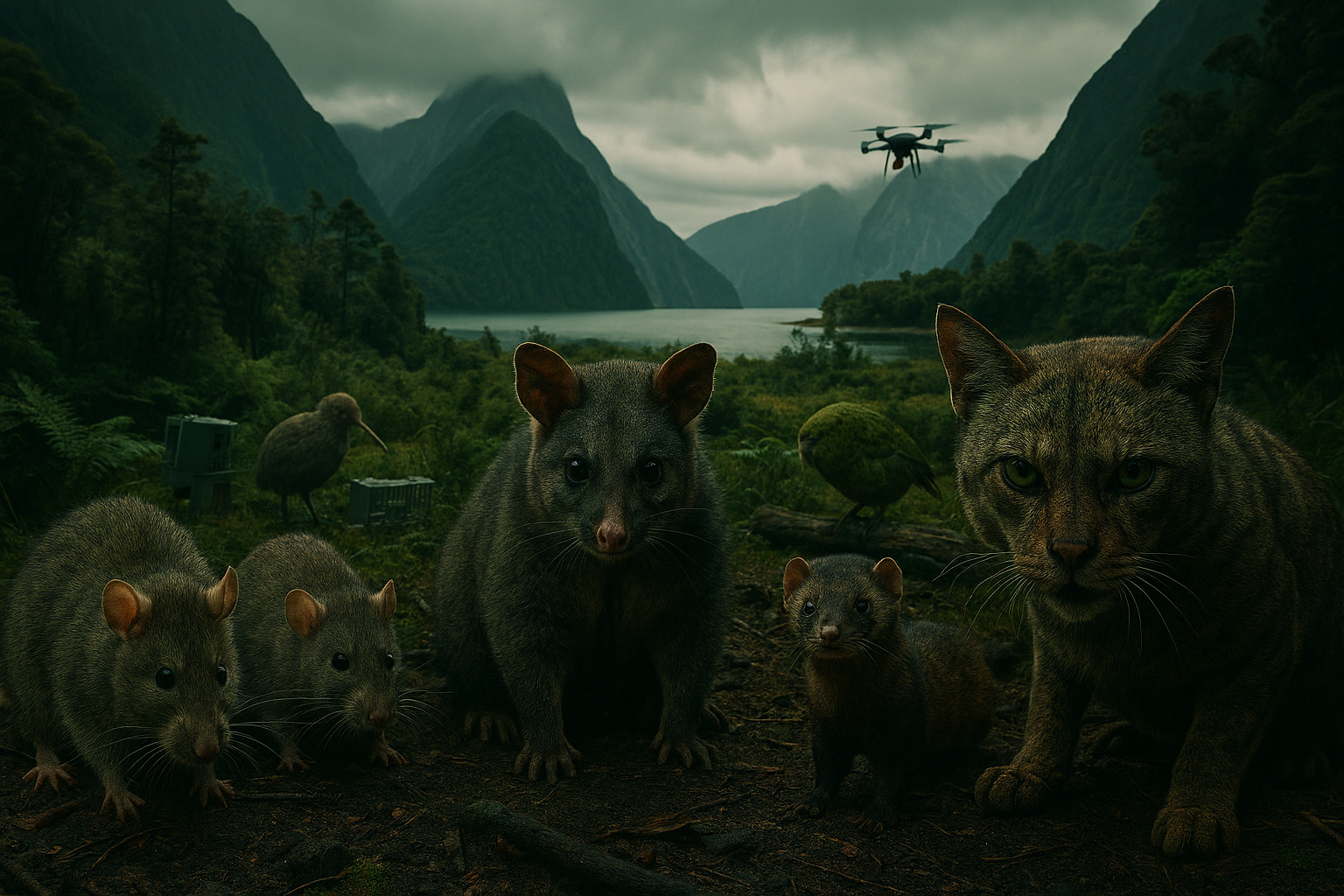
New Zealand aims to eliminate more than 30 million invasive animals by 2050 to prevent ecological collapse, protect unique birds, and save entire ecosystems.
Official reports of Government of New Zealandstudies of Department of Conservation (DOC), analyses published in scientific journals such as Nature Ecology & Evolution, PNAS, Science and strategic program documents Predator Free 2050 They reveal that the country has adopted one of the most radical and controversial environmental policies of the 21st century. The stated objective is to eliminate more than 30 million invasive animals By the year 2050, the goal is to prevent the mass extinction of native species that simply did not evolve to coexist with mammalian predators.
The initiative did not arise from activism or international pressure. It stems from concrete data, continuous ecological monitoring, and a rare consensus among biologists, ecologists, and environmental managers: Without extreme intervention, much of New Zealand’s wildlife will cease to exist in the coming decades..
An archipelago that evolved without mammalian predators.
To understand why the situation reached this point, it is necessary to look at the geological and biological history of the country. New Zealand separated from the supercontinent Gondwana approximately… 80 million yearsSince then, it has remained isolated in the South Pacific, without a land connection to other continents.
— ARTICLE CONTINUES BELOW —
Are you in favor of US military intervention in Venezuela and the arrest of Nicolas Maduro?
— Click Oil and Gas (@clickpetroleoeg) January 3, 2026
This isolation had a unique consequence: There were almost no terrestrial mammalian predators.The only known native mammal was a small bat. In contrast, birds occupied ecological niches that, in other parts of the world, belong to mammals.
This led to the emergence of unique species:
- Birds that They lost the ability to fly.
- Species that They nest in the ground.
- Slow-moving reptiles, such as the tuatara.
- Giant insects, some the size of small rodents.
This ecosystem functioned stably for millions of years, until the arrival of humans.
The introduction of predators and the beginning of the collapse.
The first humans arrived around 700 the 800 years, bringing with them the Pacific rat. Centuries later, European colonists introduced a series of mammals for economic, agricultural, or pest control purposes: Larger rats, cats, weasels, ferrets, stoats, and possums.
These species have found the perfect environment:
- Prey without behavioral defenses
- Absence of natural competitors
- High availability of food
The result was an unprecedented population explosion.
Why are rats considered public enemy number one?
Rats are responsible for a disproportionate share of environmental impact. Studies by the DOC indicate that they attack eggs, chicks, and even adult birdsIn addition to devouring insects, seeds, and sprouts.
The most alarming data shows that:
- Rats kill tens of millions of native birds per year
- On some islands, the survival rate of pups has fallen to less than 5%
- Entire species disappeared locally after the arrival of rats.
The high reproductive rate exacerbates the problem. A single pair can produce… hundreds of descendants in just a few yearsmaking control nearly impossible without coordinated action.
Possums: the plague that devours entire forests
The Australian possum was introduced in the 19th century for the fur industry. Today, it is estimated that there are… more than 25 million individuals spread across the country.
They cause damage on two fronts:
- FaunaThey prey on eggs, offspring, and native insects.
- FloraThey consume leaves, flowers, and buds on a large scale.
Government reports indicate that possums consume millions of tons of plant biomass per year, weakening trees, creating artificial clearings, and accelerating erosion processes. Furthermore, they are vectors of bovine tuberculosis, directly affecting livestock farming and generating economic losses.
Mustelids: predators that are too efficient.
Weasels, stoats, and ferrets were introduced with the intention of controlling rabbits. The effect was devastating. These animals are extremely efficient hunters, capable of eliminating adult birds quickly.
Research published in PNAS They show that:
- Mustelids drastically reduce populations of rare birds.
- They are responsible for local collapses of endangered species.
- They operate mainly in continental areas, where control is more difficult.
Unlike rats, which attack eggs and offspring, mustelids hunt adult breeders, which further accelerates the population decline.
Feral cats: the invisible predator
Feral cats represent the most controversial aspect of the program. The population is estimated to be between… 2 and 3 million living outside of human control.
Studies cited by Nature Ecology & Evolution indicate that cats:
- They kill birds, reptiles, bats, and small mammals.
- They hunt even when they don’t need food.
- They are responsible for modern extinctions on islands around the world.
In New Zealand, they particularly affect species that live on the ground or in open areas. The government differentiates between domestic cats and feral cats, but acknowledges that the line between the two is one of the biggest challenges of the plan.
The Predator Free 2050 program
Officially launched by the government, the Predator Free 2050 Set clear goals:
- Eliminate rats, possums, and mustelids from key areas.
- Create continental zones free of predators.
- Develop new population control technologies.
- Protecting endangered species before they reach the point of no return.
The investment involves billions of dollars over decades, including scientific research, satellite monitoring, smart traps, and biotechnology.
Results already observed
Where controls have been rigorously implemented, the results are immediate:
- The survival rate of baby birds increased by less than 5% to more than 60%
- Species considered locally extinct have reappeared.
- Forests began to regenerate more quickly.
Predator-free islands have become true living laboratories, used as a model for interventions in larger areas.
Economic and agricultural impact
Beyond the biodiversityThe plan has economic effects:
- Reducing agricultural losses caused by possums
- Reduced spread of diseases in livestock farming.
- Protection of essential ecosystem services, such as pollination and natural pest control.
Government studies indicate that the cost of do not act It would be much greater than the investment in the program.
The initiative has turned New Zealand into a symbol of a modern dilemma: To what extent can humanity intervene to correct damage it has caused itself?
Critics question:
- The use of lethal methods
- The emotional impact on the population
- The international precedent
Proponents argue that the alternative is the definitive extinction of species that do not exist anywhere else on the planet.
An experiment that could change global conservation.
If the plan is successful, it could serve as a reference for:
- Australia
- Havai
- Galapagos Islands
- Pacific and Indian Ocean archipelagos
New Zealand is betting that Active intervention is the only way to preserve highly specialized ecosystems. in a globalized world.
At the heart of the debate is an uncomfortable but unavoidable question: When extinction is caused by human action, doesn’t inaction also become a moral choice?