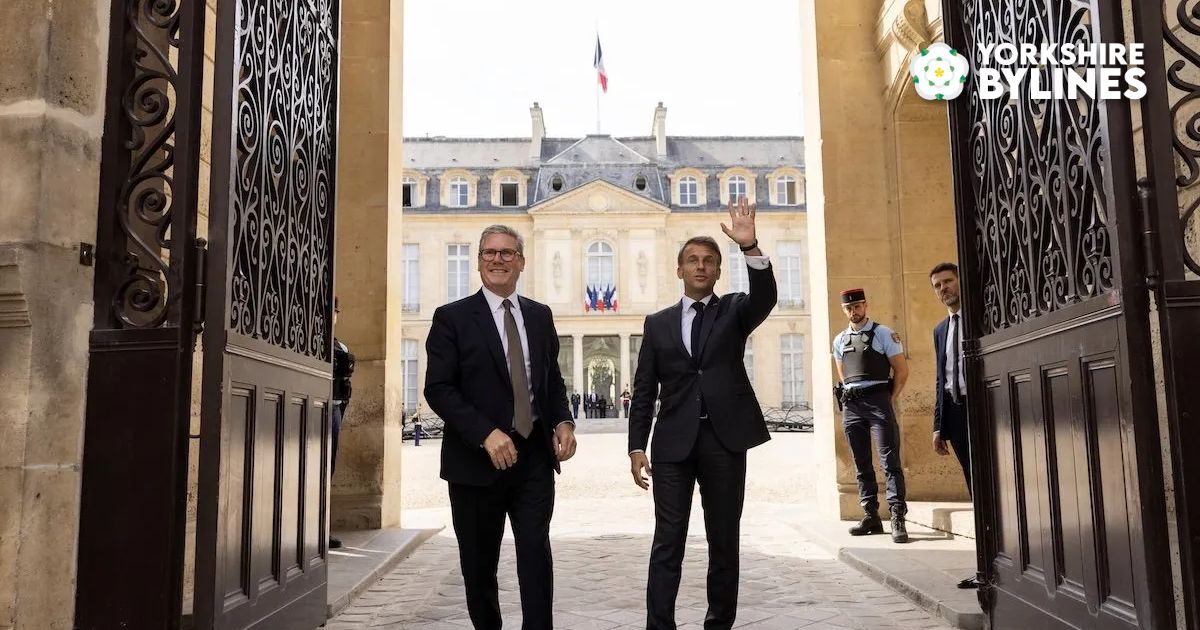
Keir Starmer was recently questioned on relationships with the EU and the possibility of negotiating to join the customs union with the EU. This is an option currently being pressed by some politicians, including the Lib Dem’s Sir Ed Davey and Starmer’s own deputy David Lammy, as well as back benchers and some ‘wannabe’ future Labour Party leaders. Starmer ruled out joining, or more accurately negotiating on a ‘bespoke’ customs union, in favour of a more ambitious realignment with the EU single market.
The Daily Express, the ever-dutiful pro-Brexit newspaper, described Starmer’s proposal on its front page as, “a full blown Brexit betrayal”.
However, given recent polls showing a clear case of ‘Brexit remorse’ among voters, there was a noticeable lack of response from known pro-Brexit ex Tory ministers such as Jacob Rees Mogg, Lord Frost, Michael Gove and others who appear to be no longer willing to squirm on the mainstream TV studio sofas at the unmitigated disaster of Brexit.
Customs union would not be straightforward
It is dawning on many politicians that negotiating a full customs union would not be the walk in the park they thought it would be.
The EU will drive a hard bargain that would require the axing of recently negotiated UK trade deals with India, the UK–USA economic trade prosperity deal (current status unknown), the South Korea deal as well as others still in the pipeline in the Middle East. “We are better looking to the single market rather than the customs union for our further alignment,” Starmer said, adding that it :“…would not mean ripping up those new trade deals elsewhere”.
Equally, Starmer’s proposed visit to China later this month, which has been ‘on-and-off’ over the building of a new Chinese embassy in London, is reported to include a 40-strong delegation. The delegation includes a sizeable business cohort (it would be a good idea to take some experienced trade unionists as well) to look at possible sector deals covering fintech, green technology and creative industries, with potential side-events on talent-mobility simplification.
What’s the alternative?
As a committed pro-EU ex-union official, I had worked with union research staff, the international department of my union, Unite, along with experienced local union reps who worked for multinational manufacturing companies. We had looked at the options available to the UK – and not surprisingly we campaigned to fully remain in the EU.
I would like nothing better than a bespoke customs union deal as a staging post on the way to rejoining the EU – but I recognise negotiating such a deal would be highly complex and lengthy.
To hear some Labour and Lib-Dem MPs, they seem to think it would be the case that we simply turn up in Brussels and ask the EU ‘where do we sign?’
In all the debates so far on realignment with the EU or negotiating a customs union, there has been little or no recognition that the EU will drive a hard bargain – as Boris Johnson is rumoured to have once said: “You will never out-negotiate the EU.” – as he found out with a slapdash Brexit deal.
The government’s recent agreements to rejoin the Erasmus scheme of international education, training, youth, and sport exchanges will allow students and staff to study or work abroad. In addition, talks are open on a youth mobility scheme which will be popular with industry, young people, and parents of teenagers who enjoyed the benefits of working and studying in the EU in their youth. These are all steps in the right direction.
Sectoral deals may be stronger than customs union
But it is now clear that post-Brexit sectoral deals are where Starmer is heading – with better deals on food, agriculture and energy for starters. Starmer is also keen to secure sectoral deals with the EU, rather than a single broad deal such as a customs union, in an effort to ‘Reform-proof’ them for the future while continuing to edge us closer to Europe.
And, lest we forget – many EU countries and institutions are still feeling wounded by Brexit. Not only do they see a possible future Reform government creating the chaos that EU countries have endured from certain of our political factions for over 30 years, there are those institutions and politicians who were sick and tired of the unending stream of anti-EU propaganda, lies and xenophobia they faced week-in, week-out. Nor do they want to see their relationships with other countries outside of the EU being destabilised.
This was made very clear at a public meeting of trade union reps in Norway, not long after the Brexit vote, where I spoke about future ‘possibilites’ for the UK. One of the options was, of course, the UK applying to join the EEA (the European Economic Area, comprising Iceland, Liechtenstein and Norway), only to be told publicly by one respected union official with ties to the Norwegian government: “We are not going to have the UK joining and let them f**k it up for us”.
Those politicians who think there are any headline-grabbing easy answers to sort out our relationship with the EU need to speak carefully, and understand that rebuilding the relationship with the EU will be a long, hard road: there are no quick fixes.
 Friends of Bylines Network
There has never been a greater need for grassroots journalism that investigates the stories that really matter, holds power to account and champions the voices of everyday citizens. We are proudly powered by volunteers but what we do isn’t free.
STAND WITH US for independent, citizen-led journalism that makes democracy stronger, and you will even get some exclusive benefits.