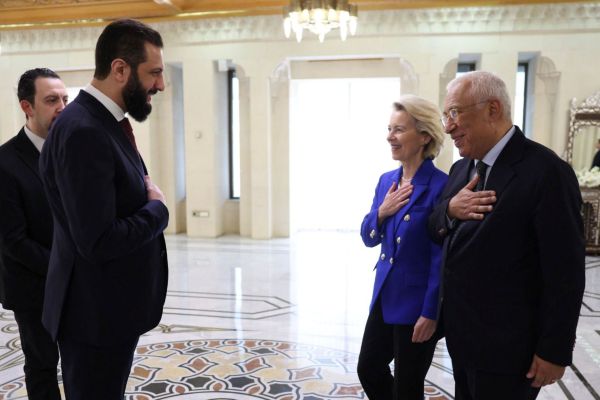
On Friday, high-ranking officials from the European Union visited Syria, where they met with interim President Ahmad al-Sharaa. This visit signifies a notable step toward enhancing relations between Syria and Western countries. The delegation, which included European Commission President Ursula von der Leyen and European Council President António Costa, was engaged in a broader regional tour.
Both leaders conveyed messages of support for Syria as it endeavours to rebuild after nearly 14 years of civil conflict, which concluded in December 2024 with the removal of former President Bashar Assad through a rapid rebel offensive led by al-Sharaa, who at the time was the leader of an Islamist rebel group.
“After decades of fear and silence, Syrians began a long journey toward hope and renewal. Europe will do everything it can to support Syria’s recovery and reconstruction,” Von der Leyen posted on X.
Al-Sharaa has embarked on a notable diplomatic initiative, successfully restoring relations with both Western and Arab nations that had previously distanced themselves from Assad’s government due to extensive reports of human rights violations committed by his security forces before and during the conflict. In the wake of Assad’s fall, Syria has continued to face significant economic challenges and has witnessed several instances of sectarian violence. Furthermore, Al-Sharaa’s administration has encountered difficulties in consolidating control throughout the country.
Recently, confrontations arose between Syrian government forces and Kurdish fighters in the northern city of Aleppo, coinciding with stalled negotiations for a potential merger between the newly formed Syrian army and the Kurdish-led Syrian Democratic Forces, which exert control over substantial portions of northeastern Syria. Although Syria’s Defence Ministry announced a ceasefire on Friday, there has been no public response from the Syrian Democratic Forces, and it remains unclear whether the Kurdish forces in Aleppo have accepted the ceasefire proposal.
The diplomatic delegation is scheduled to continue its engagement with a visit to Lebanon, where the army announced that it has completed the initial phase of a plan aimed at disarming non-state groups, including the influential militia Hezbollah.
Costa posted on X that the delegation had come “to show the EU’s continued support to Syria.”
“There is still a long way ahead but you have already taken the first steps,” he wrote.
This article used information from The Associated Press.