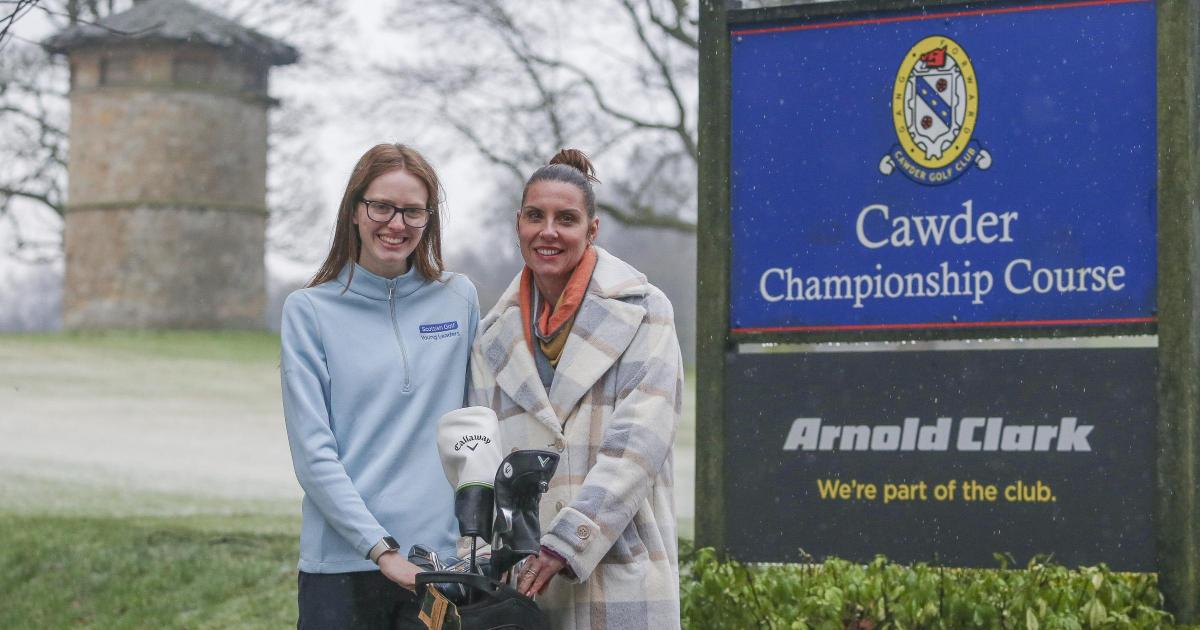
Cawder’s general manager Lucie Paterson has set out some ambitious objectives for the club and its newly-appointed women and girls coordinator, 20-year-old Emma Fraser, who has also taken on the responsibility of junior coordinator. Previously a diversity and inclusion officer at Morgan Stanley, Ms Paterson acknowledges that the current task will be tough but insists it is vital for the club’s long-term future.
Why is this a priority?
Obviously we’ve seen some huge changes in golf but there’s still quite a long way to go.
We’re probably sitting at around 900 members and I would say slightly less than 10% of them are women and girls. That’s why it’s become a priority area for us. They are out there – women that play golf – we just need to attract them to this club.
What’s the plan?
What we’ve decided to do is that Emma has taken it on as a volunteer role this year so that we can use that money to re-invest a little bit in the women’s section.
One of the things we are looking at is maybe getting a couple of extra sets of junior golf clubs for girls. We think that’s a definite barrier to girls taking up golf – it’s quite an expensive outlay at the start of a hobby. If we can purchase a couple of sets for pros to use for lessons and things like that, we can offer that as a service for girls to try it out rather than having to go out and buy clubs or borrow them.
Heather McGrattan (left), Laura Little and her mother Margo Little of Cawder Golf Club (Image: Cawder GC)
We’re also trying to develop a bit of a social side. We’ve got a little bit of a fund that we can maybe put up the money for the food and the drink. And if there’s things that Emma wants to go to that would be helpful and beneficial it means we can cover her expenses for that.
So are you coming at this from a standing start?
No, we’ve already got a pathway to golf membership that’s for anyone who is new to golf, but in our experience it’s been mainly women.
People who are brand-new to golf and would like to take lessons, we offer them a heavily discounted membership for the first two years because we understand that a year sometimes isn’t long enough to decide if golf is for you. Also, the statistics tell us that if you can keep a member for two years, you’ve probably got them for a very long time after that.
We’re looking to develop some advertising and social media on that and make sure people know about it. We’re also trying to make some of our existing competitions more family-friendly so women and girls feel that they’re more included.
The clubhouse is a refurbished 18th-century mansion (Image: Cawder GC)
What do you hope to achieve with the new programme?
We’d like to increase our active female adult members by at least 10% by the end of year one, and continue to grow by 10% for years two and three, so that will go up incrementally. And then we’ve got a slightly more ambitious junior goal where we’d like to increase the number of girls by 50% year-on-year.
We have five active girls in our junior group, none of whom have a handicap, so that’s something else that we’d like to increase and that’s another goal that we have got.
What’s the business rationale?
Golf is changing. We are a private members’ club and we had been very traditional for a very long time, but I think the reality is that type of club is kind of on its way out. It doesn’t seem to suit people any more, and I feel is that whatever is going on inside your club should be reflective of what’s going on outside your club.
There’s more than 50% females on the planet, so why are so few of them playing golf? If we want to continue to be a successful club we have to change along with the times, and we’ve got to build up our female membership.
Access the entire series of Around the Greens here.