Analysis: From a return to the moon to telescope launches, there’s plenty of exciting events to expect from space this year
It’s 2026 and we’re fully into the era of New Space where space agencies like NASA no longer work alone but in partnership with private enterprise. With a global space budget of half a trillion dollars and rising, orbital-based Internet, ordinary people in space, a revolution in space and planetary science and our first steps back to the Moon with our sights on Mars, are all taking shape.
We are also in an age of tensions in space mirroring those on Earth: the USA and China in a race to land people on the Moon; environmental issues with the use of space by private enterprise that international law struggles to keep pace with; and the military use of Cislunar Space (the globe of space around Earth defined by the orbit of the Moon) where the USA’s new military Space Force, with twice NASA’s budget, and China doubling its space budget, sees Europe lagging behind, despite its recent progress in space.
Ireland and space
2026 heralds a new beginning for Ireland in space by committing €170 million to ESA from 2026 to 2030 and a new National Space Strategy. Over 100 Irish companies are working on space missions across software, materials and photonics. Our formidable astrophysics is now being brought to space with our own space probes and instruments by UCD, DIAS, Maynooth University and others.
We need your consent to load this rte-player contentWe use rte-player to manage extra content that can set cookies on your device and collect data about your activity. Please review their details and accept them to load the content.Manage Preferences
From RTÉ Radio 1’s This Week, Irishman leading construction of world’s largest ever telescope
And soon, people from this island will go to space: Dr Norah Patten an aeronautical engineer on a Virgin Galactic flight in 2027 and Belfast born astrophysicist Dr Rosemary Coogan as a UK-funded ESA astronaut now awaiting her first mission.
Along with membership of the European Southern Observatory – the largest astronomical observatory in the World run by 16 European nations for which Ireland now holds the presidency – our island nation is establishing its presence in global space and astronomy.
Return to the Moon
The USA and China may be competing to put boots on the Moon, but participation is now global. The USA’s new lunar program Artemis also involves Europe, Japan and Canada. Artemis I in 2022 saw an unmanned test flight around the Moon. Artemis II, scheduled for launch between February and April sees the return of the first people to the Moon since Apollo 17 in 1972. Three American and one Canadian astronaut will orbit the Moon on a 10 day journey that lays the foundation for lunar landings in the coming years. And because 82% of people alive today were not born when Apollo 17 happened, this will be the first time for most of the World’s population to witness people travelling to the Moon.
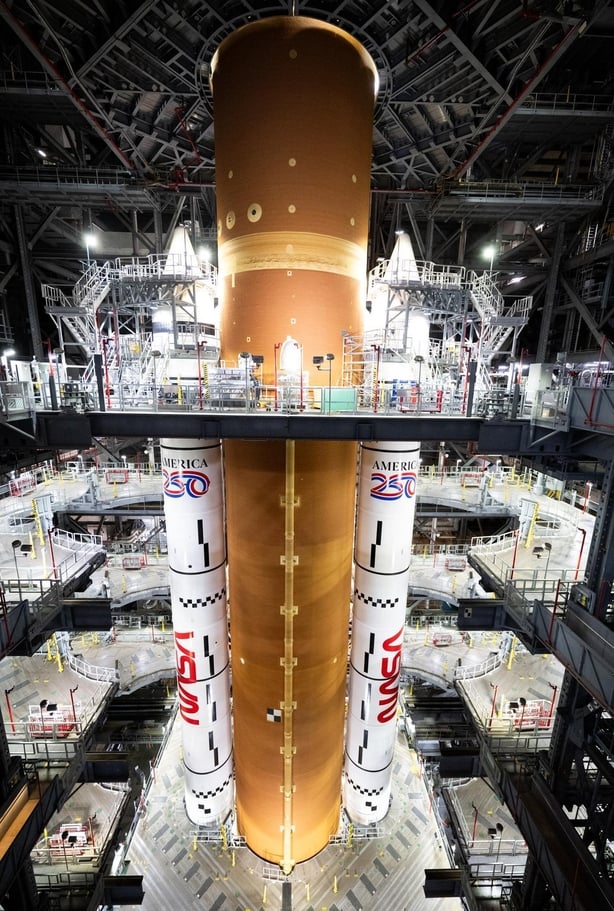
The Artemis II Space Launch System rocket being prepared to bring the first people to the Moon since 1972. Credit: NASA
Other exciting lunar missions follow. August sees China sends its sophisticated Chang’e-7 unmanned mission to the lunar south pole that includes a rover and a drone that will hop across the lunar surface.
NASA’s Commercial Lunar Payload Service (CLPS) sees three private unmanned missions to the Moon: Intuitive Machines IM3, Firefly Aerospace Blue Ghost Mission 2 and the Draper mission, through which dozens of experiments and mini-rovers will be deployed in preparation of a return – for the long-term – of people from many nations to the Moon.
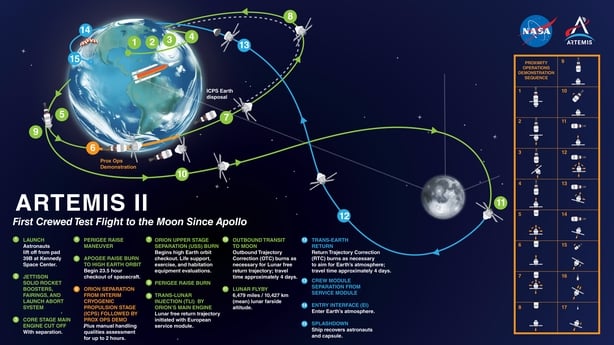
Artemis II Graphic showing the full 10 day journey around the Moon and home. Credit: NASA
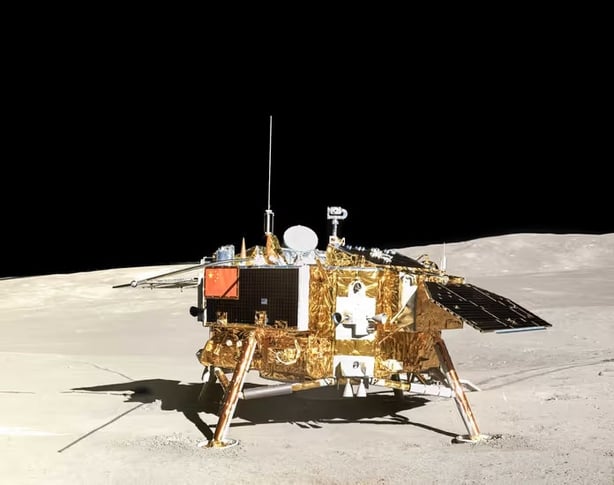
China’s Chang’e-7 unmanned space probe to the south lunar pole carrying a lunar rover and hopper. Credit CNSA
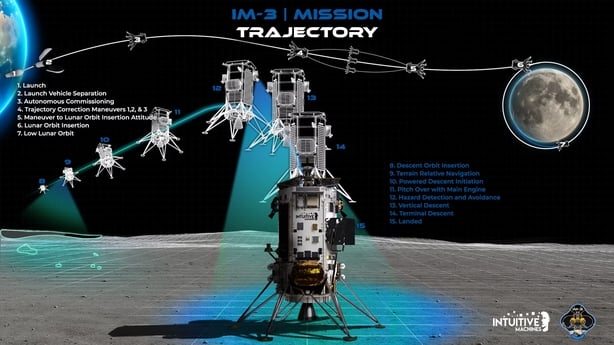
Intuitive Machines IM3 CLPS unmanned mission to the Moon, whose payload includes the Lunar Vertex rover, JPL CADRE 4 autonomous rovers and LUSEUM radiation monitor. Credit: Intuitive Machines
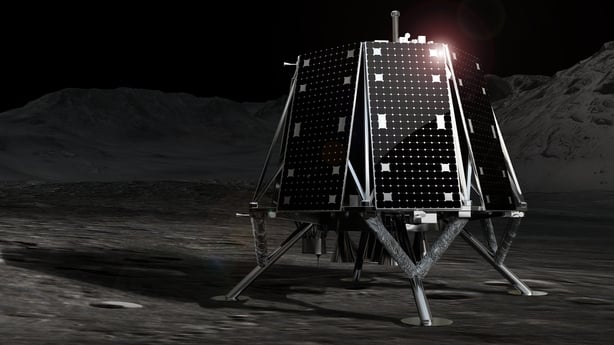
Draper CLPS unmanned mission to the Moon, among its payload is a suite of seismometers and two satellites to deploy to lunar orbit. Credit: Draper
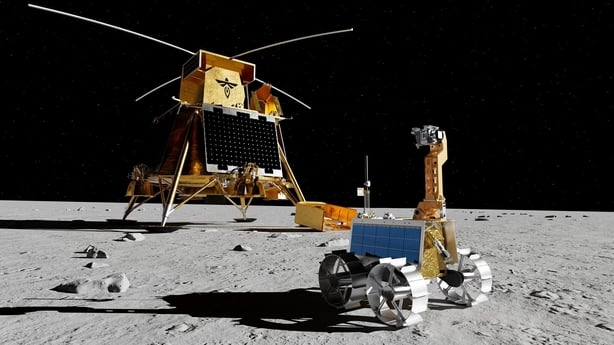
Firefly Aerospace Blue Ghost Mission 2 CLPS unmanned mission to the Moon whose payload includes NASA’s LuSEE-Night radio telescope, the UAE’s Rashid Rover 2, ESA’s Lunar Pathfinder, and Volta Space’s wireless power technology. Credit: Firefly Aerospace
Space and planetary science
We are in a golden age of astronomical discovery, and 2026 sees the full operation of the revolutionary Vera C. Rubin telescope in Chile, and the launch of no less than three new space telescopes.
The Vera C. Rubin Telescope, 25 years in the planning, saw first-light in 2025 with a stunning image, and over the next 10 years will survey half the visible Universe every three days with near-Hubble Telescope quality, set to transform our understanding of the Cosmos by monitoring billions of galaxies and stars and discovering millions of asteroids and thousands of planets around other stars – in effect – filming the live activity of our visible Universe.
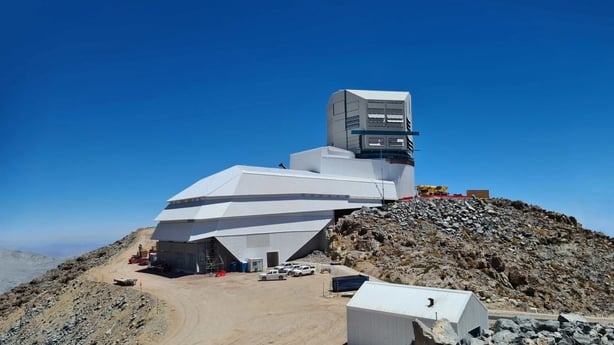
The Vera C. Rubin Telescope, commencing this year a 10 year survey of the Universe monitoring over 20 billion galaxies, 17 billion stars in the Milky Way, discover 90% of hazardous Near Earth Objects and millions of asteroids, among many other discoveries, that will transform our understanding of the Cosmos. Credit: Vera C. Rubin Observatory
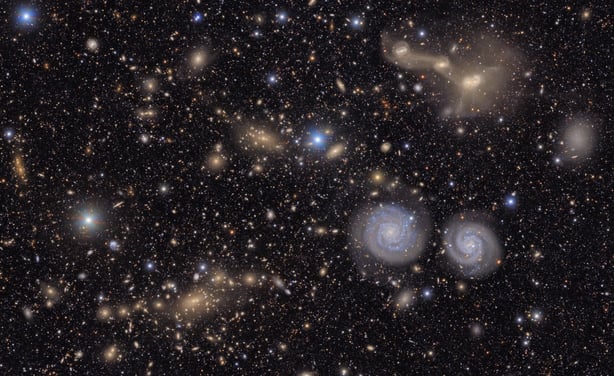
The first-light image of the Vera C. Rubin Telescope. A spectacular image of similar quality to Hubble, but covering a region of space about 250 times that of a typical Hubble image. Credit: Vera C. Rubin Observatory
In tandem, a small armada of new telescopes will launch into space. In October, NASA’s Nancy Grace Roman Space Telescope – in many ways the successor to Hubble – will investigate dark matter and energy and search for exoplanets with 100 times the scope of Hubble. China launches its first Xuntian Space Telescope to probe the Cosmos at Hubble quality but with images 300 times the size. Orbiting close to their Tiangong space station, Xuntian will be serviceable by astronauts for many years.
ESA is a leader in space science and in December launches the PLATO space telescope to search for Earth-like planets around Sun-like stars. All of these marvels of science and engineering built to investigate our next great questions about the origin, nature and fate of the Universe and of life everywhere, too.
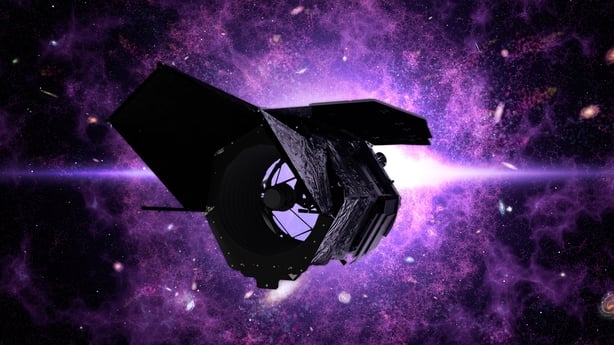
The Nancy Grace Roman Space Telescope. A natural successor to Hubble and set to provide stunning new views of the Universe. Credit NASA
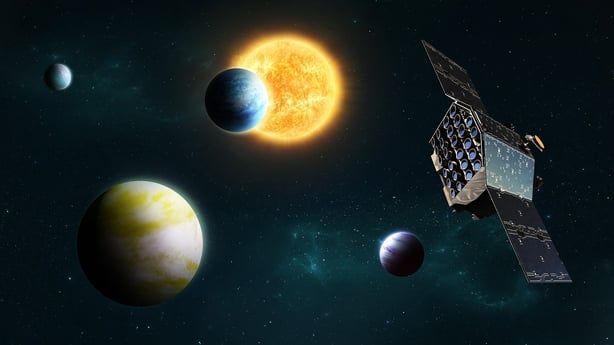
PLATO: A space telescope by ESA specifically to search for Earth-like planets around Sun-like stars. Credit: ESA
Of the many exciting planetary missions this year, two stand out: Japan’s MMX will travel to Mars’ tiny moon Phobos, to collect samples from the surface and return them to Earth in 2031, while ESA’s Hera arrives at the binary asteroids Didymos and Dimorphos in November to examine the aftermath of NASA’s DART space probe, which intentionally crashed into Dimorphos in 2022, all toward understanding how to deflect harmful asteroids from Earth impact.
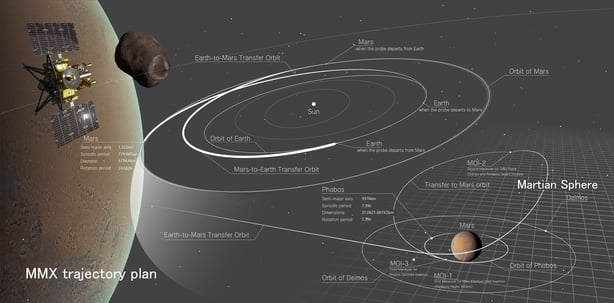
MMX, Japan’s Sample Return Mission to Mars’ moon Phobos whose returned samples will provide unprecedented insight into Phobos, and lay the foundations for a sample return mission from Mars’ surface. Credit: JAXA
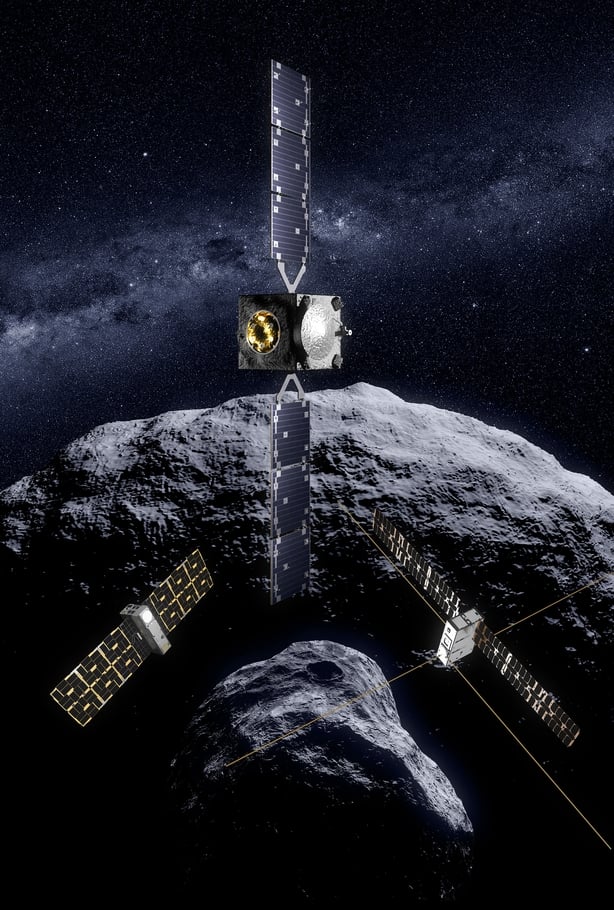
HERA, a space probe visiting the near Earth asteroids Didymos and Dimorphos to provide spectacular views, and with two small CubeSats subsurface radar of the impact left by NASA’s DART mission which intentionally crashed into Dimorphos in 2022. Credit: ESA
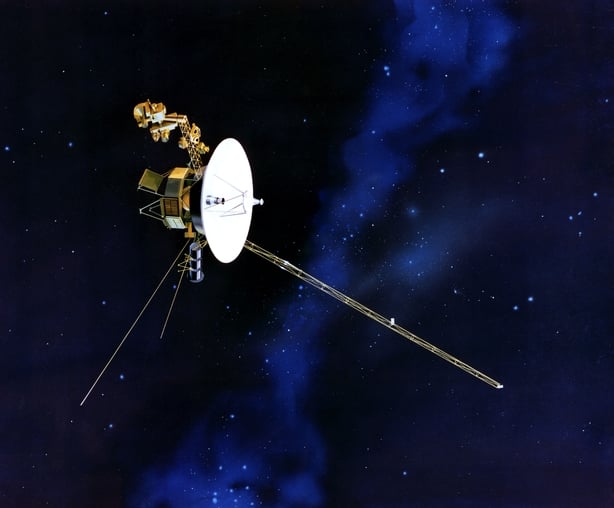
Voyager 1. Launched in September 1977 and visited Jupiter in March 1979 and Saturn in 1980, revolutionising our view and understanding of those planets and the outer Solar System. Now in interstellar shape, it will reach the milestone distance of 25.9 billion kilometres from Earth on November 15th 2026, meaning light (and radio) takes one day to travel between Earth and the space probe. Voyager 1 will travel out into the Milky Way galaxy and is expected to last for a billion years or more. Credit: NASA
Finally, November 15 sees the Voyager 1 spacecraft, launched in 1977, reach a distance of 1-light-day from Earth – a distance milestone that will be headline news.
Follow RTÉ Brainstorm on WhatsApp and Instagram for more stories and updates
The views expressed here are those of the author and do not represent or reflect the views of RTÉ