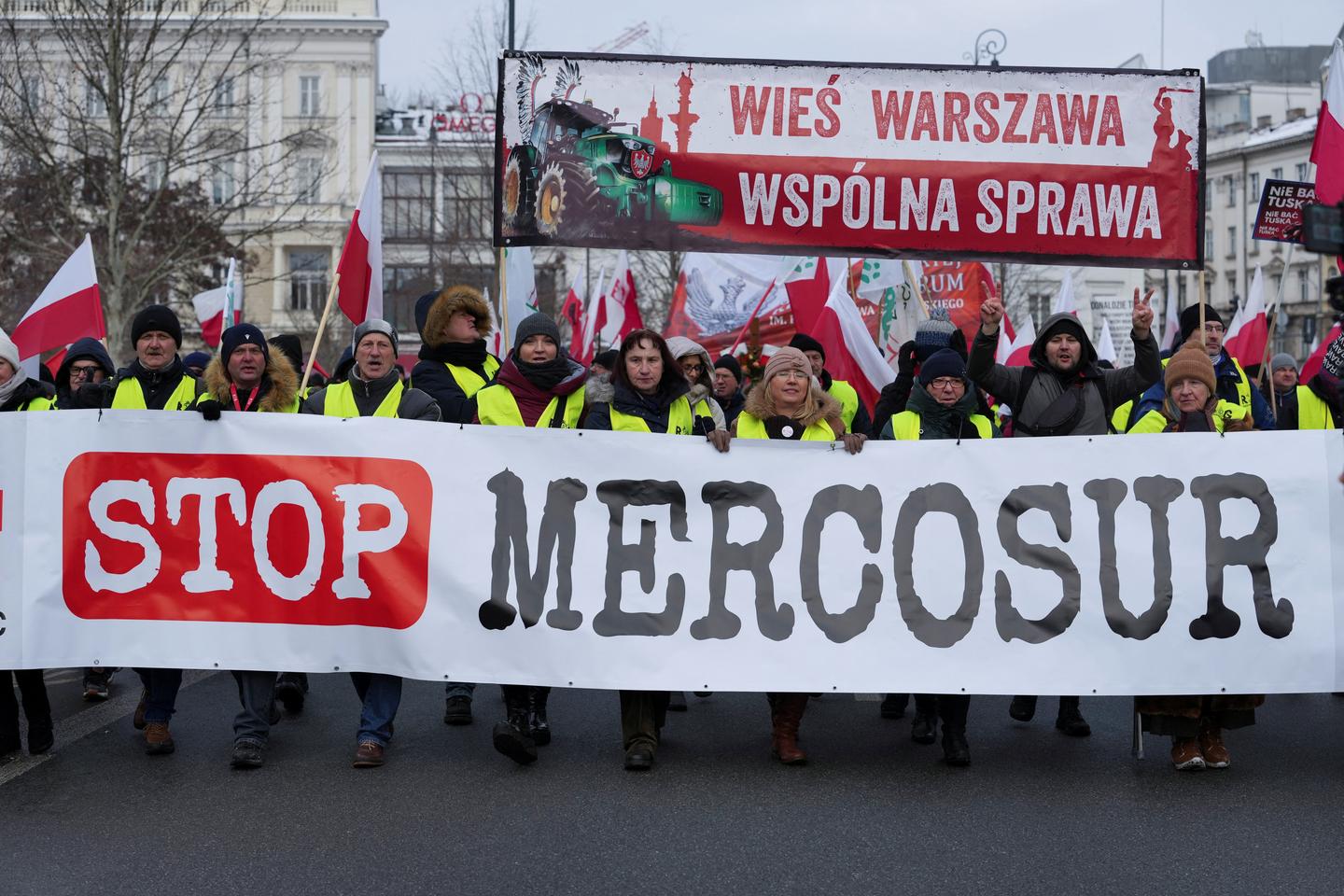
After more than 25 years of negotiations, the European Commission is scheduled to officially sign the free trade agreement between the European Union and the Mercosur countries on Monday, January 12, in Paraguay. Despite voting against it, France was unable to prevent its adoption during a final meeting of European diplomats on January 9.
The agreement with Brazil, Argentina, Paraguay, Uruguay and Bolivia is being presented by Brussels as a major economic and geopolitical tool for the EU. Nevertheless, it faces particularly broad opposition in France, where it has crystallized concerns among the agricultural sector, environmentalists and the entire political class.
What exactly does this trade agreement contain? Why is it facing such strong rejection in France? And could Paris’s stance still affect its implementation? Here are five key points to understand the situation.
What is the agreement about?
This is a free trade treaty that has been under negotiation for more than a quarter of a century between the EU and the Mercado Comun del Sur, or Mercosur (“Southern Common Market”), a South American trade bloc that includes Brazil, Argentina, Paraguay, Uruguay and Bolivia (though the latter joined the group late and is not participating in the agreement).
The treaty contains several measures designed to facilitate trade between the two regions: the gradual elimination of almost all tariffs, legal protection against the imitation of 344 European products (such as roquefort, comté or champagne) and the creation of new import quotas in Europe, notably for South American beef (99,000 metric tons per year).
The EU hopes to boost exports of European goods – cars, clothing, wines – which currently face high tariffs in Mercosur countries. With 780 million consumers and between €40 billion and €45 billion in annual imports and exports, it could become the largest trade agreement ever signed by the EU, and a way for the bloc to diversify its markets amid ongoing tensions with the United States and China.
Although the agreement was finalized on June 28, 2019, it was never signed because of hesitations from several countries on both sides of the Atlantic, including France, which have so far blocked its official signing.
Why is it contested in France?
In France, the EU-Mercosur agreement faces near-universal opposition from all political forces, ranging from the radical left to the far right, as well as from the main agricultural unions.
Partner service
Learn French with Gymglish
Thanks to a daily lesson, an original story and a personalized correction, in 15 minutes per day.
Try for free
Help us improve Le Monde in English
Dear reader,
We’d love to hear your thoughts on Le Monde in English! Take this quick survey to help us improve it for you.
Take the survey
New
Le Monde’s app
Get the most out of your experience: download the app to enjoy Le Monde in English anywhere, anytime
Download
The criticism centers on the risk of a massive influx of South American products, particularly beef, which is seen as unfair competition for French farmers. Beef produced in Brazil or Argentina is significantly cheaper than European beef, due to lower production costs (land, labor, animal feed) and less stringent health and environmental regulations (the use of pesticides and antibiotics).
These differences in standards have also drawn criticism from environmentalists. They argue that the agreement could increase long-distance trade, raise greenhouse gas emissions, encourage Amazon deforestation and endanger consumer health by allowing products that do not meet European standards to be imported.
What is France’s position?
French President Emmanuel Macron initially supported the agreement when it was concluded in June 2019. At that time, he claimed to have prevented Jair Bolsonaro, then president of Brazil (2019-2023), from pulling out of the Paris climate accord as the far-right leader had threatened to do, on top of securing the inclusion of a clause that would compel Brazil to uphold its climate commitments.
But just a few weeks later, in August 2019, Macron reversed course during the G7 summit in Biarritz. As fires ravaged the Amazon, Macron criticized his Brazilian counterpart’s inaction on climate and biodiversity, and decided to withdraw French support from the EU-Mercosur agreement.
Since then, without rejecting the project outright, France has advocated for renegotiation to include stronger protections for the environment and for European farmers. Paris has specifically demanded the introduction of mirror clauses, which would require identical standards for goods traded between the EU and Mercosur.
The French government has also called for tougher safeguard clauses – a mechanism that allows the Commission to temporarily reinstate tariffs if the trade of certain sensitive products (such as poultry, beef, sugar, ethanol) surges, thus risking market destabilization. France proposed that this clause be triggered if import volumes rose by more than 5% or prices fell by more than 5% compared to a three-year average. In December 2025, member states and the European Parliament ultimately agreed on a less stringent threshold of 8%.
Read more Subscribers only EU-Mercosur agreement: Do Brussels’ latest measures offer greater protection? Now that it’s been voted on, is the deal done?
Despite its efforts, France failed to convince enough countries to form a blocking minority during a Brussels meeting of EU ambassadors on January 9. As a result, the agreement is set to be officially approved by a written vote of the 27 member states by the end of the day.
While nothing now prevents European Commission President Ursula von der Leyen from flying to Paraguay on Monday to sign the agreement on behalf of the EU, the process is not yet complete. “The outcome is not set in stone,” regardless of the result of the January 9 vote, insisted Jean-Noël Barrot, the French foreign minister, in an interview with the radio station France Inter on Wednesday.
Indeed, for the agreement to be ratified, it must still be approved by the European Parliament, where a majority is not guaranteed. The agreement could, however, enter into effect before that vote, under a “provisional application” mechanism, as explained by the media network Euractiv – with the risk that it could later be scrapped if MEPs reject it.
Another obstacle could further complicate the agreement’s future: a lawsuit before the European Court of Justice challenging the legality of the ratification procedure chosen by the European Commission, which some see as a way to bypass opposition from Paris and from certain national parliaments. France or the European Parliament could initiate such a review, potentially delaying the process for several months – or even derailing it, should the court rule against it.
Can France refuse to apply this treaty?
Despite Paris’s “no” vote on the EU-Mercosur agreement, France cannot, on its own, block its adoption or refuse to implement it. Trade policy falls under the exclusive authority of the EU. The European Commission negotiates on behalf of the 27 member states, based on a mandate granted in 1999 by the member states, including France.
The French “no” was mainly of domestic political value. Macron and the government were seeking to respond to almost unanimous opposition on the issue and ongoing protests from farmers. However, this position has not been enough to ease criticism, as both the Rassemblement National and La France Insoumise have announced their intention to submit a motion of no confidence against the Lecornu government, condemning the president’s failed opposition strategy.
Translation of an original article published in French on lemonde.fr; the publisher may only be liable for the French version.