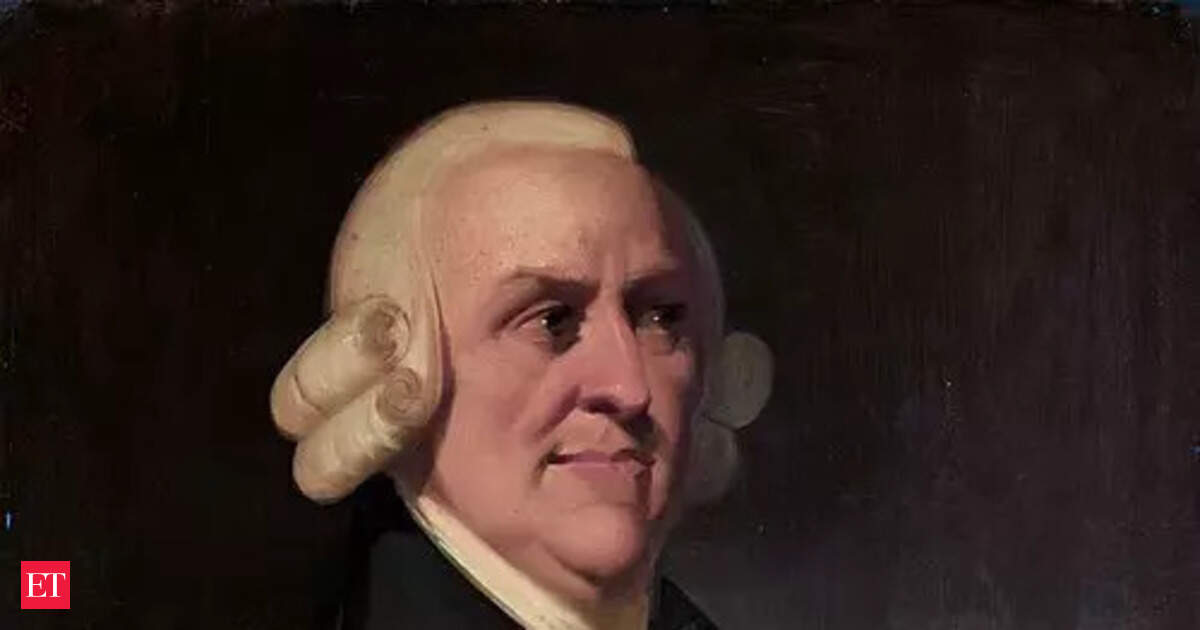
Quote of the Day: A powerful Quote of the Day does more than sound wise; it asks us to pause and examine how we think, judge, and act in our everyday lives. Some quotes endure not because they offer easy answers, but because they unsettle comfortable assumptions. Among the great thinkers of the Enlightenment, Adam Smith is often remembered as the father of modern economics. Yet long before his ideas shaped markets and governments, Smith was deeply concerned with the inner life of individuals, how people understand themselves, regulate their emotions, and make moral judgments. His reflections on self-knowledge and moral awareness remain strikingly relevant in an age defined by quick opinions and constant reaction.
The importance of a Quote of the Day lies precisely in this capacity to slow us down. In a world driven by speed, certainty, and public performance, thoughtful quotes remind us that wisdom begins internally. They invite reflection rather than reaction, humility rather than dogmatism. Adam Smith’s words on self-knowledge speak not only to personal ethics but also to social harmony, suggesting that many conflicts we experience outwardly are rooted in unresolved tensions within ourselves. Live Events
Quote of the Day Today January 5The Quote of the Day today by Adam Smith is, “The first thing you have to know is yourself. A man who knows himself can step outside himself and watch his own reactions like an observer.”
This insight reflects Smith’s broader philosophy far beyond economics. Adam Smith’s legacy is not merely economic but moral, a reminder that progress, fairness, and prosperity ultimately depend on the character and self-understanding of individuals. As a Quote of the Day, his reflection on knowing oneself invites us to begin every judgment, and perhaps every reform, by looking inward first.
Early Life and Family Background
Adam Smith was baptized on June 5, 1723, in Kirkcaldy, Fife, Scotland, and died on July 17, 1790, in Edinburgh. He was a Scottish social philosopher and political economist whose work helped lay the foundations of classical liberalism. While he is best known for An Inquiry into the Nature and Causes of the Wealth of Nations (1776), Smith himself saw that book as part of a much larger moral and social framework, as per information sourced from Britannica.Education and Intellectual Formation
Smith was the son of Adam Smith, a comptroller of customs, and Margaret Douglas, the daughter of a landowner. Raised in the small but thriving fishing village of Kirkcaldy, Smith’s early life was quiet and largely undocumented, though stories from childhood hint at his absent-minded temperament even at a young age. At just 14, he entered the University of Glasgow, where he was profoundly influenced by Francis Hutcheson, a moral philosopher whose teaching helped shape Smith’s lifelong interest in ethics, sympathy, and human nature.
After graduating, Smith traveled to Oxford on a scholarship, studying at Balliol College. Although he found Oxford intellectually stagnant, those years sharpened his habit of independent study. Upon returning to Scotland, Smith began delivering public lectures in Edinburgh, covering subjects ranging from rhetoric and history to moral philosophy and economics. These lectures led to his appointment as a professor at the University of Glasgow, first in logic and later in moral philosophy, as per information sourced from Britannica.
Moral Philosophy and Lasting Intellectual Legacy
It was during his Glasgow years that Smith experienced what he later described as the happiest period of his life. He taught demanding courses, engaged with students and colleagues, and socialized with leading figures of the Scottish Enlightenment, including his close friend David Hume. In 1759, Smith published The Theory of Moral Sentiments, a work that explored how humans form moral judgments and regulate their behavior. This book introduced the idea of the “impartial spectator,” an inner observer through which individuals judge their own actions, a concept that directly echoes today’s Quote of the Day.
Smith’s later masterpiece, The Wealth of Nations, expanded these moral ideas into the economic and social realm, examining how self-interest, competition, and institutions interact within society. Yet at its core, Smith’s philosophy remained focused on human character, restraint, and self-awareness. He never viewed markets as purely mechanical systems but as extensions of human behavior, shaped by moral psychology as much as by material incentives, as per information sourced from Britannica.
Quote of the Day Meaning
The meaning of Adam Smith’s Quote of the Day lies in its emphasis on self-knowledge as the foundation of moral judgment. When Smith writes that one must first know oneself, he is pointing to an essential discipline: understanding one’s own motives, biases, and emotional reactions before passing judgment on others or the world at large.
To “step outside oneself” and observe one’s reactions like an outsider is, in Smith’s philosophy, the work of the impartial spectator. This inner observer allows individuals to question whether their anger is justified, whether their certainty is earned, or whether their judgment is clouded by self-interest. Without this reflective distance, people risk confusing impulse with principle and conviction with truth, as per information sourced from Britannica.
The quote also suggests that many social conflicts are rooted in unexamined inner struggles. When individuals lack self-awareness, they project unresolved tensions outward, turning personal discomfort into moral certainty. Smith believed that a stable society depends not only on laws and institutions but also on citizens capable of self-restraint, sympathy, and reflection. In this sense, knowing oneself becomes a civic virtue, not merely a private one.
In modern life, where opinions are often formed and broadcast instantly, Smith’s words serve as a reminder that wisdom requires pause. Self-knowledge does not eliminate disagreement, but it tempers it with humility. It encourages dialogue rather than dogmatism, understanding rather than reflexive blame. The ability to observe oneself honestly, Smith believed, is what allows individuals to live ethically within a complex social world, as per information sourced from Britannica.
Iconic Quotes by Adam Smith
Beyond today’s Quote of the Day, Adam Smith left behind many lines that continue to shape moral, political, and economic thought. Together, these quotes reveal a thinker deeply attuned to both human limitations and human potential. These quotes are taken from Goodreads.
“Mercy to the guilty is cruelty to the innocent.”
“Never complain of that of which it is at all times in your power to rid yourself.”
“No society can surely be flourishing and happy of which by far the greater part of the numbers are poor and miserable.”
“It is not very unreasonable that the rich should contribute to the public expense, not only in proportion to their revenue, but something more than in that proportion.”
“Virtue is more to be feared than vice, because its excesses are not subject to the regulation of conscience.”
“All for ourselves, and nothing for other people, seems, in every age of the world, to have been the vile maxim of the masters of mankind.”
“The learned ignore the evidence of their senses to preserve the coherence of the ideas of their imagination.”
“It is not from the benevolence of the butcher, the brewer, or the baker that we expect our dinner, but from their regard to their own interest.”