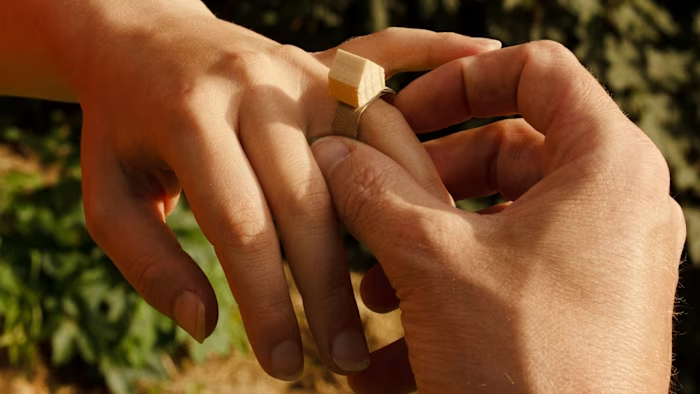
At HomeView of Graceland: The Absence of Elvis
Photography by William Eggleston, words by Winston Eggleston
 The complete Graceland portfolio, ‘Untitled, 1983-84’, consists of 11 dye transfer prints © Eggleston Artistic Trust. Courtesy Eggleston Artistic Trust and David Zwirner
William Eggleston was both an obvious and strange choice of the estate of Elvis Presley to photograph Graceland. Both men were born in the 1930s and raised in Mississippi, the border of which is mere miles from Graceland. My dad, who has played piano since he was four years old, is a great lover of classical music, particularly Bach. Yet, in truth, he wasn’t a fan of Elvis.
About five years after Elvis died, the estate contacted Dad to photograph Graceland. The commission was initially for the publication of a small book to be sold as a souvenir in the gift shop. It had pictures of the grounds, interiors and many possessions Elvis left behind. Elvis was 42 years old when he died in 1977 at his home. Graceland was a postbellum mansion built in 1939 that he purchased in 1957. Since then, the musician’s compound had become an enduring symbol of Memphis, opened to the public as a museum in June of 1982 to much fanfare. After the book was published, Dad decided to have larger prints made of some of the images. In co-operation with the estate, he then published the portfolio Graceland, which comprised 11 20”x24” dye-transfer prints.
My dad had never met Elvis, but he met several times with his widow Priscilla Presley, who agreed to let him photograph the ground floor of the house in the evenings, after it was closed to the public. She gave him an extensive tour of the property and shared her memories with him. Dad took the photographs at Graceland between 1983 and 1984. My siblings and I accompanied and assisted him on a number of occasions. At the time, Elvis’s aunt Delta actually still lived there.
Photographing this commission was tricky because my dad’s work is democratic and neutral. The irony is that the end results symbolise a particular strain of American success and tragedy.
 Untitled, 1983-84 © Eggleston Artistic Trust. Courtesy Eggleston Artistic Trust and David Zwirner
 Untitled, 1983-84 © Eggleston Artistic Trust. Courtesy Eggleston Artistic Trust and David Zwirner
 Untitled, 1983-84 © Eggleston Artistic Trust. Courtesy Eggleston Artistic Trust and David Zwirner
“William Eggleston: The Last Dyes” is at David Zwirner New York from January 15
KAZ/KÒ
By Nathyfa Michel
 Installation view of KAZ/KÒ © Nathyfa Michel
In Régina, on the quiet banks of the Approuague river, French Guiana, houses disappear the same way people do: not abruptly, but through a gradual fading. The village has been hollowed out by a rural exodus towards the capital Cayenne or to mainland France, by land disputes, abandonment and plots being reclaimed for unpaid taxes. My family was among those who left early, leaving behind our home, our grandmother and part of our history.
In French Guiana, a colony turned French department in 1946, the French state still owns 90 per cent of the land. Today, the municipality of Régina conducts an extensive (though often opaque) campaign to recover vacant plots. Throughout the town, signs announce an “owner’s absence”; after a year’s notice, the land is reclaimed by the commune. Ours is one of the last houses still standing in the village centre. Although legally ours, it was slated for demolition to “make space” in a place already emptied.
My project KAZ/KÒ emerged in response to this news. Built by a grandfather I never knew, the house holds some of the missing pieces of a fragmented family history. Faced with its looming disappearance, I staged an in situ installation intended to reactivate the house’s layered memories. The installation soon became a playground to experiment with ways of reconnecting my body to the house’s invisible presences. I revisited mourning rituals, listened for forgotten memories caught in spider webs or scattered in termite nests. I sang, sweated and wept as I assembled on the wall an archival collage that functioned as both photographic shroud and record.
At the centre of the house, an altar gathers objects found on site and items left by visitors. It grows and expands continually, becoming a shared space where a constellation of memories converge as a quiet act of resistance against erasure.
Since its inception in spring 2025, KAZ/KÒ has evolved into a space for exchange. After collaborating with me on the installation, my father returned from Europe to settle back in Régina, now using the space to pass on his knowledge of craft — especially calabash engraving — and his invaluable memories of French Guiana. Even under threat of demolition, KAZ/KÒ stands strong as a site of transmission.
The installation “KAZ/KÒ” is open daily, nathyfamichel.com/galerie-kaz-ko and is part of The International Biennial of Photographic Encounters of French Guiana www.rencontresphotographiquesdeguyane.com until 26 January
Conditions of living
By Anthony Luvera
 ‘Like a blade of light, its glass fin protruding dramatically’, The Relay Building, Aldgate, London © Anthony Luvera
“Conditions of living” examines the rise of economic segregation in housing developments, a phenomenon commonly referred to as “poor doors”. Created in collaboration with a community forum of residents in Tower Hamlets, east London, this socially engaged project draws on extensive research into the social, political and economic evolution of market-driven “affordable” housing and the state of social housing today.
Brought together from almost 1,000 households in eight developments, participants in the Conditions of Living Community Forum have a range of housing tenure backgrounds, from social and affordable rental accommodation to shared and sole ownership. Through photography, sound recordings and facilitated discussions, we explored how economic segregation operates in daily life, and how restrictions extend beyond separate entrances to influence access to amenities, resources and public space. Workshops and individual meetings invited participants to consider why segregated entrances exist and how architecture and planning shape access to essential social rights, including healthcare, education, culture, transport and environment.
 Handwritten texts by Conditions of Living Community Forum participants © Anthony Luvera
 © Anthony Luvera
 © Anthony Luvera
 © Anthony Luvera
Segregation in housing developments can manifest in many ways: physically separate entrances; floors reserved for non-market-rate units; isolated lifts or internal sections; entire blocks designated for specific tenures; and restricted communal facilities. Local authorities continue to permit developers to embed such divisions into new schemes. Despite public criticism, London remains one of the few major global cities yet to ban “poor doors”.
 Billboard installation of ‘Housing For People or Profit?’, Roman Road, Bethnal Green, London © Anthony Luvera
The built environment plays a powerful role in determining the ways people live together. Architecture and planning can be used to enforce social inequalities through the privileging of market forces, resulting in discrimination and segregation. “Conditions of Living” brings together research and the experiences of those living in the buildings to construct an image of this much discussed, yet often invisible phenomenon. The project invites us to reflect on these convoluted systems and contemplate alternative possibilities for housing conditions, communal living and collective action.
“Conditions of Living” by Anthony Luvera is published by Dulwich Road Studio Press
War Rooms
By Christopher Nunn
 © Christopher Nunn
These photographs were taken around the Kharkiv region of Ukraine immediately before and after the 2022 eastern counteroffensive that liberated thousands of square kilometres from Russian occupation.
Around this time I was working on the documentary film Intercepted, and the crew and I were staying in Kharkiv city, which was being frequently attacked. We encountered these spaces while filming around the city, as well as in smaller towns and villages in the region. Sometimes the people who lived there showed us inside, but most of the time these houses had simply been left abandoned.
The photographs were taken quickly from an open doorway without disturbing the scene. In many cases the buildings weren’t structurally safe, and in some of the towns that had recently been liberated the houses hadn’t been properly checked for explosives or mines left by Russian forces.
 © Christopher Nunn
 © Christopher Nunn
These domestic spaces have been transformed by conflict, whether by damage from missile strikes, ground combat, looting, military occupation or by the residents themselves surviving invasion. Within them we see remnants of past lives and traces of human behaviour, fragments of possible narratives among the chaos of Ukraine’s deadly new reality.
Further east, in the Donbas region, the scale of destruction is worse than anywhere else.
Recommended

I’ve spent a lot of time here over the past decade, and have fond memories of countless birthdays, holidays and gatherings of family and friends around dining tables in rooms just like these. Almost all these towns are now destroyed, occupied or at the very edge of the ever-advancing frontline.
The idea of home is a frequent topic of discussion. Where is home and what does it mean when your house, street and city no longer exist?
From HomeResident aliens
By Guanyu Xu
 ‘RK-08282018-01142022’, 2022 © Guanyu Xu
What constitutes a home for immigrants, and how can photography counter the precarity produced by political systems?
Resident Aliens presents physical photographic installations within immigrants’ interior spaces to examine their personal histories. By photographing layered arrangements of domestic environments, belongings, personal archives and images made by my collaborators across the world, the project blurs the boundaries between familiar and foreign, public and private, belonging and alienation. The work felt particularly urgent to make, set amid the global rise of neo-nationalism.
Since 2020, I have collaborated with more than 40 individuals living in Chicago, East Lansing, New York, Hong Kong, Beijing, Nanjing and Shanghai. Participants come from a wide range of countries and regions, including Brazil, China, Colombia, Egypt, Germany, India, Israel, Malaysia, South Africa, South Korea, Sweden and the United States. The project seeks to create diverse representations of immigrant legal statuses and living conditions, and I continue to expand its geographic scope to include additional perspectives.
 AK-08102008- 05032021’, 2021 © Guanyu Xu
 JY-01202013-07252021, 2021 © Guanyu Xu
Collaboration is central to the project, functioning as both a social and artistic practice. Through sustained conversation, I work with participants to represent their layered identities. Entering their domestic spaces as an outsider, I transform these often temporary environments into site-responsive installations, which are then preserved through photography.
Bringing together ideas about the temporality of photography, of immigration status, and of identity, the project emphasises the contradiction inherent in representation, both photographic and legal. The result is situated somewhere between photography, installation and performance.
I want to ask: in this interconnected world, how do we redefine citizenship and the legality of a person?
A reasonable degree of likelihood
By Tudor Rhys Etchells
 Untitled, Grand Hotel Scarborough, England, 2022 © Tudor Rhys Etchells
 With immediate effect we are no longer undertaking Legal Aid Agency funded work, Scarborough, England 2022 © Tudor Rhys Etchells
Immigration law decides who can settle in the UK and call it home. It is one of the most complicated areas of legal practice. I worked in the system for eight years as a lawyer for asylum seekers and other vulnerable migrants. For the final three, I attempted to document a bureaucracy that remains hidden to most. In my role, I had to mediate my client’s reality by questioning their traumatic experiences in order to construct a narrative to present to the Home Office. I became concerned with my own position as a legal representative, which led me also to question who can be photographed by whom and the power dynamics of those interactions.
To me, the photograph and the law are both frameworks for negotiating evidence, belief and knowledge. I was, and remain, frustrated by the sensationalist imagery used to represent those fleeing persecution both in news stories and by documentary and fine art photographers. By turning the camera to the brutal mundanity of the legal structures that determine their lives, I encourage the viewer to question the law itself.
 ‘Offshoring as Reality’, 2022 © Tudor Rhys Etchells
 ‘The Third Policeman’, 2023 © Tudor Rhys Etchells
Backlogs meant that my clients were stuck in limbo, often hundreds of miles away from me and other legal representatives, in remote coastal towns of England and Wales. This temporary accommodation, as well as my own office, was where the absurdity of unending administrative demands played out.
The photographs themselves became spaces of dark humour, a coping mechanism for those entwined in the system. I adopted a visual language designed to mock the attempts of documentary photography to represent truth. By putting myself in front of the camera, I acted out the contradictions of performing for the system, against the system and as the system. By breaking the fourth wall, I wanted to subvert photographic and legal portrayals of truth. In refugee law, you must prove that there is a “reasonable degree of likelihood” of harm upon being returned home. In the photograph, there is no burden of proof.
 ‘Self- Portrait as Young Legal Aid Lawyer’, 2022 © Tudor Rhys Etchells
 Untitled, Grand Hotel, Scarborough, 2022 © Tudor Rhys EtchellsDiscarded fruit
By Kalpesh Lathigra
 © Kalpesh Lathigra
At first the camp appears as colours against the dust. Then, lifting my gaze, I see plastic, orange tarpaulin, clothing bleached by the sun. These are hues that suggest people have already stayed too long.
It is 2013, and I am on commission for UNHCR, the United Nations High Commissioner for Refugees, documenting their work at the world’s largest refugee camp, Za’atari in Jordan, where Syrians have been seeking refuge since 2011 when the Syrian conflict began. What was meant to be temporary has become something else. Not quite permanent, but closer to that than temporary. The site now has paths that feel more like roads. A street is jokingly called the Champs-Élysées.
The title of the series “Discarded Fruit” refers to one image from the refugee camp which shows fruit that is overripe, bruised, on the turn — not waste quite yet, but something removed from circulation. People in Za’atari exist in a similar condition: not destroyed, or erased, but paused, held at the edge of usefulness by a world uncertain what to do with them next.
 © Kalpesh Lathigra
I am taken back to my own family’s history. Nim, my wife, is a refugee, as are all her family. That word “refugee” stings. It has been stretched, appropriated, dulled. I now speak instead of people seeking refuge. Nim and her family were displaced from Uganda by Big Dada, Idi Amin, in 1972, when the dictator expelled Uganda’s Asian population. We regularly pore over what photographs remain in Nim’s family albums. This is where the memories of the displaced live.
In Za’atari an economy grows. On the main boulevard, hair is cut and meat is sold. Phones are repaired and weddings take place. Commerce does not signal recovery, it signals refusal. People insist on living even as the future remains abstract, indefinitely deferred. I am mesmerised by the people here.
I eat Syrian lunches and drink sweet tea, trying to cross my legs on the floors of their homes. They are my uncles and aunties, my brothers and sisters. That is my experience. Their traditions are mine; we are the same and this could have been me, it was Nim.
 © Kalpesh Lathigra
 © Kalpesh Lathigra
“The Lives We Dream in Passing” is at NCPA, Mumbai, India from February 12
Homesick
By Hrair Sarkissian
 ‘Homesick’, 2014, two-channel video installation
I made “Homesick” in 2013-14, at a time the war in Syria was escalating. My parents were refusing to leave Damascus. They were still living in the apartment I had grown up in, and where I had lived until I left Syria in 2008. Obviously most importantly it was the place that housed and sheltered my parents (my father has since passed away, but my mother is still living there today). In addition it was, and still is, the place where I feel I belong, a container for my memories and a place for my family’s collective identity. At the time, I was constantly in fear of what could happen: to my parents, to my history, to my country. The pre-emptive destruction of the house became a vessel for that fear. I recreated an architecturally exact scaled concrete model of the apartment building, a little over 2m high, and documented myself destroying it with a sledgehammer. It took me seven hours. The resulting video is built up of photographs taken after each hit. You don’t see me, so all that is visible is the building slowly imploding, accompanied by the sound of my hits.
Recommended

Like in much of my work, this project is not just about the space, but about the emotions and histories invested there. While my work often deals with traumatic events that happened before in a place but are now invisible, this project addresses the very real possibility of a loss before the event. I channelled all my rage, my fears and my feelings of hopelessness enacting a worst-case scenario in order to gain some control over the situation. Looking back, a little over a decade later, a lot has changed, but the work is still as relevant as ever. The fear of what could happen to our homes, to our existence, is still an ongoing nightmare for many.
 ‘Homesick’, 2014, two-channel video installation © Hrair Sarkissian
 © Hrair Sarkissian
 ‘Homesick’, 2014, two-channel video installation © Hrair Sarkissian
 © Hrair Sarkissian
 ‘Homesick’, 2014, two-channel video installation © Hrair Sarkissian
 © Hrair Sarkissian
Stolen Past by Hrair Sarkissian is at Ibraaz, London from March 25 ibraaz.org
Rethinking HomeKitchen table series
By Carrie Mae Weems
 ‘Untitled (Woman Standing Alone)’ © Carrie Mae Weems. Courtesy of the artist and Gladstone, New York, Fraenkel Gallery, San Francisco, and Galerie Barbara Thumm, Berlin
 ‘Untitled (Woman Playing Solitaire)’ © Carrie Mae Weems. Courtesy of the artist and Gladstone, New York, Fraenkel Gallery, San Francisco, and Galerie Barbara Thumm, Berlin
For this 1990 series, Carrie Mae Weems staged and photographed a fictional drama in which she plays the lead. The setting is always the same: a small room with a table and a single overhead light. Other cast members play lovers, friends and daughters.
From this modest set-up, the artist creates an entire world. The kitchen, traditionally considered a female space, has rarely been pictured as a site of importance. Weems turns this idea on its head. She suggests the kitchen table is the stage where life’s biggest moments play out, and where the full range of human emotions is expressed.
 ‘Untitled (Woman and Daughter with Make-Up)’ © Carrie Mae Weems. Courtesy of the artist and Gladstone, New York, Fraenkel Gallery, San Francisco, and Galerie Barbara Thumm, Berlin
 ‘Untitled (Woman Brushing Hair)’ © Carrie Mae Weems. Courtesy of the artist and Gladstone, New York, Fraenkel Gallery, San Francisco, and Galerie Barbara Thumm, Berlin
The series compellingly examines women’s lives. It boldly asserts, in particular, Black womanhood’s complexity, strength and beauty. Reflecting on it in an interview in 2017, Weems said: “I think the images are more current now than ever before, and I’m still very much aware of the ways in which women are discounted. They’re undervalued within the world generally, and within the art world in particular. I think it’s one of the reasons that the series still proves to be so valuable, or invaluable, to so many women, and not just Black women, but white women and Asian women; and not just women, but men as well, have really come to me about the importance of this work in their lives. I find it remarkable.”
Carrie Mae Weems presents “Contested Sites of Memory” at the Lincoln Center, New York, on January 29-30. “Carrie Mae Weems: Something Grander Still” will be at AGBS at the University of Texas at Austin from Jan 30-May 29. “The Heart of the Matter” is at FOMU Antwerp from March 20-Aug 23 before travelling to C/O Berlin from September 12
 ‘Untitled (Girlfriends Triptych 2)’ © Carrie Mae Weems. Courtesy of the artist and Gladstone, New York, Fraenkel Gallery, San Francisco, and Galerie Barbara Thumm, Berlin
 ‘Untitled (Man Reading Newspaper Triptych 3)’ © Carrie Mae Weems. Courtesy of the artist and Gladstone, New York, Fraenkel Gallery, San Francisco, and Galerie Barbara Thumm, BerlinOne bed, two blankets, eighty-five rules
By Sabine Hess and Nicolas Polli
 © Sabine Hess and Nicolas Polli
We — Nicolas and Sabine — met each other in 2021 in Valle Verzasca at a photography festival in the south of Switzerland. We shared conversations, shy smiles, cheap beers, and what would later become the first of a long list of kisses. Coming from two different regions of Switzerland and living in two different countries, this place offered us a platform for exchange and togetherness.
The day after, with a slight hangover, we drove home together — and never really left each other’s side again. Although we continued to live in different places, we managed to preserve the initial connection found there.
 © Sabine Hess and Nicolas Polli
 © Sabine Hess and Nicolas Polli
Two years later, in 2023, we decided to move in together — or at least to give it a try. This marked the beginning of our first collaborative photography project, One Bed, Two Blankets, Seventy-Six Rules. Starting with an artistic residency, we took time to test our compatibility in living together. In a humorous and experimental way, we played with the norms and expectations surrounding our perception of a “relationship”. This approach allowed us to create a playful yet vulnerable body of work, in which we confront both the joys and the struggles of learning how to share a space with each other.
 © Sabine Hess and Nicolas Polli
 © Sabine Hess and Nicolas Polli
The photographs are accompanied by a set of rules on how to live together more harmoniously. By bringing together these two elements — photography and text — we created a book. After the initial residency, we continued to work on the project, adapting it over time as our relationship evolved in the following years. The most recent edition, exhibited at Peckham 24 last year, was titled One Bed, Two Blankets, Eighty-Five Rules.
“One Bed, Two Blankets, Eighty-Five Rules” is published by Ciao Press
Find out about our latest stories first — follow FT Weekend Magazine on X and FT Weekend on Instagram