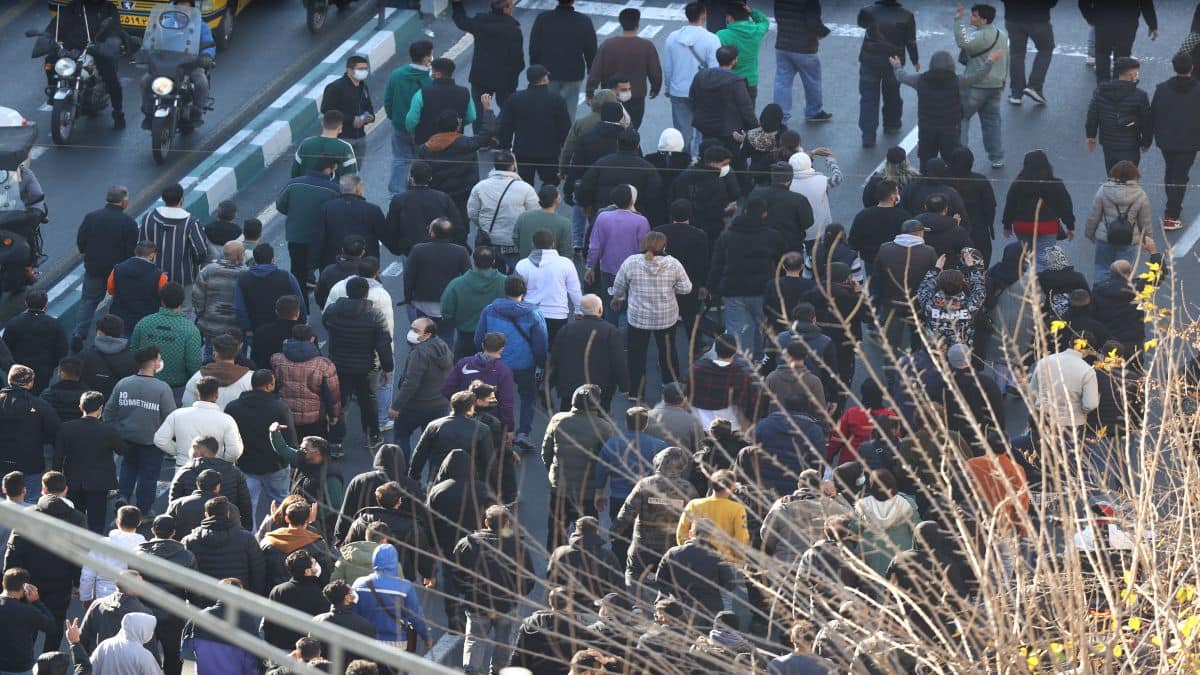
At least 538 people have been killed in a sweeping crackdown on nationwide protests in Iran, activists said, as Tehran warned the United States and Israel against any move to intervene in support of demonstrators.
A sweeping crackdown on nationwide protests in Iran has killed at least 538 people, with activists warning that the death toll is likely higher, as authorities issued sharp threats against the United States and Israel over any move to protect demonstrators.
The US-based Human Rights Activists News Agency said more than 10,600 people have been detained during two weeks of unrest. The group, which relies on a network of activists inside Iran who crosscheck information, has been considered reliable in previous waves of protests.
STORY CONTINUES BELOW THIS ADInformation blackout hampers verification
With internet services largely shut down and international phone lines cut, it has become increasingly difficult to assess the scale of the demonstrations from outside the country. Iranian authorities have not released official casualty figures, and the Associated Press said it could not independently verify the toll due to the communications blackout.
Activists abroad fear the shutdown has emboldened hard-liners within Iran’s security forces to intensify a violent crackdown. Despite this, protesters again took to the streets in Tehran and Iran’s second-largest city on Sunday.
Trump voices support for protesters
US President Donald Trump expressed support for the demonstrators, writing on social media that “Iran is looking at FREEDOM, perhaps like never before. The USA stands ready to help!!!”
According to two people familiar with internal White House discussions, Trump and his national security team have been weighing a range of responses, including cyberattacks and possible direct strikes by the US or Israel. The White House has not confirmed any decisions, while a large US military deployment to the Caribbean has added another strategic factor for planners.
Iran threatens US and Israel
The warning against the US and Israel came during a speech in parliament by Mohammad Baagher Qalibaf, the hardline speaker and former presidential candidate.
“In the event of an attack on Iran, both the occupied territory and all American military centers, bases and ships in the region will be our legitimate targets,” Qalibaf said. “We do not consider ourselves limited to reacting after the action and will act based on any objective signs of a threat.”
Lawmakers surged towards the dais chanting, “Death to America!”
It remains unclear how seriously Iran is considering military action, particularly after its air defences were badly damaged during a 12-day war with Israel in June. Any decision to escalate would ultimately rest with Supreme Leader Ayatollah Ali Khamenei.
Regional military posture
The US military said it is “postured with forces that span the full range of combat capability to defend our forces, our partners and allies and US interests” in the Middle East. Iran previously targeted US forces at Al Udeid Air Base in Qatar in June, while the US Navy’s 5th Fleet remains based in Bahrain.
An Israeli official said Israel was “watching closely” developments between Washington and Tehran. Israeli Prime Minister Benjamin Netanyahu also spoke with US Secretary of State Marco Rubio overnight, discussing Iran among other issues.
STORY CONTINUES BELOW THIS AD
“The people of Israel, the entire world, are in awe of the tremendous heroism of the citizens of Iran,” Netanyahu said.
International reaction
At the Vatican, Pope Leo XIV referred to Iran as a place “where ongoing tensions continue to claim many lives”.
“I hope and pray that dialogue and peace may be patiently nurtured in pursuit of the common good of the whole of society,” he said.
Protests continue despite pressure
Videos shared online, reportedly transmitted using Starlink satellite connections, showed demonstrators gathering in Tehran’s Punak neighbourhood, with streets blocked and protesters waving lit mobile phones. Others were seen banging metal objects as fireworks went off.
“The pattern of protests in the capital has largely taken the form of scattered, short-lived, and fluid gatherings, an approach shaped in response to the heavy presence of security forces and increased field pressure,” the Human Rights Activists News Agency said, adding that surveillance drones and security movements indicated tight monitoring.
Footage from Mashhad, Iran’s second-largest city, also suggested continued unrest, underscoring the persistence of protests despite the heavy crackdown.
End of Article