DEMONSTRATION:
Many European farmers fear their livelihoods would be undercut by a flow of cheaper goods from Latin American countries if the deal passes
Thousands of farmers in Ireland and France on Saturday protested against the EU’s trade deal with the South American bloc Mercosur, a day after EU states approved the treaty despite opposition from some members.
In central Ireland, tractors streamed into the roads of Athlone for a demonstration, displaying signs including “Stop EU-Mercosur” and with the EU flag emblazoned with the words “sell out.”
“We have good quality Irish beef and good standards here, and they don’t have the same standards in South American countries,” said Trisha Chatterton, a 50-year-old farmer. “There is not a lot of traceability on their beef.”
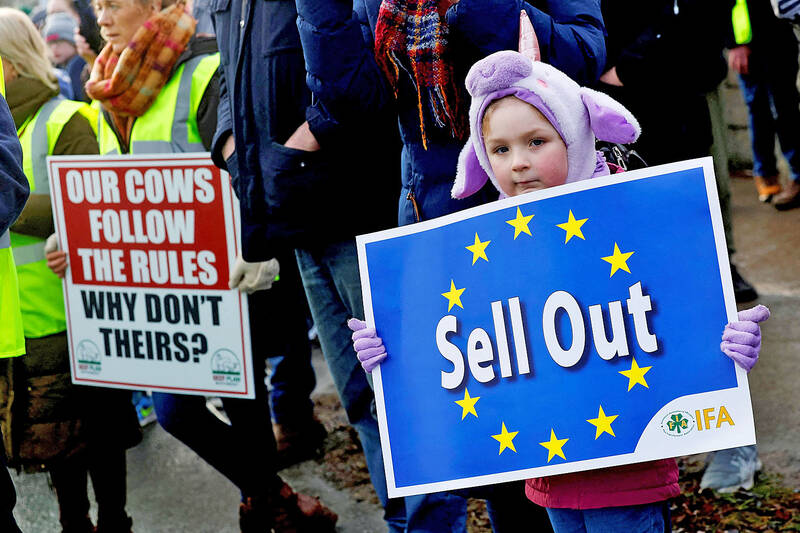
Photo: Reuters
The agreement is widely opposed by farmers for fear it would result in an influx of an extra 99,000 tonnes of cheap beef from South America, disrupting European agriculture.
The Irish Farmers’ Association (IFA), Ireland’s main farmers’ lobby group, called the result “very disappointing.”
It said it would “renew” focus on securing a majority against the deal in the European Parliament.
“We expect Irish MEPs [members of the European Parliament] to stand behind the farming community and reject the Mercosur deal,” IFA president Francie Gorman said in a statement.
In France, police on Saturday ejected farmers occupying a fuel depot near Bordeaux in the southwest.
Later in the day, other farmers tried to block road traffic to the port of Le Havre in the northwest. Two highways remained blocked on Saturday in the southwest of France, farmer unions said.
Farmers on Friday also marched in Poland, and blocked roads in France and Belgium as the EU gave the green light to the trade deal.
While the accord has been welcomed by business groups, European farmers have bitterly criticized it.
The deal, more than 25 years in the making, would create one of the world’s largest free-trade areas, boosting commerce between the 27-nation EU and the Mercosur bloc comprising Brazil, Paraguay, Argentina and Uruguay.
Major Mercosur exports to the EU include agricultural products and minerals, while the EU would export machinery, chemicals and pharmaceuticals with lowered tariffs applied.
Many European farmers fear their livelihoods would be undercut by a flow of cheaper goods from agricultural giant Brazil and its neighbors.
Such concerns prompted Ireland, France, Poland, Hungary and Austria to vote against the accord.
The Mercosur deal still has to be approved by a majority of MEPs in the European Parliament in the coming months, where voting coalitions have become more volatile and unpredictable.