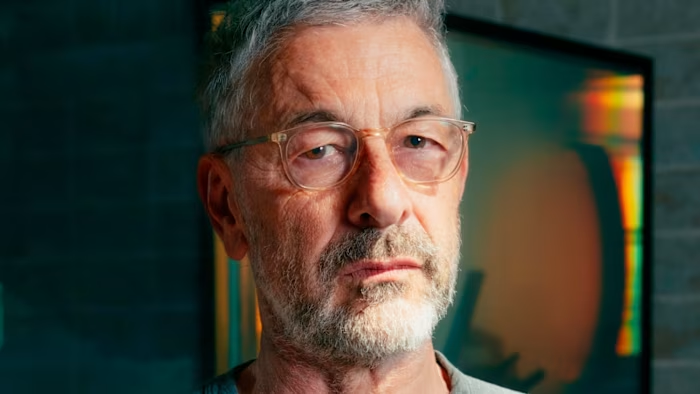
“I don’t care what you say about these quantum technologies,” the French conceptual artist Pierre Huyghe told Berlin-based curator Bettina Kames, “I don’t buy it.”
Quantum sensors and quantum computers exploit the workings of the world at the smallest achievable scale, where, among other oddities, particles may occupy more than one position at once. They perform calculations and take measurements that are otherwise fundamentally impossible. With them we could revolutionise drug discovery, secure global communications, understand the climate and accelerate artificial intelligence.
“People are usually fascinated and intrigued by this field,” says Kames, co-founder of LAS Art Foundation in Berlin, a roving gallery of future-facing, interdisciplinary work. Kames was out to commission a piece on the quantum realm but found Huyghe — an artist famed for his living installations that encompass aquariums, medicinal plants and Ibizan hounds — “quite critical”.
“Quantum science and technology is a battlefield,” Huyghe tells me from his studio in Santiago, Chile. He says this with some relish: despite his reservations, there is no denying his appetite for a field notorious for its “weirdness”. “Everything about it gets cast as analogy and metaphor because the researchers are still having a hard time putting their achievements into words and formulas. There is some agreement, but also a lot of argument.”
The problem, I suggest to the quantum physicist Tommaso Calarco — architect of the European Union’s quantum strategy, and collaborator on Huyghe’s latest artwork — is that we can’t simply point to the odd things that happen at such a tiny scale. The quantum realm involves structures smaller than the wavelength of light, so there’s no way we can actually experience them with our senses.
Only it turns out — as Calarco explains with a grin — that we can.
An atom throws off a photon whenever one of its electrons jumps with seeming randomness from one orbit to another; the human eye is sensitive enough to detect this constant flickering. “It’s the only time in your life you will ever see an effect without a cause.”
Back in the lab, Calarco’s job is to protect the parts of quantum computers from this sort of interference. He wondered how you could visualise working, not just with one atom, but with dozens arranged in a lattice, as in a quantum computer. “I had no idea Bettina had Pierre Huyghe on her list of potential collaborators. When I heard, I said: ‘I’m catching the first plane to Chile.’”
 ‘Zoodram 5,’ part of Huyghe’s series of living ecosystems installations set in aquariums © Courtesy of the artist/Marian Goodman Gallery
In Paris in 2013, Calarco, at a loose end, had wandered into Huyghe’s retrospective at the Centre Pompidou. “I was blown away by the depth of each piece, by their variety, by their overarching coherence.” One piece, “Zoodram 4”, featured a hermit crab living inside a replica of Brancusi’s “Sleeping Muse” sculpture. Rather than have a museum display his art, Huyghe’s art had taken over the museum. “It was overwhelming.”
Kames set up a Zoom call between the pair, and witnessed their instant connection. Huyghe talks now about Calarco’s “beautiful mind”; Calarco talks about Huyghe’s “genius”.
The proof will be in “Liminals”, a large-scale installation at Halle am Berghain, a vast industrial space adjoining the notorious Berlin nightclub, in which quantum properties are transposed into sensory information, encompassing film, sound, vibration, dust and light. The exhibition will be dominated by a “monstrous unthinkable”, Huyghe says — the faceless protagonist of an hour-long film, projected at an enormous nine metres by nine metres.
 A still from ‘Liminals’ , a large-scale installation at Halle am Berghain in which quantum properties are transposed into sensory information, encompassing film, sound, vibration, dust and light
“Pierre embraced the idea of using the quantum computer as an actual instrument,” Calarco explains. “We pluck the machine like a string.” The “string” here is the energy field between atoms. Pulling atoms away from each other yields a reverberation that can be picked up by an electrical circuit.
“For the first time, we’ll hear the sound of a quantum computer,” Calarco says. “It’s one of the biggest achievements of my career.”
“Liminals” is merely the latest stop on Huyghe’s magical mystery tour of a charming but indifferent cosmos. For Huyghe, fiction is often the lens through which we see reality most clearly — that idea has provided the artist with rich pickings throughout his career. Take 2002’s “L’Expédition Scintillante”, the fictional tale of an expedition to Antarctica, told through an epic exhibition comprising indoor fog, a melting ice ship, and a twirling ice skater.
“We construct fiction to turn chaos into cosmos. Fiction is our tool to survive,” Huyghe says. “Without it, we would be confronted with the reign of contingency. The world would be quite literally unthinkable. Fiction is a mask we put on everything, but at the same time it’s the lens bringing the world into focus.”
Other pieces have been artfully daft. In 1999, Huyghe and frequent collaborator Philippe Parreno purchased the rights from a Japanese design company to AnnLee, a wide-eyed purple-haired female manga character, for a few hundred dollars. They then handed over the avatar to other artists to use in any way they wished, creating animations in which AnnLee wanders a lunar landscape, or recites Philip K Dick’s Do Androids Dream of Electric Sheep? Finally, in 2002, AnnLee was “terminated”, buried in a coffin constructed out of parts from Ikea’s Billy bookcase.
Since the 2010s, Huyghe has been less interested in creating fictions; now his artworks pretty much force you to make up stories of your own.
 Pierre Huyghe’s ‘Untilled’ from 2012, a ‘live construct ecosystem’ that populated a compost heap with ant nests, psychotropic plants, a sculpture of a nude woman with a live beehive for a head and an albino dog roaming the installation
At the 2012 Documenta 13 exhibition in Kassel, Germany, he created “Untilled”, a “live construct ecosystem” in a compost heap, populating it with ant nests, psychotropic plants, a sculpture of a nude woman with a live beehive for a head, and an albino dog with a pink leg named “Human” that roamed the installation. The idea behind “Untilled” was to create an artwork that possessed a life of its own, separate from human attention.
Huyghe has been refining this proposition ever since. For 2018’s Uumwelt, at London’s Serpentine Gallery, he collaborated with informatician Yukiyasu Kamitani at Kyoto University, Japan, to read our minds — volunteers were asked to think of various images while inside an MRI scanner, with the brain data then fed through AI software which reconstructed those thoughts through its own bank of pictures. Keeping up with the blizzard of disjointed, surreal images spilling from five huge screens forced viewers into a hallucinatory state. People stumbled out convinced they’d seen something. No one could agree what it was.
Huyghe’s 2014 film “Untitled (Human Mask)” features a masked monkey, dressed as a young girl and trained as a waiter, tootling about an abandoned café. It is Huyghe’s most celebrated piece, and also the most misrepresented. Yes, it’s “about” being unaware of the role one plays in the world. But it’s much more a trap for the viewer: you can’t help but read human intentionality into what that monkey’s up to. You can’t help but make up stories.
 Huyghe’s 2014 film ‘Untitled (Human Mask)’ features a masked monkey, dressed as a young girl and trained as a waiter, tootling about an abandoned café © Courtesy of the artist/Anna Lena Films
“I think we are deeply chimeric and deeply monstrous and we’re made out of bits of mask. That is what I was trying to say,” Huyghe explains. “But it’s not a discovery that should be depressing! There’s joy to be had in being artificial.” Artifice is our species’ special talent, after all.
As Halle am Berghain resounds to the twanging of quantum-scale strings, Huyghe’s gigantic filmic protagonist tries to know itself. This generated figure, says Huyghe, is “a speculative fiction on a meaningless condition — a human-like membrane inseparable from the environment it is in.”
A knotty thought? Perhaps: but it’s bread and butter to a physicist like Calarco. When you look into the quantum realm, you see a world that doesn’t need you. So you try to understand it. You tell stories about it, come up with analogies, metaphors. “And you feel alive. You wake to your own agency, your own consciousness,” Calarco says. It’s what made him such an admirer of Huyghe’s art. “The work doesn’t try to sell you anything. It doesn’t need your attention. It interests you, and you make it yours.”
January 23-March 8, las-art.foundation
Find out about our latest stories first — follow FT Weekend on Instagram, Bluesky and X, and sign up to receive the FT Weekend newsletter every Saturday morning