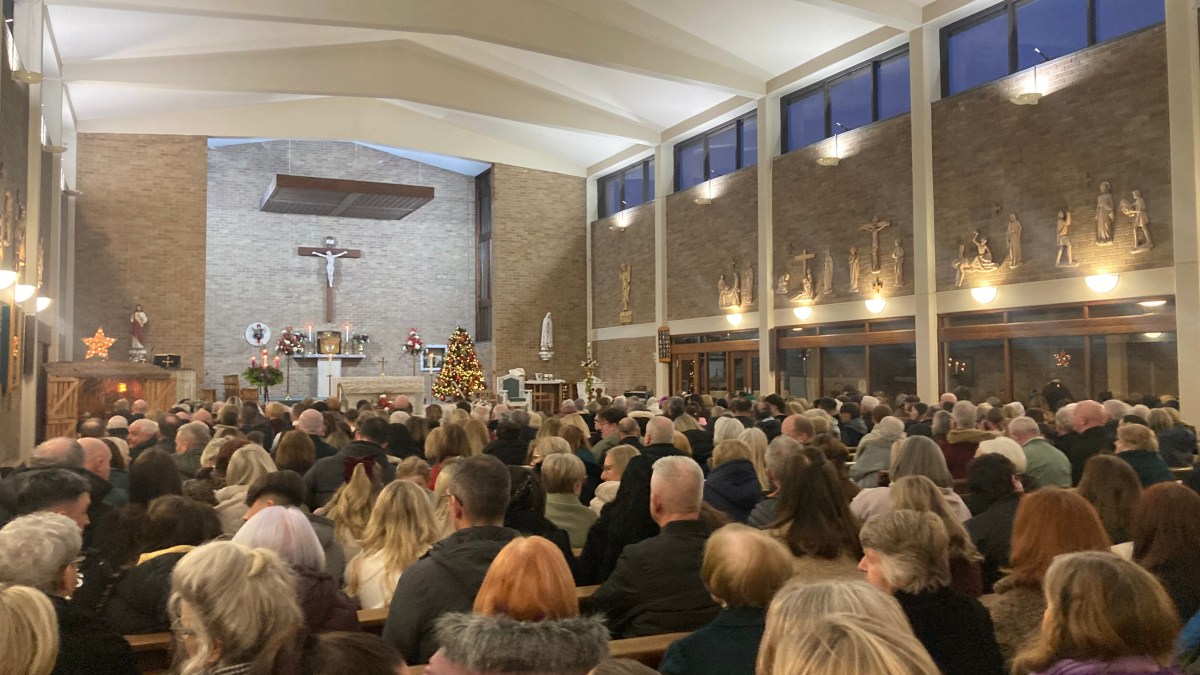
Michael Oswald, a retired teacher, has seen the streets go one by one in the shadow of the Holy Family church in Port Glasgow. It was only a matter of time before the church went too.
“The school and parish were together, this was the parish church. I have many great memories, but also sad memories, of times spent in this parish in connection with the school,” said Oswald, who taught at St Stephen’s High in the Inverclyde town.
He was among the 1,000 worshippers who squeezed into the church to mark its final Mass at the turn of the year.
“When I was driving down the road I didn’t think I would be terribly emotional,” he said. “But once I came here, I have to admit I was, seeing people I taught, worked with, the people who are parishioners here. Particularly when the decree was read. It struck me more than I thought it would.
“This parish is very close to these people’s hearts and has been for years. It’s very difficult for this part of Port Glasgow. It has changed beyond recognition in a very short period historically.
“I remember walking along the length of Parkhill Avenue outside years ago and it took hours, there were so many people outside to speak to. It was always vibrant. There were large families of young people from working-class roots wanting to do better for themselves. But the houses in the streets round about have been knocked down and there’s been no replacement for them.
“This was the only public building in this part of the town now, so even aside from the sadness of the parish going, it’s a very sad moment for the community and the people who continue to live here. A lot of them are very affected by the situation, not just about the parish, but the whole area having changed.”
Oswald’s emotions have been increasingly felt in communities across Scotland, with new statistics revealing that one church every week has closed across all denominations over the past five years.
The numbers, compiled by the charity Scotland’s Churches Trust, show 329 churches have closed since 2020, with nine closing their doors in the last fortnight.
Almost 300 Church of Scotland churches have closed, with four Episcopal churches and six United Free churches, according to the findings.
In addition, more than 20 Catholic churches have closed in Scotland since 2015, with 15 closing within the past five years, according to separate figures from the Bishops’ Conference of Scotland.
These show there were more closures of Catholic churches in Lanarkshire’s Motherwell diocese than in any other part of the country in the last decade. Argyll & the Isles was the only diocese to record no closures in the same period.
Three Catholic churches have closed in Aberdeen diocese since 2020 and the same number in Glasgow since 2015. Four have closed in the diocese of Galloway and in St Andrews & Edinburgh, since 2017 and 2018 respectively. The diocese of Dunkeld has lost one church since 2018.
Dr DJ Johnston-Smith, director of Scotland’s Churches Trust, said closures particularly affected communities outside large urban areas.
“The pattern is both urban and rural, but rural Scotland appears to be hardest hit because congregations are far apart and the maintenance of a traditional 18th-century rural building is quite heavy, with only a handful of the congregation left to pay for its upkeep,” he said.
The most recent closure recorded by the Bishops’ Conference was that of Holy Family in Port Glasgow, one of two churches to close in Inverclyde in the same week, the other being Greenock’s United Reformed Church.
May Stevenson, 90, grew up in Port Glasgow, going to Mass in a local Hibernian hall, then in a Nissen hut in the town’s cemetery. When the Holy Family church was finally built, designed in the late 1950s by the renowned architects Gillespie, Kidd & Coia, her late husband Phil helped construct the altar wall.
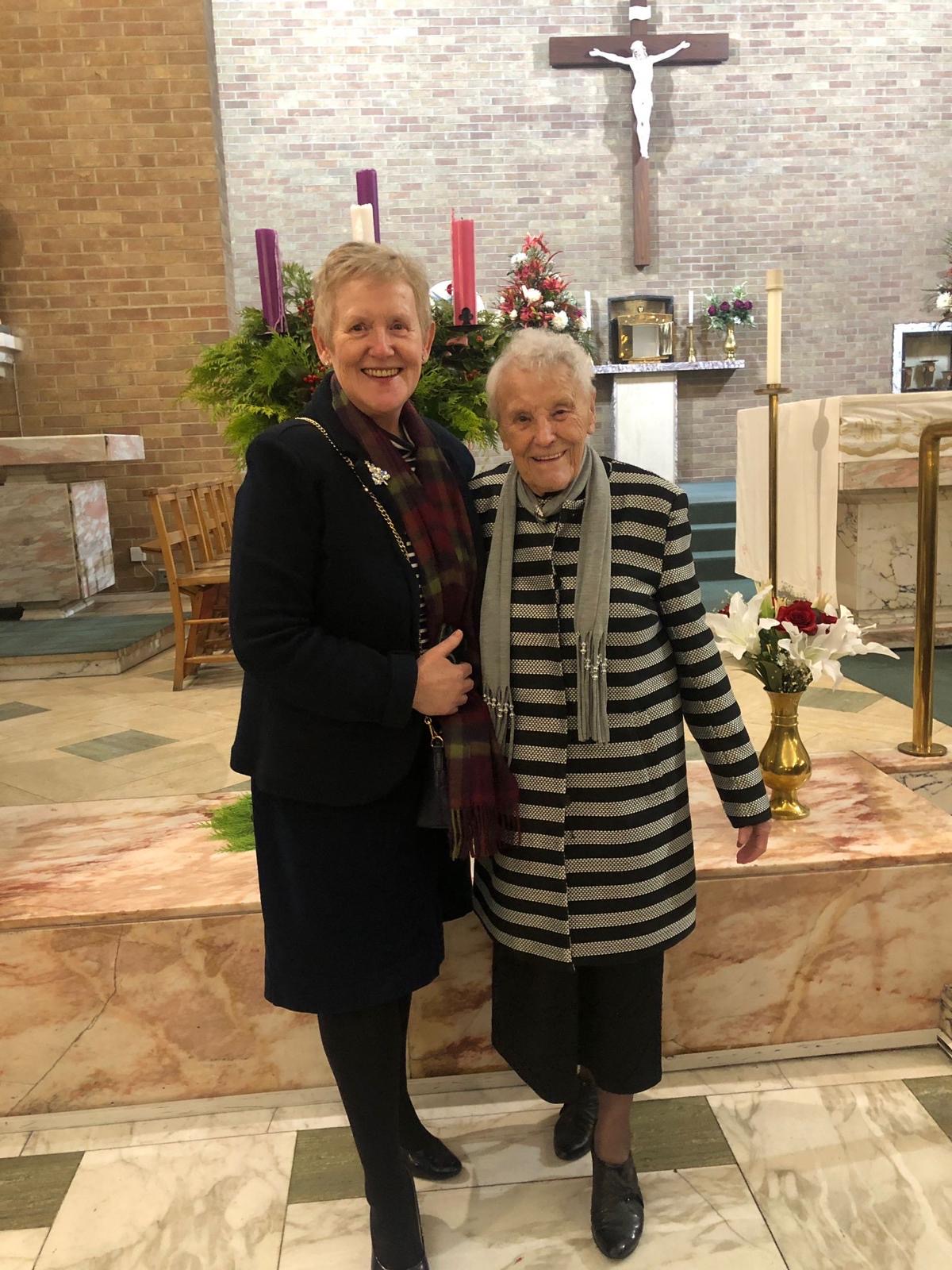
May Stevenson and her daughter Linda
PAUL ENGLISH
“It’s good to be here, but it was sad,” she said, recalling her family’s historical connection with the church. “It was very emotional tonight. I was a cleaner here and worked in the hall. But everything goes on. Life goes on.”
Johnston-Smith pointed to an increasingly secularised society as part of the reason for the closures.
“We raised the alarm bell nationally a few years ago that there would be potentially 500 by 2025,” he said. “The number is mercifully a little bit less than that but it’s well over 300 that have closed between 2020 and 2025 and that comes in at over one a week over that period.
“Big congregations have dwindled and census data shows the country has secularised. A church which might have once attracted the entire community is no longer doing so; 18th-century churches once had 300 people coming every Sunday, now some have less than ten.
“So as well as a congregational drop, the volunteers who are required to run the church are either no longer there or are so elderly they can’t do what they once did.”
• ‘Every congregation for themselves’ — deepening crisis in the Kirk
The trust, which considers 800 more churches to be at risk across Scotland, said the closures were also accompanied by a shifting theological stance by many denominations, focusing on people rather than buildings.
He said: “We are now seeing a theological change. For example, the Church of Scotland tell you it’s a ‘mission plan’ and that they don’t need buildings for a mission.
“Something that all denominations now share is the belief that the church is the people and not the building, and that comes out again and again in discussions. But talk to the community and ask them and they tell you that the church is bricks and mortar.”
Hugh Scott has been an active member of the Holy Family parish since the 1940s, before the designated church was built. He said: “The Holy Family parish started in the Hibs hall in 1946 to help feed local families and I went to the films there on Sunday afternoons. The parish has been about seeing the same people every week and it’ll be a real loss, mostly for elderly ones. It’ll be difficult passing it and not coming in.”
In the church grounds is a sculpture commemorating the Wallace Oak, testament to the apocryphal lore of William Wallace being tethered to a tree on these Clydeside slopes before being taken to England for execution. There’s also a Napoleonic gun battery, where soldiers kept an eye on the timber ponds in the river below.
As the congregation filtered down the steps of Holy Family one last time, many who had fought to keep the chapel open were in tears, resigned to their loss after a Mass presided over by 16 clergy.
According to the trust, it is buildings like the Holy Family that are most at risk.
“The modernist buildings are the most endangered of all,” Johnston-Smith said. “Just because they have A-listing protection doesn’t bring them new purpose or make them sustainable.
“That’s why they’re closing. We are seeing sales documents subject to planning permissions. Many modern buildings can be converted or demolished and there are plenty of 20th-century buildings that have already fallen.”