FEEDBACK from school pupils on pilot programmes for Edinburgh’s plans to restrict mobile phone usage in secondary schools has been “mostly positive”.
Portobello and Queensferry High Schools were selected by the City of Edinburgh Council to pilot restrictions, utilising magnetic, lockable pouches, on mobile phone usage in secondary schools last year.
The schools have served as ground zero in advance of potential plans to ban mobile phones in secondary schools across the city in an effort to boost engagement and attainment.
As part of the recently launched consultation on the ban, council officers have been gathering feedback from pupils, who have mostly responded positively, according to a new report to the Education, Children and Families (EC&F) Committee.
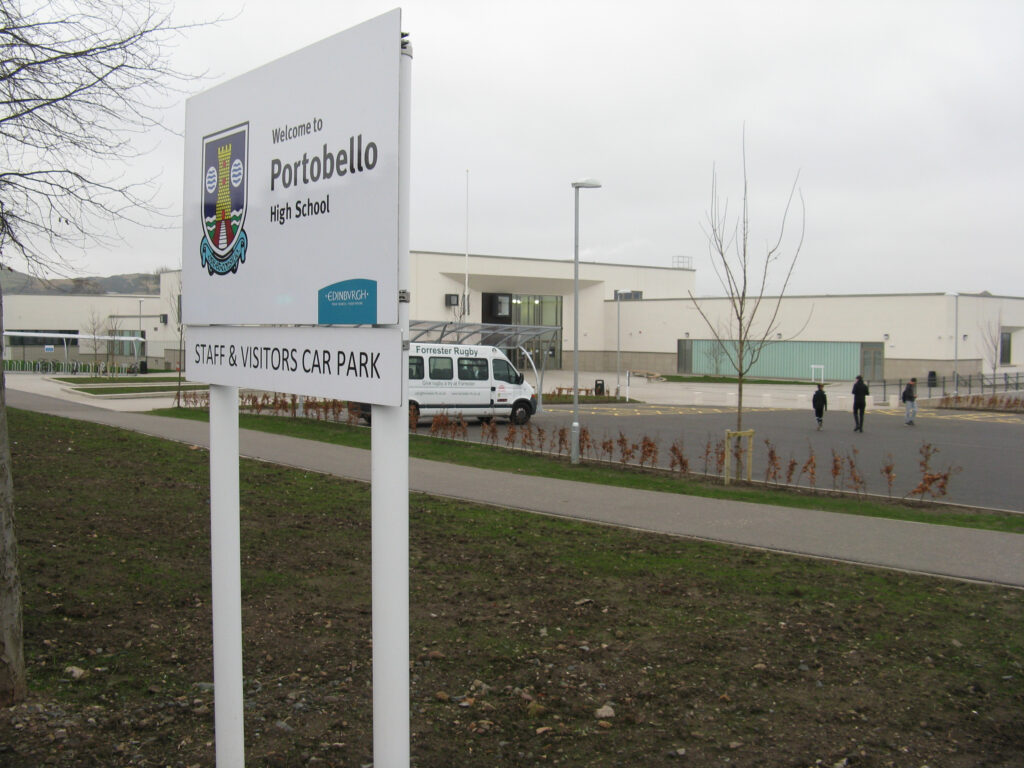
 Portobello High School is one of the schools which has been running a pilot scheme for a future Edinburgh phone ban (C) M J Richardson / Wikimedia Commons
A ban on mobile phones in primary schools was agreed in September but has been delayed by an integrated impact assessment (IIA).
That assessment will be completed by the end of January and will eventually be updated with findings from the secondary school consultation and pilot schemes.
Responses to those pilot schemes, gathered through the consultation process, from students have been described as “mostly positive”, while the mood among teachers has not yet been disclosed.
The most positive feedback has been from the S1-3 cohort, while S4-6 pupils have had a more “mixed” reaction.
Feedback from teachers will be disclosed at the meeting for the EC&F Committee next Tuesday.
Councillor James Dalgleish, education, children and families convener, was cautiously optimistic, but stressed the importance of not rushing into any decisions: “In September 2025, it was agreed that restricting the use of mobile phones in our schools would be a positive step forward.
“We want these new measures to be brought in as soon as possible but it is the right thing to do to make sure that citywide consultation with families and communities, alongside an integrated impact assessment, takes place to explore and address any issues or concerns.
“These are now well underway, and an interim update report will be discussed at Education, Children and Families committee next week.”
He added: “Through many conversations, I understand that there is broad support for keeping smartphones out of the classroom, however there are individuals who have concerns which makes it even more important that as a Council we get this change right.
“Pilots, using lockable pouches, at Queensferry and Portobello High Schools have anecdotally been successful, but not wholly without challenges, and as such the rollout of pouches in other settings needs to be explored.
“This includes options for financing mobile phone restrictions and the potential use of lockable pouches in secondary schools and lockable cabinets in primary schools.”
The report cautioned that results in terms of attainment and attendance cannot be measured at this stage.
Council officials state: “Evaluating the impact of lockable pouches on aspects of education, such as attendance and attainment, will take time and is linked to the school improvement planning cycle and reporting on levels of attainment and achievement.
“As such, some elements of impact cannot be evaluated at this time.
“However, the early impact of phone pouches on daily school life, particularly engagement in learning, can be assessed on an ongoing basis.”
Pupils continue to be consulted about the ban with the consultation not expected to be concluded until March, but the early assessment looks positive for the ban.
Also outlined by the report are several options for implementing a full ban or limited restrictions.
Option one, which is the option favoured by council officers in the event the consultation recommends a complete ban, will provide lockable pouches à la South Queensferry and Portobello and lockable cabinets in primary schools.
Option one is the most expensive, but will provide “consistency in all schools”, “does not place an additional financial burden on schools and/or families” and “complies with insurance”.
The report states that option one, the most comprehensive ban proposed, would require an initial investment of £400k with an annual cost of £80k to £100k citywide.
Other options include lockable cabinets in some/all secondary schools, and a mere policy ban, requiring schools to determine for themselves how to implement it.
This last option is not recommended due to the potential passing on of costs to families and the fact it would be difficult to have every school fully align with consultation feedback.
Councillor Dalgleish concluded: “I am working closely with officers to move this forward as quickly as we can, while also making sure that we have done our due diligence to ensure that restricting mobile phones in our schools will have the intended positive impact.”
A budget will likely be allocated next month, but the council will not officially decide upon which option to proceed with until after the conclusion of the wider consultation in February and final IIA in March.
At the meeting next Tuesday, the committee will only be asked to note the options, with a final decision expected at an EC&F Committee in March.
From there, the council will begin procurement and engagement with affected local communities.
The earliest possible date for implementation of pouches in secondary schools – a comprehensive ban – is December 2026.
If the council decides to allow schools to determine for themselves how to enforce a ban, schools could be phone-free by August.
Related