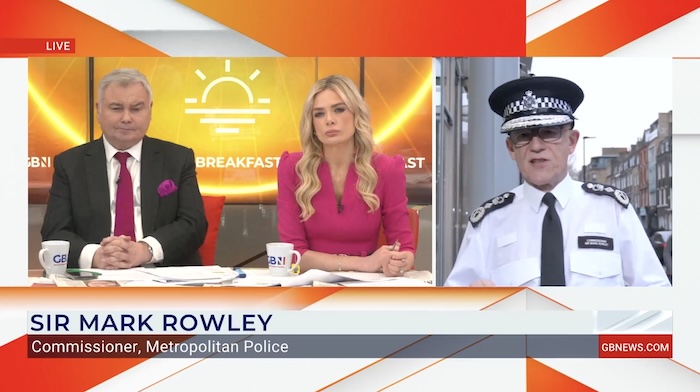
METROPOLITAN Police Commissioner Sir Mark Rowley has pledged that demonstrations in the UK in support of protesters in Iran will be policed “without fear or favour”.
Asked about the protests on GB News, he said: “We police protest without fear or favour under the law as Parliament’s created it, we can’t make up laws. We have to do that under those laws.
“I think what I’ve seen over the last few years is the most challenging period of protest ever. And our command teams who are making the decisions and the officers on the streets, it is routine now for one side of the argument to say you were too lenient on that group and the support of that group saying you were too harsh on them.
“We’re constantly criticised from both sides, because we’re the people on the street dealing with tension and trying to manage that tension and deal with illegal behaviour. So for example, there was a protest over the weekend outside a restaurant, and we’ve made an arrest there, and we’re looking to CPS as to whether we can prosecute somebody for incitement for racial hatred from that offence.
“We’ll keep doing those sorts of things. We’ll keep intervening when people break the law, and trying to find that balance between freedom of speech, which I know is really important to people, and your ability to express your opinion, but also balancing that with not doing this in a way which intimidates or affects the rights of others.”
SIR MARK ROWLEY GB News.jpeg
On Phone theft, he said: “Phone theft is a really important issue for us in London, isn’t it? What it means to people, as you say, Eamon is enormous.
“We had a case recently where we managed to recover a phone shortly after it was stolen. It belongs to a doctor, and he was really worried about his ability to be on call and serve his patients without his phone. And that’s just a very powerful example.
“We’ve turned the corner in the last year. Since April last year, this financial year, phone theft is now down by 15%. We’re doing that through two things. We’re arresting the people off the street, the people doing the thieving. But also, there’s international organised crime exporting phones across the world, particularly to China, and we’re intercepting those gangs and putting them in prison for organised crime offences.
“We’re also asking the phone companies to do more to improve the security so that your stolen phone can’t be recycled and used again as new because that’s really important. We all need to be sort of sensible in terms of our own physical precautions, but I’m asking people to go out on the streets of London feeling safe.”
Asked about failures that resulted in 5,000 recruits not being properly vetted, he said: “The work we’ve been doing to bear down on standards, we’ve removed more than 1,500 men and women from the Met in the last three years for standards-related issues. That’s more than triple the rate before.
“We’re the most vigorous, most serious you could possibly be on these issues. That data is a moment in time, some of that, some of those cases in there are with people who are currently going through vetting systems. Others will be minor offences.
“I will have people who, when they’re 14, got a caution for a minor offence, and they join the police when they’re 25, or 30. So there’s a range of different factors in there, but the public can be assured we’re being as robust and vigorous as is possible to make sure that we have these outcomes in the organisation.
“The thing I’m most proud of is all the people being removed from the Met, that’s not about me and a few senior people doing it. A lot of that is about the good men and women of the Met who care about Londoners, the ones who go out protecting victims day and day out.
“They want a safe they want a safe Met, and they’re giving more information, which is helping us deal with the colleagues who shouldn’t be in the organisation. That’s why we’re being so successful, and that’s why trust in the Metropolitan Police is growing.”