Photo by Marcus Bastel/Millennium
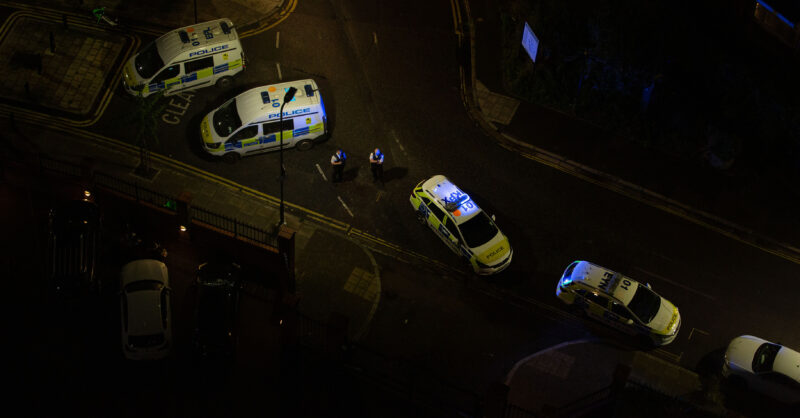
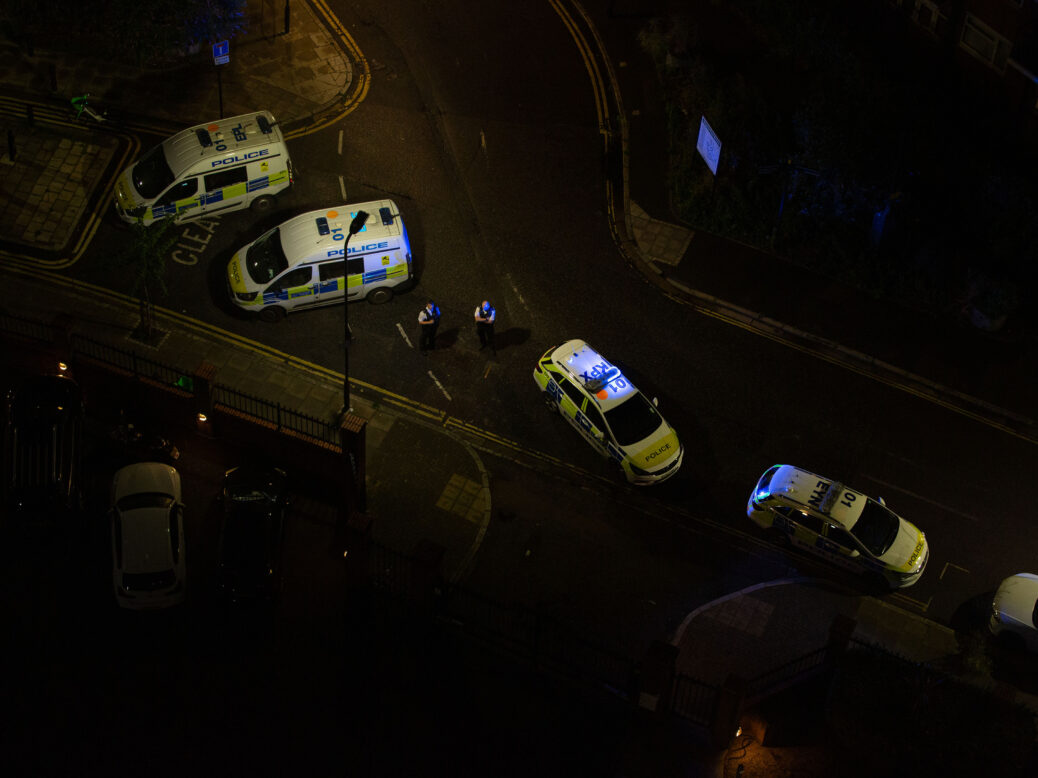
One autumn evening a couple of years ago, I joined a Metropolitan Police officer on patrol around a part of London that has changed rapidly over the past 15 years. Hackney Wick, once a canal-side fringe of derelict industrial buildings, was hewn by Olympic-era investment into a landscape of modern living, where the newbuilds are still new and the trees are yet young. In this glassy slice of a London borough that once suffered the capital’s highest knife crime rate, you’re now more likely to be sold matcha than weed.
On our walk, I expected my willing copper to observe how gentrification had disrupted patterns of urban crime, but that wasn’t the story she told. Fewer stabbings, yes. But she said phone theft and casual incidents of sexual harassment were so high on this stretch of her beat that she warned me to put away my phone. Tracking down thieves who zoom off from victims on e-scooters and Lime bikes was near impossible. She even suggested that, outside of uniform, she herself wouldn’t walk alone here at night.
It was a short trip that encapsulated a now long-standing debate about crime in the capital. Violent crime has fallen, as the London Mayor, Sadiq Khan, and the Met Commissioner, Mark Rowley, have been highlighting recently. But other crimes, often described as “petty” or “low-level”, are rising: phone-snatching, car theft and shoplifting are on the up. Hackney Wick has been pumped with investment, smartened up, populated by day with babyccino-sipping toddlers and by night with Lululemon-clad running clubs. But, as in the rest of London – and throughout Britain – no matter our class or neighbourhood, we are becoming more exposed to a type of criminality I think is better described as “chaos creep”.
When you see a pedestrian walking metres in front of you have their phone nicked by a balaclava-ed kid whizzing past on a moped, or you watch – as I did in my local Sainsbury’s a few days ago – an unmasked man sweeping a whole shelf of toiletries into a bag and marching straight out of the shop, stats from City Hall on reduced homicides feel irrelevant. This creeping feeling of chaos is compounded by a loss of control: police are unlikely to turn up (nationally, they now only solve 7.3 per cent of crime). And shop security guards often follow an unofficial “hands-off” policy for fear of the retailer (or their agency) being sued, as one senior supermarket executive explained.

New year, new read. Save 40% off an annual subscription this January.
This is not a London-specific problem. But the idiosyncrasies of British policing have turned the city into a global phone-theft hub. Police budgets have been stretched since public sector cuts were imposed in 2010, forcing officers to focus on “higher-harm” offences – those that cause most damage to victims. Thieves can easily snatch phones with impunity, and organised crime gangs can export them easily too; poor resourcing has also meant container ports are not adequately monitored (Jaguar Land Rover has even paid its own money for extra policing at ports, as so many stolen cars are shipped from Britain’s shores). Shoplifting has also professionalised: supermarket goods are stolen to order and sold on at car boots, cornershops or door to door at pubs.
All this creates an atmosphere I would argue is more about feeling unsettled than unsafe. It is part of a wider decay of the public realm, from forever broken lifts at stations to nitrous oxide canisters littering pavements in even the tidiest postcodes, to those dodgy American candy stores on Oxford Street. It is disorientating to live in a society where the state, council, police or anyone else – the cornershop owner, the bus driver – appear to have so little power over the day-to-day.
I grew up in London. I remember the story of Damilola Taylor, the ten-year-old schoolboy killed with a glass bottle on his way home from school, constantly on the evening news. I remember the flippant shorthand my schoolfriends and I would use for nearby landmarks: “stab alley”, the “murder park”, the “rape church”. I remember smashed shopfronts the morning after the London riots hit my local high street. The capital is certainly a less dangerous place today, and leaders are right to publicise data proving this – and undermining fantastical far-right visions of London as a no-go dystopia.
Growing up, I felt safe. I have never once been attacked or mugged. I still feel safe today, and I am proud of my home city: politicians such as Laila Cunningham, Reform UK’s London mayoral candidate, should be wary of talking it down. Polling that suggests local pride holds up even as national pride declines is underappreciated, in my view.
But I also feel frustrated at the chaos creep. The shoplifter selling stolen steaks to punters outside the pub. The woman often found crouching, wailing, by the Tube in the clear spin of an addiction left too long untreated. Fly-tippers who seem never to run out of soggy mattresses to discard. The men scaling scaffolding and nicking copper from the top of our block. Lime bikes parked horizontally across the path. Constant bus stop closures. Burst water pipes. London is not a violent hellscape, and it is growing safer (in fact, as I’ve written previously in this column, knife crime is rising in the provinces and suburbia rather than the capital). But, as is the case across Britain, its flaws are visible for all to see.
[Further reading: Knife crime is creeping into Middle England]
Content from our partners