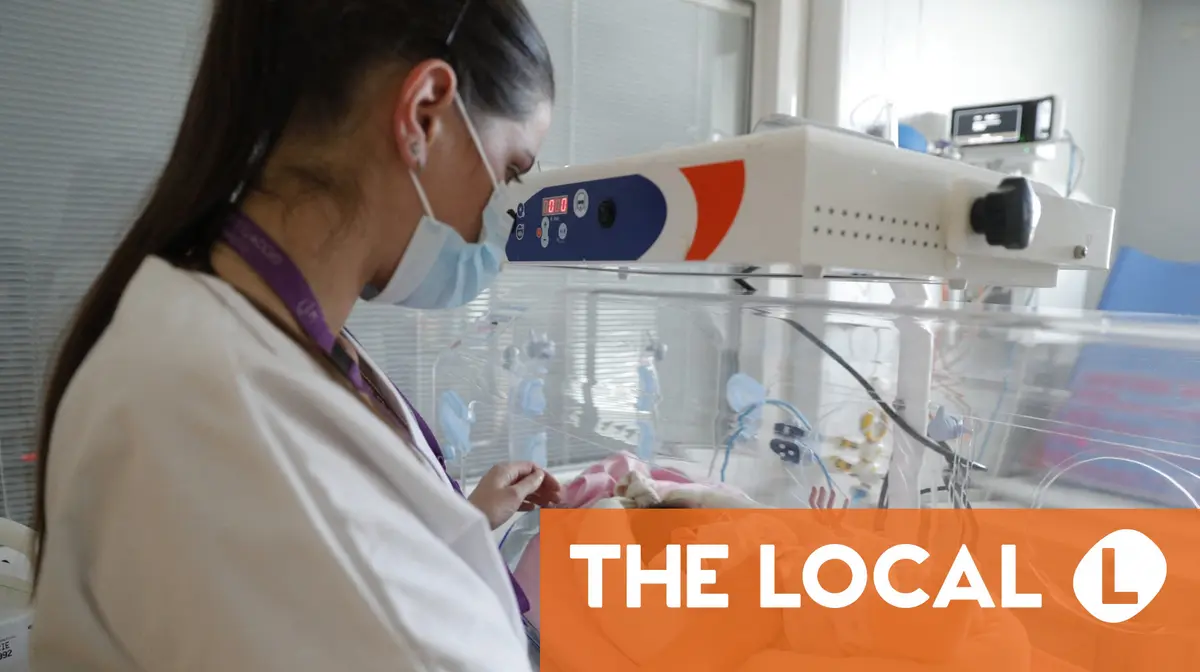
Fewer babies, more elderly people, rising life expectancy… France has changed and is now at a demographic turning point, according to the national institute of statistics.
France now has 69.1 million inhabitants – 66.8 million in l’hexagone (mainland France) and 2.3 million in the French overseas territories, which include the Caribbean islands of Martinique and Guadeloupe and the South American territory of French Guiana.
Overall, France has seen positive immigration numbers in the past year – the difference between the number of people entering and leaving the country is estimated at +176,000.
The natural balance, meaning the difference between the number of births and deaths, is down. It currently stands at -6,000 people, a first since the end of the Second World War.
This contributes to a 0.01 percent decline in the total population.
Births in decline
In 2025, 645,000 babies were born – 2.1 percent fewer than the previous year – and also the lowest number in a single year since the end of the Second World War, for the fourth consecutive year.
This decline is less pronounced than in 2024 (-2.8 percent) and 2023 (-6.6 percent), but it remains higher than the average annual decline between 2010 and 2022 (-1.3 percent).
In mainland France alone, 611,000 births were recorded in 2025, the lowest number since 1942.
Decline in fertility
The fertility rate continues its downward trend, it stands at 1.56 children per woman, after 1.61 in 2024 (1.53 after 1.58 in metropolitan France). This decline reflects a medium-term trend: the rate has been falling since 2010, when it stood at 2.02 children per woman in metropolitan France.
The same pattern is observed among men, with the fertility rate dropping to 1.56 children per man in 2025, compared with 1.61 in 2024.
READ ALSO: Does France really have the highest birth rate in Europe?✎
Older Parents
In 2025, the average age at childbirth continues to rise as it reaches 31.2 years for women, compared with 29.6 in 2005. The same trend is seen among men, with the average age at the birth of a child now 34.1 years, up from 32.6 in 2005.
Rising Deaths
Last year, 651,000 people died, an increase of 1.5 percent compared to 2024, following a 0.3 percent rise between 2023 and 2024. A severe flu epidemic in January and episodes of extreme heat during the summer contributed to this increase, which fits a medium-term trend.
Since 2011, the number of deaths has been gradually rising due to the ageing of the baby-boom generations, those born between 1946 and 1974.
Higher Life Expectancy
In 2025, life expectancy at birth reached 85.9 years for women and 80.3 years for men, a “historically high” level.
Since the mid-1990s, life expectancy has been increasing but it has been growing more slowly for women than for men, reducing the gap between the sexes. It is now 5.6 years, down from 8.1 years in 1995.
As a result of falling birth rates and rising life expectancy, people aged 65 and over are now almost as numerous as those under 20, respectively representing 22.2 percent and 22.5 percent of the population.
In 2006, only 16.4 percent of the population was aged 65 and over, while 25.1 percent were under 20.
READ ALSO: MAP: Where in France do people have the longest life expectancy?✎
More Marriages and Civil Partnerships
In 2025, the number of marriages in France is estimated at 251,000 – of which 244,000 were between opposite-sex couples and 7,000 between same-sex couples. This represents an increase of 1.4 percent compared with the previous year, following a 2.7 percent rise between 2023 and 2024.
Before the COVID-19 health crisis, the general trend for marriages had been going down, states INSEE.
In 2024, 197,200 civil partnerships (PACS) were registered – 186,800 between opposite-sex couples and 10,400 between same-sex couples – a number that remained almost unchanged from the previous year.