Unlike your coffee, though, dilution refrigeration can reach incredibly low temperatures, even down to 5-10 millikelvin.
Ultra-low temperature physics is a “frontier field”, says Haley. “If you cool something down to a temperature it’s never been at before, it might do something interesting.” Scientists have even used low temperatures to slow down light from its usual speed of 1.08 billion km/h to just 61 km/h – where it would lag far behind cars travelling at the speed limit on a British motorway.
More like this:
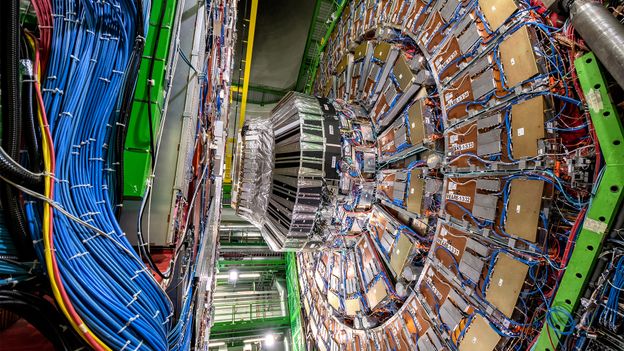
• The ‘very large’ Hadron collider
• What existed before the Big Bang?
• How cold does it get when we leave Earth?
Some scientists use ultra-low temperature setups to study how the Universe might have behaved in the aftermath of the Big Bang, for example. And dilution fridges are crucial for quantum computers, too. The large, golden chandelier-like devices you sometimes see in pictures of quantum computers are the dilution fridges that make quantum computing possible, explains Haley. The super low temperatures are necessary because heat causes errors in quantum bits, or qubits. Qubits – units of information that can exist in multiple positions at once – are essential for quantum computing.
There are other engineering applications. Computer chips have become smaller and smaller over the years but that means imaging them has become harder. It’s possible to cool down semiconductors to as low as three Kelvin in order to take sharp pictures of them for analysis or quality control purposes. “You’re looking at a small area but if it’s warm and expanding or contracting, even a little bit, it won’t give you as clear as image,” says Dylan Cawman, sales engineer at Advanced Research Systems, a company that make cryogenic cooling equipment for a range of applications.
So, if you’ve ever thought of a photograph as a method of freezing something in time – well, this may be the most extreme version of that you’ll ever hear of.
—
If you liked this story, sign up for The Essential List newsletter – a handpicked selection of features, videos and can’t-miss news, delivered to your inbox twice a week.
For more science, technology, environment and health stories from the BBC, follow us on Facebook and Instagram.