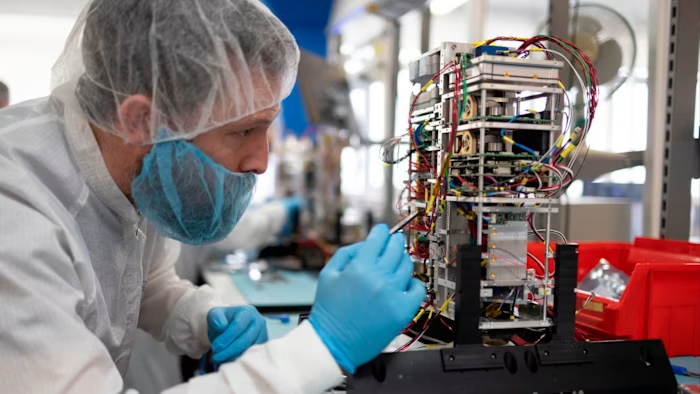
Your report on Glasgow’s satellite cluster (“Glasgow reaches for the stars in space hub push”, Report, January 12) captures something rare in industrial policy: a genuinely integrated success.
Scotland’s space economy works because universities, manufacturers, launch providers and data businesses have grown together, reinforcing one another rather than competing for attention or funding.
That coherence is its real strategic asset. It has allowed relatively modest public investment to generate outsized capability across manufacturing, analytics and services, with clear relevance to both commercial markets and national security.
Few regions manage that transition from hardware to data so effectively, or with such institutional depth. But the caution is implicit in your piece. This is a model that can easily be weakened if policy fragments support, favours isolated champions, or treats research, launch and downstream services as separable silos.
In a European environment now defined by scale and state backing, the UK’s advantage lies not in matching spending line by line, but in preserving and strengthening this integrated system.
The lesson from Glasgow is simple: it works. The priority now should be not to break it.
John W Mullins
Associate Professor of Management Practice, Marketing and Entrepreneurship, London Business School, London NW1