Workers are being forced out of Scotland by a ‘talent tax’ imposed by SNP ministers, business leaders have warned as it was revealed nearly one million Scots are set to pay the higher rates.
CBI Scotland highlighted the threat of a ‘skills drift’ amid concern over the impact of the SNP’s tartan tax gap that will see Scots pay £1.8billion more than they would if they lived elsewhere in the UK.
It comes as the Scottish Government’s fiscal forecaster said those earning the current median full-time salary of £39,900 will be paying the higher rate, currently set at 42p, within three years.
Nearly one million Scots are now on course to pay the higher rates by the end of the decade, according to the Scottish Fiscal Commission (SFC) forecasts.
This is 28.7 per cent of all workers north of the Border, compared to 22.9 per cent in other parts of the UK.
Ahead of a visit to Edinburgh today (THUR), Tory leader Kemi Badenoch condemned the SNP’s decision to force families to pay more tax to ‘bankroll a failing nationalist agenda’.
She also condemned Scottish Labour leader Anas Sarwar for announcing his party would abstain on the Budget before it had even been published.
Ms Badenoch said: ‘Under the SNP, nurses, teachers and families are being forced to pay higher and higher taxes just to bankroll a failing nationalist agenda.
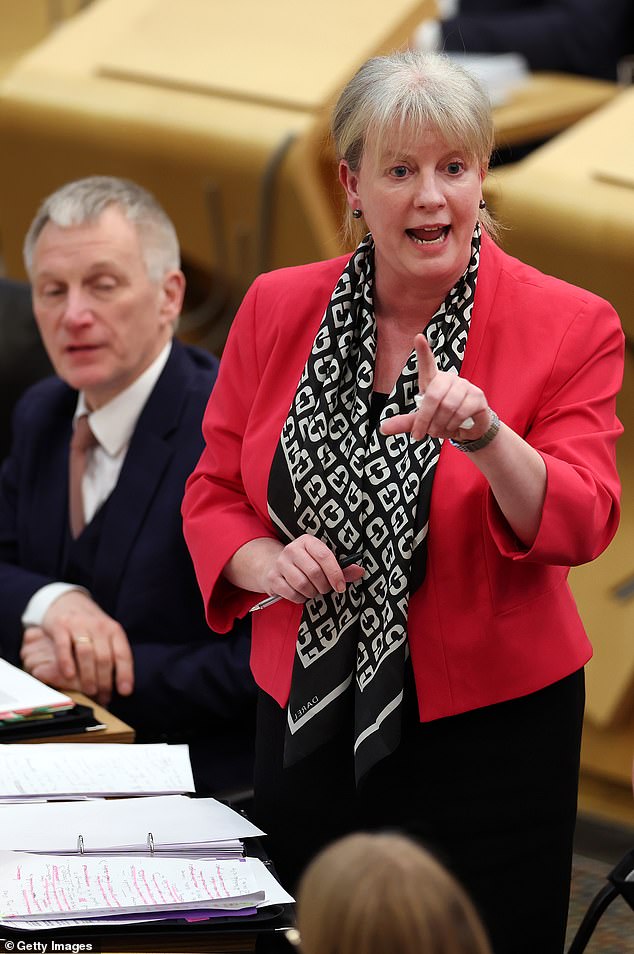
Finance Secretary Shona Robison delivering the SNP government’s budget at Holyrood
‘Labour’s decision to stand aside and let this terrible budget pass shows they can’t provide the alternative Scotland desperately needs. Reform just want more welfare spending.
‘Only the Conservatives are serious about cutting taxes for working people, getting a grip on benefits, backing businesses and restoring economic growth to Scotland and the whole of the UK.’
Andrew Bowie, the Shadow Scottish Secretary, said: ‘Scotland is being shafted by two tired, cynical governments that have completely run out of ideas.
‘By allowing this damaging Budget to pass unchallenged, Labour is complicit in raising taxes on millions of hard-working Scots.
‘Only the Conservatives will get a grip on Scotland’s ballooning welfare bill and cut taxes for working people to drive the growth Scotland so desperately needs.’
Michelle Ferguson, director of CBI Scotland condemned the Budget as a ‘missed opportunity and claimed it has ‘left the handbrake on long-term growth.
She said: ‘We had asked the Government – many of the business groups – to stop tax and regulatory drift and end the talent tax caused by income tax divergence.
‘While we welcome those middle earning tax benefits that are going to come into the economy quite quickly, we do have an issue with skills drift: people who we need coming – high-skilled, high-earning people coming into the Scottish economy, coming to work for our firms.

First Minister John Swinney smiling as Robison answers MSP’s questions on her final budget before she stands down in May
‘We’ve got a skills gap that is not closing and this Budget is not going to support or assist that in any way.’
The SFC figures also showed that the cumulative impact of tax divergence introduced by SNP ministers will be £1.75 billion next year – leading to claims John Swinney’s government is ‘punishing strivers’ to pay for a soaring benefits bill.
It followed the SNP Government’s Budget announcement of another freeze in the thresholds for the higher, advanced and top rates in 2026/27 – and the indication that this will be continued in the following two financial years as well.
Everyone earning more than £33,493 in the coming financial year will pay more income tax if they are based in Scotland than they would if based in other parts of the UK.
The new report on the Budget by the SFC highlights that in 2016/17 – the last year where rates and bands were identical in Scotland to the rest of the UK – 304,000 people in Scotland were paying higher rates of tax, which was 12.1 per cent of all taxpayers. This was a lower proportion than 15.3 per cent across the UK as a whole.
The SFC forecasts that the latest decisions on tax will mean that 835,000 Scots will pay at least the higher rate in 2026/27, which is 26.3 per cent of taxpayers, compared to 21.9 per cent across the UK.
Looking at the entire three year spending review period, the SFC forecasts that the number of Scots paying at least the higher rate will rise to 948,000, or 28.7 per cent of taxpayers, in 2028/29, compared to 22.9 per cent across the UK.
Further data showed that anyone earning £39,743 today is likely to be paying the higher rate of income tax in 2029/30 because of the decision to freeze the threshold.
It also pointed out that this includes someone on the current median full-time earnings for employees resident in Scotland, which is £39,900.
Graeme Roy, chairman of the SFC said: ‘If you look at that growth and the people who are paying higher rates of taxes, many more nurses, many more teachers, many more police officers are now paying higher rate of tax.
‘That is a really interesting kind of change in the tax system, that perhaps people that might not have thought of themselves as higher rate taxpayers 10 years ago are now actually being higher rate taxpayers under the current system of freezing these thresholds.’
Their figures also show the cumulative effect of policy difference introduced by the SNP Government on income tax will be £1.75 billion in 2026/27, up from £1.69 billion in 2025/26.
Scottish Conservative finance spokesman Craig Hoy said: ‘The enormous and widening tax gap between Scotland and the rest of the UK illustrates just how hard the SNP are clobbering middle-income workers.
‘John Swinney is punishing strivers with higher bills to pay for a rising and out-of-control welfare bill.
‘Tens of thousands more nurses, teachers and police officers on relatively modest salaries are being dragged into the higher rate, which was never intended for them.
‘The SNP’s vindictive tax on aspiration is stifling Scotland’s economic performance by making it harder and harder for businesses to recruit and retain skilled individuals.’
Finance Secretary Shona Robison yesterday told BBC Radio Scotland Breakfast that an increase to the higher rate threshold would have been unaffordable.
On the concerns about losing talent to south of the border, she said: ‘What I would say is we have positive net in-migration of taxpayers into Scotland, so there are more people coming from the rest of the UK to come and locate and work in Scotland, it was about 4,200 a year of people making a positive choice to come and live and work in Scotland.
‘And of course here in Scotland, people have a range of supports so if your kids go to university you don’t pay tuition fees – that’s potentially tens of thousands of savings.’
The decision to increase the basic and intermediate rate thresholds by 7.4 per cent will lead to a maximum benefit of £40 a year, or 61p a week, for taxpayers.
Pressed on whether she had considered increasing the higher rate thresholds too, Ms Robison said: ‘I don’t fundamentally disagree with that premise, but it is what is affordable and deliverable.
‘If I give you an example, if the higher rate threshold had been raised just to £44,000 that would have cost £125 million. It is extraordinarily expensive to raise those thresholds at the higher levels. The money is just not available to do that.
‘Of course we are very conscious of the tax revenues and the tax that people pay, we don’t take these decisions lightly at all. But I think in the round, given the social contract, the supports that people get for the taxes they pay that are not available elsewhere in the UK, we would contend that is a social contract that most people would support.’