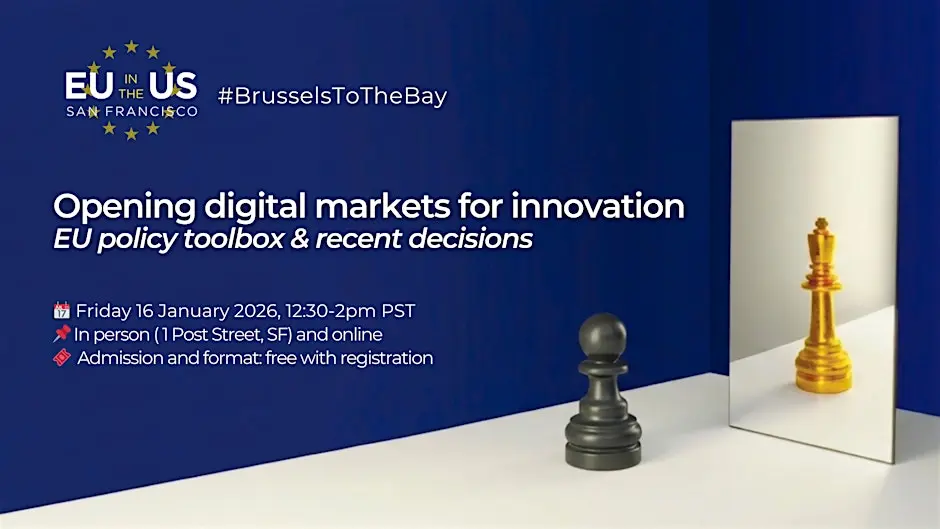
For startups and investors, innovation only matters if it can reach the market. For users, it matters if it delivers real choice, better quality, and meaningful control over how they communicate, create, and make transactions online. A new messaging app that cannot interoperate with dominant platforms struggles to attract users. An AI startup may build a strong product but remains dependent on a small number of app stores, operating systems, or cloud providers to distribute, monetise, or scale it. App developers often face fixed fees, payment solutions, limited access to customers, and little room to experiment with new business models. These constraints are commercial realities that directly affect growth, valuation, and investment decisions.
We will explore, based on real life examples, how Europe is using a combination of regulation and competition law to reduce these bottlenecks and improve market access. The EU’s Digital Markets Act (DMA) introduced clear, upfront rules for the largest platforms – “gatekeepers” – leading to opening of app distribution, limiting restrictive default settings, enabling interoperability, and giving developers and AI-driven businesses more control over how they reach users and monetise their products. The discussion will also highlight how antitrust enforcement complements the DMA by addressing specific strategies that can undermine innovation over time. Recent cases and ongoing investigations by the European Commission and the U.S. Department of Justice against big tech companies show a growing focus on practices that reinforce ecosystem lock-in, restrict go-to-market options, or foreclose emerging rivals. How do these tools interact to create more predictable and contestable digital markets? How can companies reduce their dependency on the biggest players? How is Europe improving the conditions for long-term investment in its digital and AI economy?
Schedule
12:00 – 12:30 PM: Light lunch & Networking
12:30 – 12:40 PM: Overview of the recent antitrust and DMA decisions
12:40 – 2:00 PM: Panel discussion with Q&A
Meet Our Speakers
Gerard de Graaf, Head of EU Office in San Francisco
Senior EU Envoy for Digital and Head of the EU Office in San Francisco, Gerard de Graaf has worked for more than 30 years in the European Commission across a wide range of policy areas. Until his appointment in summer 2022, he was director in DG CNECT, responsible for the Digital Services and Digital Markets Acts (DSA/DMA). Before joining DG CNECT, he worked in the Secretariat-General of the European Commission, in DG Research and Innovation and in DG Internal Market and he was trade counsellor at the Commission’s Delegation to the United States in Washington DC.
Carlota Reyners, Director for IT, Communication and Media, Directorate-General for Competition at the European Commission
Carlota Reyners Fontana is a Director in the Directorate General for Competition at the European Commission. She is in charge of the enforcement of antitrust, merger and state aid rules in the field of information technology, communications and media. In this role, she
is responsible for antitrust and mergers investigations in the areas of AI, cloud, software and hardware. She was previously head of unit for 8 years in DG CONNECT in charge of EU policy and legislation in the electronic communications sector. Between 2012 and 2014,
she was Member of the cabinet of Vice-President Neelie Kroes, European Commissioner responsible for the Digital Agenda. She holds a law degree from the Autónoma University of Madrid and a Master in European law from the Brussels university. Before joining the Commission, she worked as a competition lawyer in the private sector.
Aaron Schur, Chief Legal Officer, Yelp
Aaron Schur is Chief Legal Officer at Yelp, a platform enabling millions of consumers to share reviews, photos, and other information about local businesses. He joined Yelp in 2010 as one of the company’s first lawyers and led Yelp’s litigation strategy for over a decade, helping obtain leading decisions protecting the rights of platforms to publish the contributions of their users, and the rights of those users to speak freely online. Aaron also oversees Yelp’s government relations and user operations teams. Prior to Yelp, Aaron practiced law at the firms of Bingham McCutchen LLP and Arnold & Porter LLP. Aaron has a B.A. from UC San Diego, an M.A. from Central European University and a J.D. from NYU School of Law.
Coco Carmona, Executive Director, CODE and Partner, Shearwater Global [online]
Coco Carmona is the Executive Director of CODE (Coalition for Open Digital Ecosystems), a group advocating for open and
competitive digital markets, focusing on areas like interoperability and consumer choice, and she brings extensive experience in public affairs, IP, and digital regulation from roles at ICMP (the International Confederation of Music Publishers). A Spanish national, Coco started her professional career in a law firm dealing with trade and IP. In Shearwater, she advises companies and organisations in a range of policy areas, perhaps most notably on the regulation of the internet.
Moderator: Mike Masnick, CEO, TechDirt
Mike Masnick is the founder & editor of the popular Techdirt blog, which explores the intersection of technology, innovation, policy, law, civil liberties, and economics. He is also the founder of the Silicon Valley think tank, the Copia Institute and a board member for Bluesky, the decentralized social media network.
If you have any questions, please email us at invitation@euinsanfrancisco.eu.