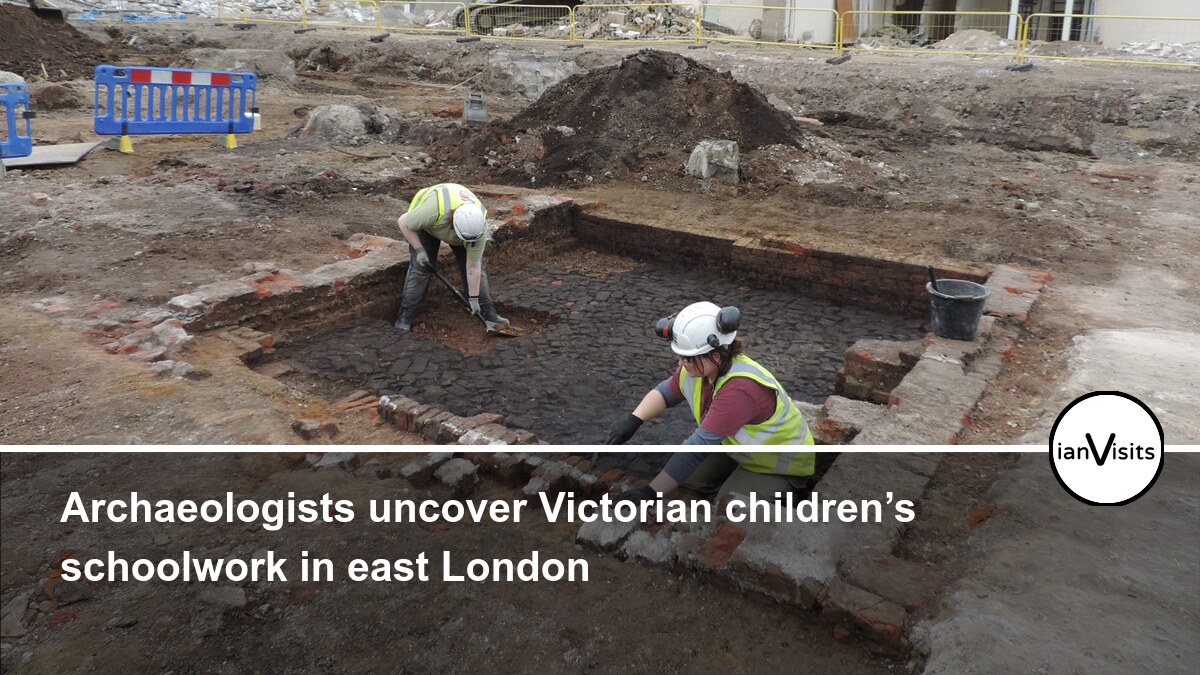
Archaeologists working in East London have made a rare discovery that is seldom preserved in the historical record — an unusually intimate glimpse into the lives of Victorian children.
 Brick cellars heavily covered with soot (c) MOLA
Among the finds uncovered by MOLA at the excavation site in East London was a fragment of a slate school tablet, still bearing the faint scratches of children’s handwriting and doodles, alongside a hoard of ceramic marbles – known as “alleys” – carefully made to resemble polished alabaster. The marbles were discovered inside an old water drain, perhaps lost during a particularly enthusiastic match.
Their presence was no accident though.
A school once stood on the site, founded in the 1530s by London Sheriff Nicholas Gibson and his wife Avice as a free school for poor boys. In the 1550s, Avice entrusted its care, along with the surrounding almshouses, to the Worshipful Company of Coopers. The charity remained here until the late 19th century, providing homes and modest alms to elderly local residents in need.
Other discoveries are also changing long-held assumptions about this corner of London in the 18th and 19th centuries.
Known at the time as Sailortown, Wapping was one of the city’s busiest and most cosmopolitan districts, shaped by global maritime trade. Living close to the docks gave residents access to goods arriving from across the world – including luxuries long assumed to be out of reach of the people who lived in the area.
 A complete Bartmann Jug discovered in a rubbish pit (c) MOLA
Among the most striking finds was a bottle seal from Château Margaux, one of France’s most prestigious wine producers. In 1771, Château Margaux made history as the first claret sold at Christie’s, and its wines were favoured by figures such as British prime minister Sir Robert Walpole and US president Thomas Jefferson. That such a seal turned up in Wapping hints at a richer social life than contemporary commentators often allowed.
MOLA Senior Archaeologist Alex Blanks explains: “The area of Wapping between the docks and Ratcliff Highway had a reputation in the 1700s and 1800s as being overcrowded and dangerous. But finds like this are revealing a more complex social history than often biased contemporary sources would have you believe.
In reality, it was a very diverse area – just like the East End is today. Archaeological evidence such as expensive imported pottery and wine glasses suggests people from a wide range of social standings may have been living in the area and getting to enjoy some of the same luxuries as the richest in society.
We don’t know exactly how the wine from Chateau Margaux got here, but we can imagine – perhaps it belonged to a schoolmaster or ship’s captain with expensive tastes.”
 Alex Blanks holds the slate tablet (c) MOLA / Andy Chopping
Historical records have also helped the team understand darker moments in the site’s past.
One of the most significant was the Ratcliffe Fire of 23 June 1794, one of the largest blazes in London’s history. Contemporary maps place this site at the heart of the inferno, which may explain the discovery of soot-blackened brick cellars buried beneath later layers.
 Brick cellars heavily covered with soot (c) MOLA
Post-fire rebuilding left further traces: the floor of a chapel added after the disaster, the foundations of terrace houses, and the wells, soakaways and rubbish pits that once filled their gardens. Pottery shards and clay pipes recovered from these pits are now offering glimpses at the everyday life in a dense, working riverside community.
Although excavation has now finished, the story is far from over. MOLA’s team continues to analyse the finds, piecing together centuries of life in Wapping – from children’s games and lessons to global trade, disaster and rebuilding – all hidden beneath the ground until now.
MOLA has started sharing more about the site in a series of monthly blogs – the first of which can be accessed here.