
The 75 hard challenge is making headlines again after Paddy McGuinness credited it with his recent body transformation. The 52-year-old actor and comedian posted pictures of himself before and after completing the 75-day challenge, with the latter image showcasing his now leaner, more muscular physique.
The viral regime, popularised by entrepreneur Andy Frisella in 2019, comprises five daily non-negotiables: two 45-minute workouts (one of which is to be performed outside), sticking to a diet of your choosing, reading 10 pages of a self-help or educational book, drinking a gallon of water and taking a progress picture.
The aim is to tick each box for 75 days straight – if you fall short at any point, you return to day one. Frisella describes it as a “transformative mental toughness programme” rather than a fitness plan, promising it will “change your life, starting from the inside”. McGuinness certainly found this to be the case.
“The effect it had on my body, and more importantly, my mind, was staggering,” he wrote underneath his post. “It really is amazing what can be achieved in such a short period of time… if you’ve got the willpower.”
The challenge tends to be like Marmite, with people falling firmly in either the “love it” or “hate it” camps. It has also drawn backlash for promoting unsustainable exercise extremes.
But as a fitness writer and coach, I have a slightly different view.
75 hard isn’t perfect, but it might not be as bad as it’s cracked up to be
There are certain things you do daily without thinking: waking up, brushing your teeth, and getting dressed. These actions are so entrenched in your life and identity that they take minimal thought or effort. So much so, omitting them from your routine feels uncomfortable. Now imagine making exercise one of these behaviours.
I always remember Arnold Schwarzenegger, 75 at the time, telling an interviewer: “Training is part of my life – it’s that simple. Until I die, I will be working out. I want to feel good.”
For him, exercise is habitual. Achieving this state is a worthy fitness goal, with consistency being the key to any successful fitness or diet plan.
To prove this point, take this 2008 research published in the International Journal of Obesity, which pitted several well-known diets against each other. It concluded that the specific diet mattered less than your adherence to it. And Schwarzenegger has developed unerring consistency in his exercise regimen by making it habitual.
You don’t have to train to Schwarzenegger’s level to develop healthy habits, but if you want to see and feel the benefits, you do have to eat well, raise your heart rate and lift something relatively heavy on a regular basis.
Make a habit of it
 Paddy McGuinness shows off incredible weight loss transformation (Paddy McGuinness)
Atomic Habits author James Clear has cemented himself as the king of habits, with his book on the topic selling more than 25 million copies. He cites a University College London study which found that forming a habit takes an average of 66 days, but the actual number for each person could be anywhere between 18 and 254 days, depending on individual factors.
To form a new habit, he says it needs to be four things: obvious, attractive, easy and satisfying. The 75-hard challenge ticks a few of these boxes.
It lasts for 75 days, exceeding the threshold for most people’s habit-forming tendencies, and has you doing the same thing daily to reinforce the desired behaviours – namely, eating better, exercising more, staying hydrated and learning. The structure of the challenge makes it obvious what you should be doing each day, and the purported benefits represent an attractive prospect.
The progress pictures, I imagine, are also designed to deliver an element of satisfaction – if you drastically change your behaviour, it will trigger changes in your mind and body, which is what people tackling this challenge tend to want from the commitment.
Should you try the 75 hard challenge?
For some people, McGuinness included, this combination of factors will provide the impetus needed for discipline development and an identity overhaul by the end of the challenge: “I am now someone who exercises regularly and eats nutritious food.”
“Challenges like 75 hard aren’t for everyone, but if you’ve got even an ounce of willpower, why not give something a whirl?” the Take Me Out presenter writes.
For others, it won’t be enough, because 75 hard isn’t easy – far from it. To describe why this is an issue, we need to liken exercise to murder. The two topics are similar in that, to do them successfully, you need motive, opportunity and means.
Motivation on day one of your new workout or diet plan is likely to be high, but it will naturally ebb and flow over time, leading to missed workouts and less healthy meal choices. This is why developing healthy habits, rather than occasional positive behaviours, can be so valuable.
Means are harder to come by. If you enjoy reformer Pilates but can’t afford pricey classes, you are far less likely to exercise consistently. The 75 hard challenge is not too bad on the financial front, encouraging outdoor workouts and not specifying the exact exercise or diet plan, allowing you to choose one that suits your wallet and preferences.
And finally, there’s opportunity. This is the big problem – many people will peruse their diary and find 75 hard’s requisite hours for exercising and cooking from scratch are hard to come by.
The solution? Dilute 75 hard to suit your needs
The fundamentals behind 75 hard are fairly sound: exercise regularly, eat a nutritious diet, stay hydrated and read for the educational and stress-busting benefits.
The human brain also loves the structure of having something it can do daily, so the format of the challenge seems a good way to help people develop healthy habits. And, as McGuinness says, it will suit some people in its unabridged form.
But most people will be stopped in their tracks because the five daily non-negotiables appear unachievable. However, some of this can be solved by altering how you look at the list.
For example, two 45-minute daily workouts, with one being outside, is a lot for anyone to handle – particularly if you interpret these as gut-busting cardio bouts or maximal lifting sessions.
But if one of these workouts was a walk, either during your lunch hour or accumulated through your commute, the number starts to seem a little more manageable. The other can be anything from a gentle yoga session to a trip to the gym, allowing you to vary the intensity of your workouts to suit your routine and energy levels.
The same approach applies to nutrition. It may not be what the challenge’s creator intended, but I like Fat Loss Habits author Ben Carpenter’s idea of following a few health-promoting rules each day rather than a strict diet:
- Focus on including more nutrient-dense wholefoods in your diet, as these have a habit of displacing less nutritious processed alternatives. Eating five (or more) portions of fruits and vegetables daily is a good place to start.
- Eat between 1.2g and 1.8g of protein per kilogramme of body weight per day – active and older populations should look towards the higher end of this spectrum to support tissue maintenance and repair.
- Eat at least 30g of fibre per day.
As GP Dr Jeff Foster points out, drinking one gallon (3.79l) of water is excessive for the vast majority of people. Instead, I like seasoned coach Ed Haynes’ prescription of drinking 35ml of water per kilogramme of body weight per day.
For your daily reading, 10 pages isn’t a bad idea, although I can’t help but feel a little fiction wouldn’t go amiss after a hard workout. And the daily progress picture doesn’t really chime with me – everyone has a different relationship with the mirror, and there are plenty of non-aesthetic ways to measure a workout plan’s success. This brings me back to McGuinness’s posts.
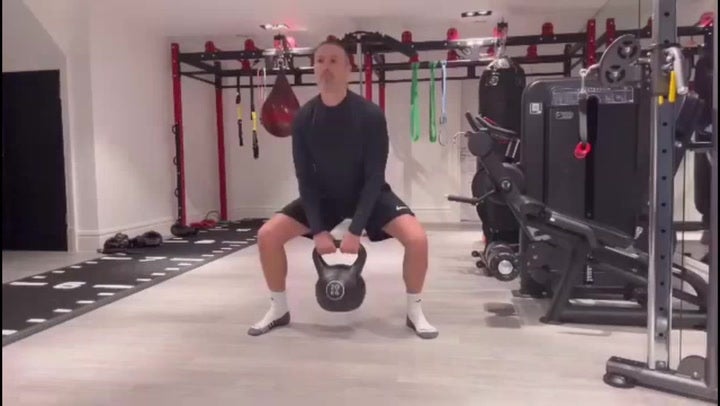
“I started off walking and doing slow jogging,” he says in a video of his exercise journey. “[Lifting] really light weights – I was totally out of shape – just nice and gentle twice a day.”
But after a calf injury and a shift of emphasis from running to strength training, McGuinness noticed a change.
“Something amazing happened,” he says. “Everything kicked in, and I started to get stronger.”
What follows is a montage of clapping press-ups, dips with a 13kg rucksack strapped to his back, weighted pull-ups and more.
If you can complete the 75 hard challenge, or even an altered version of it, you will create discipline and develop plenty of health habits – both of which will serve you incredibly well as you move on with your efforts to stay in shape. Even if you’re not a purist like McGuiness, you will still see plenty of physical changes.
The change in your body’s capabilities is where the true magic lies. You start to enjoy exercise, enjoy what your body can do and enjoy how you feel, with these positive effects filtering through to your mind and mood. And while that won’t get as many likes as an eye-catching before-and-after picture, this feels like a better measure of progress.
The underlying principles of a healthy lifestyle – plenty of movement, regular strength training, a nutritious and energy-appropriate diet, ample sleep and balanced stress levels – are fairly straightforward.
If a viral challenge helps you hit these criteria, that’s great. But it’s not a secret formula that’s getting you there – just health-promoting behaviours done consistently. And what a boring-yet-helpful article that would be.