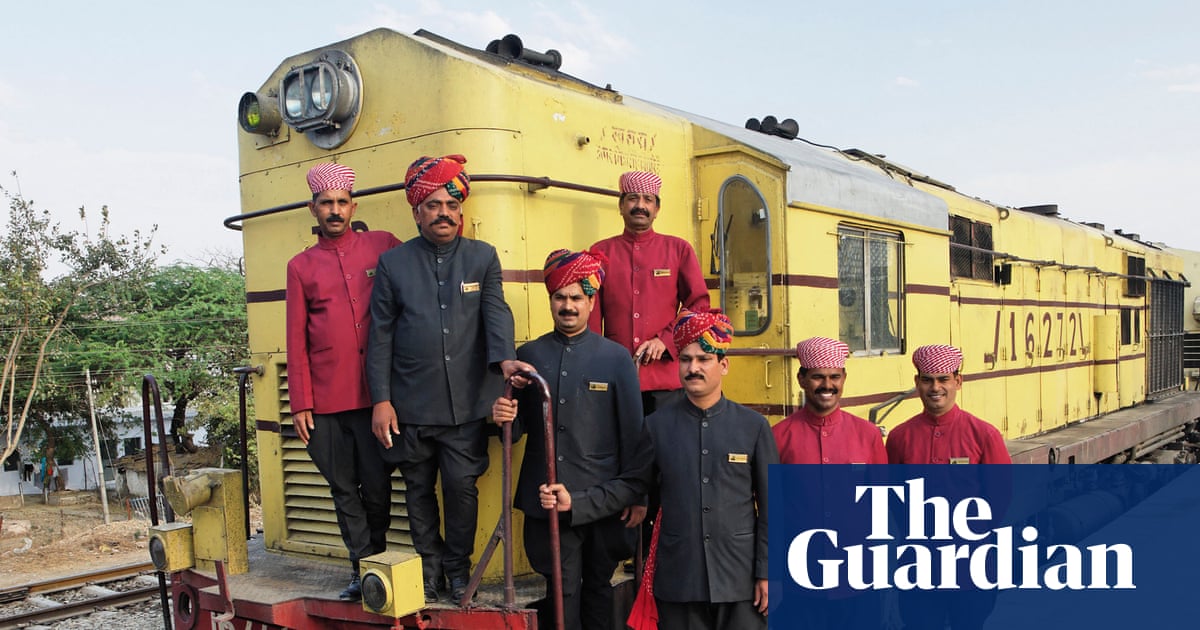
It is one India’s most ubiquitous garments, with origins in the grand Mughal courts and Rajasthani kingdoms of times past, and still widely favoured by sharply dressed grooms at wedding receptions.
But this week, the distinctive high-collared bandhgala jacket – known to many as the “princely jacket” in a nod to its royal origins – found itself at the centre of a lively debate after it was denounced by the Indian railways minister as a symbol of a “colonial mindset”.
In an attempt to “banish” such colonial hangovers, Ashwini Vaishnaw has declared that the bandhgala will be immediately removed as part of the formal uniform of Indian Railways staff.
“We have to get rid of all colonial mindset,” Vaishnaw said. “We need to find each of them and remove them, whether it’s in our working style or dressing style.”
But while the tailored jacket became part of the Indian Railways uniform in the late 19th century, during the time of the British Raj, it has been denied that the coat itself is a colonial relic.
Raghavendra Rathore, an Indian menswear designer and descendent of the royal family of Jodhpur in Rajasthan who pioneered the jacket’s design centuries ago, called the garment “India’s most refined expression of royal tailoring”.
“I think it’s unfair to say this jacket is not part of our own history or it’s the costume of another culture,” Rathore said.
“It has developed and evolved over four centuries, going back to the Mughal courts and the Rajasthan princely states. This jacket was here before the British arrived in Calcutta and it’s gone through a very fluid evolution since then.”
Narendra Modi’s government has pledged to free India from the legacy of more than 100 years of Britain’s colonial rule. Photograph: Altaf Hussain/Reuters
For Rathore, whose fashion label has focused on the traditional cultures and craft of the bandhgala, it remains a distinctively Indian garment that encompasses layers of history.
The now-ubiquitous closed neckline, the fitted and tailored torso and shaped shoulders of the jacket first emerged in the courts of Mughal emperor Akbar in the 16th century.
As the design evolved into a waist-length fitted jacket, it was then adopted in the courts of the Rajput warrior rulers and maharajas of Jodhpur, in what is now Rajasthan state, where it underwent further transformation and adaptation. The high neck was seen as particularly favourable for the chilly conditions of north India during the winter.
By the 19th century, the jacket had been further modified by the Jodhpur royal family to make it suitable as an outfit for riding horses and playing polo, to be matched with tight breeches now known more commonly as jodhpurs. It was as a polo uniform that the bandhgala jacket became popularised in the west by the early 20th century.
Far from being a western imposition, the adoption of the bandhgala jacket by Indian Railways in the late 19th century saw it replace more European-style frocks and tunics.
Rathore acknowledged there was some colonial influence on the evolution of the jacket during the time of the Raj. Elements were copied from British military uniform jackets, such as certain trims and tailoring, and other paraphernalia that were added to the designs. But “the jacket itself always remained Indian”, he emphasised.
The bandhgala is not the only relic to face the ire of the Hindu nationalist government of prime minister Narendra Modi, as it has pledged to free India from the legacy of more than 100 years of Britain’s cruel and exploitative colonial rule, which only ended in 1947. “The goal of a developed India is to remove any trace of the colonial mindset,” Modi said last year.
After Indian independence, the bandhgala was reclaimed as a nationalistic garment, and kept on as a formal part of the railways uniform. While Rathore conceded it was not always the most practical item for those working on the railways – particularly in the high summer temperatures – he questioned what might be brought in to replace it.
“There is much curiosity over what they will choose,” he said. “The hope is it’s not just an ordinary western suit.”