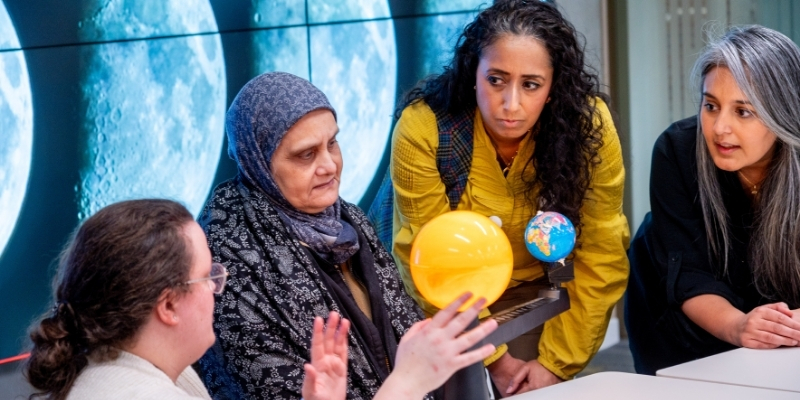
A new project which aims to provide Muslim communities across the UK with the skills to host local astronomy hubs and moongazing events has been established.
The Moonsighters Academy, a collaboration between the Universities of Leeds and Cambridge, is an innovative, nine-month public engagement programme, combining online and in-person training with outdoor astronomical observations.
The Islamic calendar is based on lunar cycles and the start of each month is marked by the sighting of the first crescent moon. The sightings also mark the start and end of Ramadan, Islam’s holiest season.
As earlier Muslim communities in the UK couldn’t establish regular lunar observations, often due to cloud cover, they tended to outsource their calendar to different countries.
However, as different countries see the crescent moon on different days, this resulted in communities within the UK not being able to celebrate Eid on the same date. Even within the same families, some may be fasting while others feast.
This project’s aim is to enable Muslims to conduct their own lunar observations here in the UK, which could help reduce the friction that can arise when mosques observe Ramadan or Eid on different dates.
Ultimately, this programme is about giving people the tools and capability to connect their communities to the cosmos, and I am very excited that we have been able to bring it to life.
Dr Alexander, Physics and Astronomy
The project is inspired by Cambridge PhD candidate, Imad Ahmed, whose research focuses on the Islamic lunar calendar debate in the UK, and who co-leads the curriculum design for the Moonsighters Academy. He’s also director of the New Crescent Society.
The project is a collaboration between the Faculty of Divinity and Institute of Astronomy at the University of Cambridge and the School of Physics and Astronomy at Leeds.
Creating communities of astronomers
Imad said: “My hope is that Muslim communities across the UK will end up having a co-ordinated way of celebrating religious festivals that all of them can share in. The project is truly inter-disciplinary, bringing science and social history together.
“By having a community of astronomers capable of conducting their own lunar observations here in the UK, we’ll be able to stop relying on word from abroad and eliminate much of the confusion that surrounds key milestones in the Islamic calendar.
“Muslims in the past have had a strong connection to astronomy and what I want is for us to go from moon-fighting to moonsighting to moon-uniting.”
The programme kicked off with a two-day residential training session at Leeds, bringing together participants from across the UK. It will expand through online sessions and resources, and a peer support network to enable communities to host their own local moon gazing events.
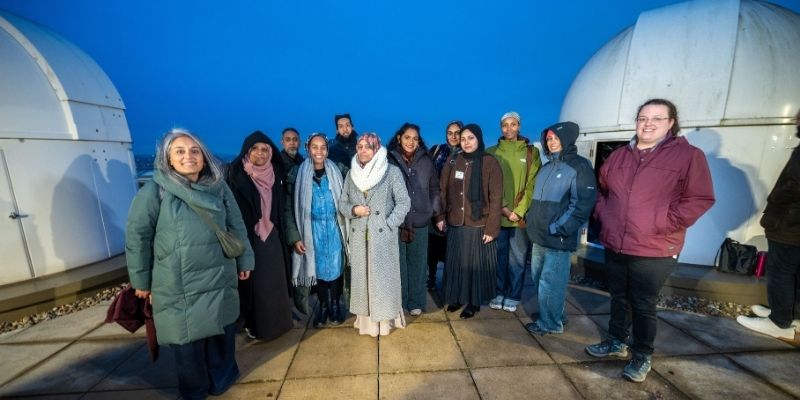
Moonsighters Academy participants with Dr Alexander (far right), between the University’s rooftop telescope domes.
Mohammed Attaur said: “I wanted to join this programme because it connects faith, science and culture and it’s trying to tackle a genuine problem in the community. I’m keen to contribute to this noble ambition of unifying the community.
“I’m hoping by the end of the nine months I will be fully equipped and skilled to lead a moonsighting group in Rochdale, make it fun and retrain other people so that the momentum keeps going and that in due course we will have our own little community of moonsighters in our town.”
Astrophysicist Dr Emma Alexander, Research Fellow at Leeds and project co-lead, said: “One of my favourite aspects of working in astronomy is being able to share it with others, especially when I can help ignite sparks of curiosity about our Universe and shake off stereotypes of who astronomers are.
“I am particularly excited that our cohort includes some brilliant female students at the start of their careers in astronomy and related fields; they are part of our next generation of excellence in British science, who will inspire others. Ultimately, this programme is about giving people the tools and capability to connect their communities to the cosmos, and I am very excited that we have been able to bring it to life.”
Combining science and culture
Erin McNeill, Physics Outreach Officer at Leeds, said: “We’ve brought together an amazing cohort from across the UK and created a space where community, culture and astronomy sit side by side. We believe that everyone is an astronomer, in their own way, and that looking up at the night sky together is one of the most powerful ways to connect science with everyday life.”
The 38 participants are community leaders from all over the UK and include imams, schoolteachers, scout leaders and at least one grandmother, with an even split between male and female. The course will build skills and empower moonsighters to conduct lunar observations in their own localities and spread the extra knowledge they’ve learned among their peers.
Participants were asked how and why they began to pay attention to lunar cycles. Several said having young children had increased their awareness of the natural world, while one recalled they had first started looking for the moon during the pandemic, finding it an enjoyable outdoor activity. While astronomy can be a solo endeavour, the cohort is united in wanting to get more people engaged in the quest for each new Moon.
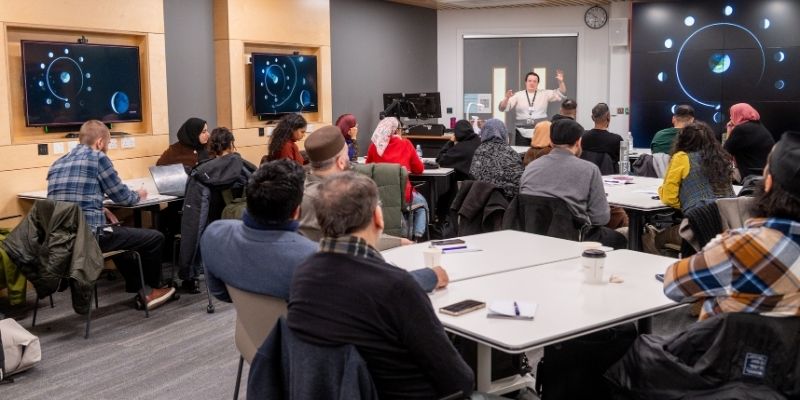
Dr Alexander leads a Moonsighters Academy workshop
Naz Shah, MP for Bradford West, joined Professor Nick Plant, Pro-Vice-Chancellor: Research and Innovation at Leeds, on a Leadership Panel at the event. She said: “The work that is being done here, on the Moonsighters Academy project, is second to none: it’s inspiring.”
Professor Plant said: “This unique project, which includes basic astronomy training for leaders from across the Muslim community, has the potential to be transformative for neighbourhoods across the country.
“The University of Leeds is committed to working with communities, and civic engagement, knowledge exchange and collaboration sits at the heart of our research.
This academy brings together scientific understanding, cultural practice, and community leadership enabling us to work with communities to bring real benefits to society.”
The project is funded through the Science and Technology Facilities Council (STFC) Spark Awards scheme, which aims to promote wider public engagement with STFC-supported science and technology, particularly in the fields of astronomy, particle physics, computational science and nuclear physics research.
Further Information
For further information or interview requests, please contact Deb Newman via D.Newman@leeds.ac.uk
All images by Mark Bickerdike for University of Leeds
Moonsighters Academy funding is via grant number UKRI3296