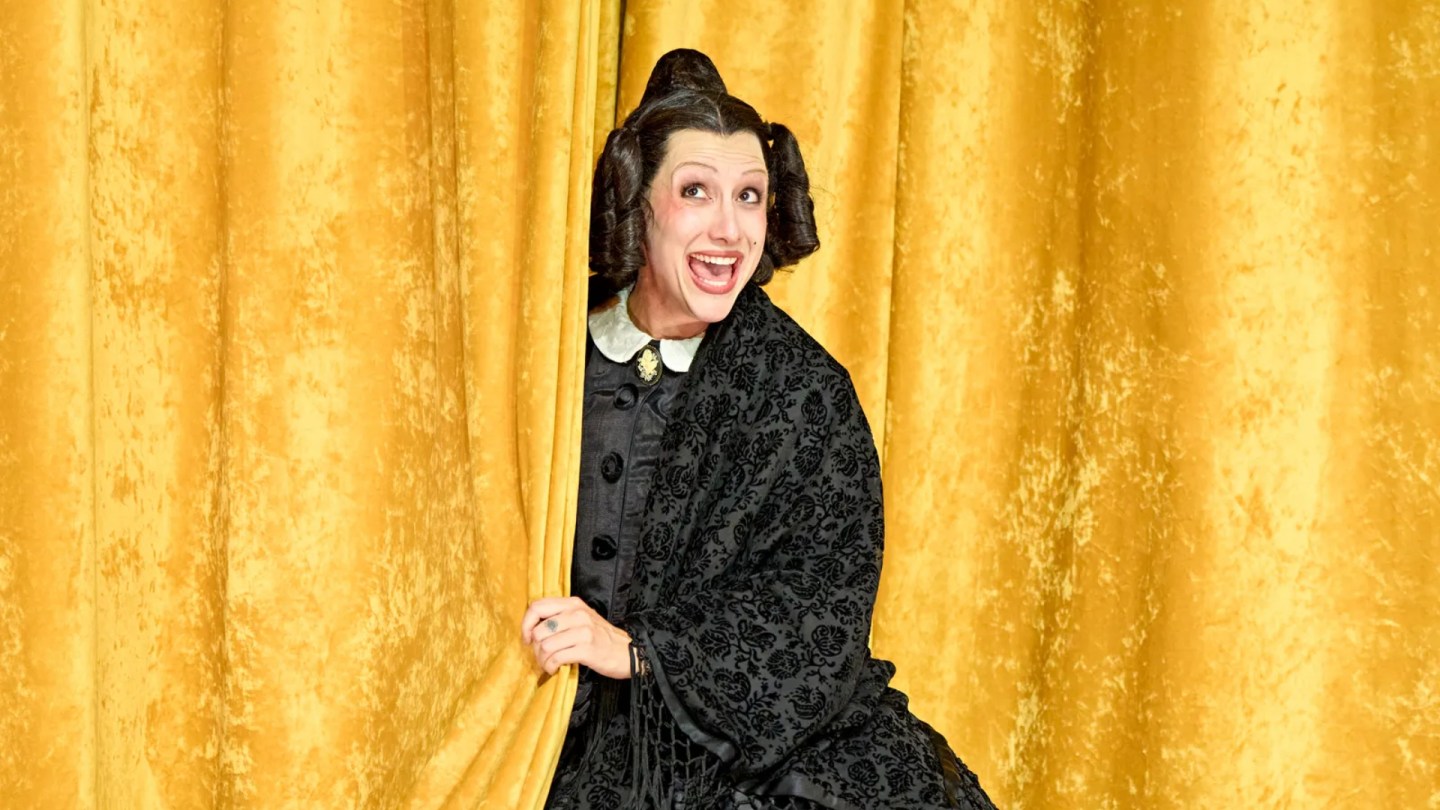
When Mason Alexander Park was passed the Oh, Mary! baton from friend Cole Escola to lead the West End transfer of the latter’s Tony Award-winning play, they weren’t immediately nervous about stepping into the boots of Mary Todd Lincoln.
Playing the wife of assassinated U.S. President Abraham Lincoln in this wonderful corner of the theater world requires a disregard for one’s inhibitions to the nth degree. She drinks like a fish, pushes White House enemies down flights of stairs, and happily bends herself over the corner of the Oval Office’s Resolute Desk for, well, no one’s pleasure but her own. “She is a demonic presence,” Park concedes to The Hollywood Reporter over Zoom in early January.
The American actor also wasn’t too apprehensive about the impeccable comedic timing required for director Sam Pinkleton’s 80-minute joyride, a wild, queer reimagining of the weeks leading up to Abe’s death from Mary’s point of view, nor the show’s confetti-covered musical numbers that demand a complete mastery of body and voice. So what was the sharp-witted Park, star of The Sandman, Quantum Leap, and undoubtedly one of the brightest talents on stage right now, more preoccupied with?
Three things, it turns out: You, me and those tricky theater critics.
“What I was most nervous about was the reception of the actual play itself,” says the North Carolina native about bringing Oh, Mary! to the Trafalgar Theatre. “Because it’s an import, and because famously [with] any sort of transfer, there’s always this snooty journalistic desire to bring something down a few pegs when it comes from America or vice versa. … I wanted the play, as a piece of writing, to succeed. I want this for Cole, I want this for Sam and for everyone that was involved in that original production. I want it to have the life here that it deserves, and I hope I’m able to give it that.”
Park’s qualms have been quashed in joyous fashion. London’s theater scene is fired up by the addition of Oh, Mary! — her beaming face backdropped by a vibrant yellow on posters and billboards plastered around the city — and though our troubled First Lady takes plenty of booze-infused tumbles across the play’s duration, Park doesn’t put a foot wrong. Such is their popularity — and the side-splitting efforts of cast members Giles Terera, Kate O’Donnell, Oliver Stockley and Dino Fetscher — that some of the biggest names in showbiz just can’t stop themselves from seeing what all the fuss is about. Luke Evans, Joe Locke, Ruth Jones, Hannah Waddingham, Sir Ian McKellen, you name it: The Brits want to see Mary Todd Lincoln chase her cabaret dreams.
Park’s no stranger to the West End, of course. They’ve played the Emcee in Cabaret here, and worked with director-in-demand Jamie Lloyd on The Tempest and Much Ado About Nothing. What’s been solidified with Mary’s introduction, however, is a mutual love. “I could so easily be trying to do theater in America while doing film and television or whatever,” says the performer, “but nothing has ever made me feel quite the way that being here and being in the West End has.”
Below, Park gets into the devilish debauchery of Mary Todd Lincoln. They discuss feeling wholly welcomed as a trans actor on the West End, why the silliness of the show only works if taken entirely seriously, and the toll that eight shows a week of Oh, Mary! takes on even the most committed of stage actors: “If you play her the way I play her, it’s a bit like having a panic attack for 80 minutes.”
This show was the perfect tonic for my winter blues. I was so impressed.
Thank you very much. It’s so great for being 80 minutes long, because this is the beginning of week six, and the amount of people that are sending me messages or tagging me [and] coming to the stage door going, “This is the sixth time I’ve seen the show,” it’s quite staggering.
I want to start with your friendship with Cole and how Mary landed on your desk, because I read that they were eyeing you for this before the news about Oh, Mary! coming to the West End was even public. Is that right?
I’m not really sure exactly how everything fell into place. All I know is that I’ve been a long time admirer of Cole, and supposedly both Cole and Sam have also secretly admired me from afar for whatever reason. The industry is so small to begin with, but especially when you are an alternative artist or queer artist, [you’re] finding your people or being aware of your people that are on the periphery of what is considered mainstream. It makes it an even smaller pool. That’s why we always had our eyes on each other from a distance.
I knew that I had a job in New York — I had written a show that was being performed off Broadway — and I was like, okay, I’ve got a week in the city where I’m just in rehearsal, so I can go and see stuff at night. And I knew I wanted to see my friend Darren [Criss] in Maybe Happy Ending, and I wanted to see Cole in Oh, Mary! so I booked the tickets… It was Cole’s last weekend ever in the show, after winning the Tony, and [later] I got a call from my British agent and and they were like, “Hey, so Mary‘s coming to the West End. And we were just asked if you would be interested.” I believe that was just from the producer side in the U.K. too. So it’s one of those things where you never really know who had the idea first, or where it was sparked. But upon talking to Sam and Cole after getting [the part], they both were very much like, “Oh, we’ve been talking about you for a while as someone who would be a really great Mary,” which was really nice and moving to hear.

Mason Alexander Park is no stranger to the West End.
Courtesy of Getty
Did you have conversations with Cole about passing on the baton? Did they give you any advice?
They did offer some advice and we talked a lot about the show, but I actually learned so much about it by watching it. Cole is a remarkable performer, but also such a brilliantly specific writer. I also write, and I love writer-performers so much because I think that if you’re locked in with what it is that they’re doing, you can understand the needs of the play and the needs of the role. It was so clear from watching how Cole attacked Mary Todd. When I saw, it made so much sense to me: how the play works at its best. So a lot of my questions were just naturally answered by observing. I didn’t really ask for a lot of advice from Cole, mainly because I knew that we also wanted to build something different with the West End production, and it was a completely new group of people who had never done the play before. So there was this desire for Sam, our director, and for everyone involved, to treat it like it was a new play, and to not try to copy and paste anything from the Broadway production unless it was absolutely vital… That momentum is really useful to the play, and I know that treating the play like it’s an absolute emergency is the way to keep ahead of the audience. But beyond that, I’m going to treat Mary Todd like she’s me in some capacity and I’m going to do my thing with it.
Was that liberating, or more nerve-wracking?
I’d say it was quite liberating, because the authenticity of any performance really thrives on the individual actor believing themselves and believing what they’re believing in themselves — believing that what they’re doing is worthwhile in some capacity. So I know what I can bring to a room, and I know what skill sets I have that are useful to Mary. Being encouraged to play and bring as much of myself and my… [raising an eyebrow] secret talents [laughs] was really liberating and allowed me not to be too nervous.
I think what I was most nervous about in this process was the reception of the actual play itself. I was nervous because it’s an import, and because famously [with] any sort of transfer, there’s always this snooty journalistic desire to bring something down a few pegs when it comes from America or vice versa. I was a bit nervous that that was going to be the case. I’m sure it has in many ways, but in so many ways it hasn’t, which has been really amazing and has allowed us to just feel like, “Yeah, this play is a Pulitzer Prize finalist.” It’s an amazing piece of theater. It isn’t just some silly, dumb, night out. There is so much that’s being said within the piece as well. I wanted the play, as a piece of writing, to succeed, and I really was nervous that a lot of that has to do with Mary, and a lot of that has to do with people believing in her. So that was, maybe, the only nerve-wracking aspect of it: I want this for Cole, I want this for Sam and for everyone that was involved in that original production. I want it to have the life here that it deserves, and I hope I’m able to give it that.
You’re right — there’s an odd sincerity to this play that works so well. It’s utterly salacious, but it’s 110 percent. It’s all or nothing. It’s Pulitzer finalist writing, and taking it as seriously as you do is what makes it so brilliant.
It needs to be the most serious thing. It has to be the most important thing. Otherwise, the audience doesn’t necessarily go along with the ride and with the surprise. It moves at such speed that you have to get on this train that’s already moving, and you invite 700 people to do that every single night. It requires a lot of energy and a lot of trust in the company. I think they were really smart in hiring not only remarkable performers, but proper actors to do this show. I don’t necessarily know if I consider myself a proper actor. [Laughs.] But Giles Terera and Dino Fetscher and everyone that I’m in this company with is an astoundingly talented dramatic actor on top of being absolutely ridiculous. Being able to commit to the ridiculousness requires this deep well of belief.
Do you feel like you’ve settled into a rhythm with the show now?
Oh, we’re definitely in a rhythm now. I think we were just given so much. We really were set up in the best way by this team. Everyone feels really cozy and really able to play and bring whatever is going on with them that day to the stage. I think it’s made such an electric company and such an electric experience. We are all there with the same mission in mind. And we know how brilliant this play is and how fun it is, and how amazing it is to send all of those people out into the world completely buzzing because of of the play.
You’ve done a few bits on the West End now. You live in London. What have you noticed about the difference between Broadway and West End audiences? I know we can be a bit quieter here…
With this play in particular, having seen it in New York a lot and seen it here — everyone’s really leaning in here [in London], which I love. People are listening to the play. So sometimes, I feel like British people will laugh to themselves but they’re trying to be very polite! They don’t want to ruin anyone else’s experience. We always appreciate when there’s a handful of gays in the front that have loud cackles, and you’re like, “There we go.” The whole audience immediately feels that they have permission to not have to be so polite. And then those nights are feral — it feels like you’re on Broadway.
In New York, I think sometimes the audience can laugh before the joke even happens, because they’re just so primed and ready to be there. And I don’t necessarily know that either is a better situation. I personally am in love with the audiences that we have here, and I think the play is meeting them in such a nice place, but, yeah, New York is just naturally far more commercial, and it’s far more boisterous. [In London], everyone still has this really high-end artistic air about about the theater community, which I think is fabulous. I hope we can hold on to it and not get too Disney-fied in the West End, you know?
There is a very deep respect for theater on the West End.
Yeah, and God bless! [There’s] truly just the deepest reverence for this art form in the city, and that is just so unique to the U.K., and it’s a major reason why I’ve remained here and why I’ve fallen in love with working in London. Because I could so easily be trying to do theater in America while doing film and television or whatever, but nothing has ever made me feel quite the way that being here and being in the West End has. So this has become home because of it.
Dino Fetscher and Mason Alexander Park in ‘Oh, Mary!’ at the Trafalgar Theatre.
Photographer: Manuel Harlan
On the night I came to see the show, Ruth Jones and Hannah Waddingham were in the row in front of me. It was celeb-spotting galore. So many famous faces have come to support you guys — have you been particularly starstruck by anyone?
I mean, those are great examples. I’m always moved when my friends come and when people that I’ve worked with come. Speaking of Ruth Jones, like Mat Horne, who was also in Gavin & Stacey with her, we did The Tempest together [on the West End] this time last year. And Mat came in. There was something about seeing him — someone who I adore as a comedian — like, bowled over crying-laughing in the third row at a matinee… It was just so moving to me, and really made me feel very supported.
But, you know, Sir Ian McKellen has been very gracious, and I’ve met him many times since I’ve made London home, and he’s seen me in a few things. There was just something very special about having him come back on press night in particular and just spending some time with him, talking about how the Trafalgar Theater was the home of farce in the U.K. and this is a return to a major theatrical movement in in U.K. history, which I just I found really, really special, because everyone reveres [him].
I feel like I see Sir Ian everywhere. Such a little theatergoer.
He’s always out there! A little theater girly! I love that. I hope that’s me whenever I’m Ian’s age — if I make it! — I would love to still be so curious about the world and so engaged in the community. He is so active and engaged in this art form and it is so inspiring. The longevity that it makes you want to aspire to is really unique.
I was also really happy to read that you’ve felt very welcome as a queer performer, as a trans performer, on the West End in London. What you and Cole and everyone involved are doing feels, sadly, quite urgent at the moment. Have you felt the weight of that or has it been quite lovely?
The whole thing has just been so lovely. There are obviously moments where the joy of this piece reminds me of how necessary it is for queer people, in particular, to be platformed in a joyful way. So much of the conversation around transness [and] so much of the conversation around gender non-conformity and queerness, in particular to the U.K. media, is in the complete opposite direction. It is all just drab and and terrible and inflammatory and attempting to create this narrative that is in actual opposition with the reality of most queer people’s daily expression. Most of the trans people I know are vibrant and beautiful and remarkably gifted and happy — and don’t run into an issue every hour on the hour. But we’re sort of led to believe that there’s this trans menace in the U.K. that is slowly tearing apart society, which is is quite flattering in some in some ways, to think that a very small minority has that level of influence and power.
But the reality of it is that we are just some of the most mundane and remarkably normal people on earth and that is certainly not the narrative that’s being pushed constantly. So I think as a trans person leading in my fourth West End show now, and acting opposite another trans actress, Kate O’Donnell, who’s [making] her West End debut… Us just being in a play in which it isn’t actually about anything in regards to the trans conversation. We are just performers. We’re just actors playing these ridiculous roles and making people laugh like very, very hard every night. That is radical to me. Like that is such a radical expression of resistance, artistically. It’s such an antidote. The amount of trans people and queer people that have come to the show and have just been like, “This is exactly what I needed. I just needed to see something super silly and to be surrounded by people that are all in love with this group of performers and not really thinking about anything other than that.” Oh my god, it’s so, so cool.
There are such good vibes in that theater, where everyone is so willing to be swept up in 80 minutes of raucous entertainment. You mentioned dipping your toe into film and TV and one of your biggest roles to date was in The Sandman. Could you be tempted back into that world?
Oh, any day.
Really?
Any day. I would love to. Obviously, film and television is so hard scheduling wise if you’re looking to build a life in the theater… Finding that balance is always this impossible game of chess. I think I’ve done it really well the last five years. I’ve been very, very, very lucky to have shows like The Sandman and Quantum Leap in my life for years, and also then sneak away and go, “Okay, I’m gonna go do Cabaret for like, five months on the West End and then I’ll come back to Quantum Leap.” So I’m hoping, because this past year I’ve only been doing theater for about a year now, and it has been so fun, but I definitely am looking forward to finding a year coming up where I can balance it out a little bit with a film or television gig. Just to keep mixing it up, you know? It’s good for the brain and body to be playing in all different sandboxes. I think it keeps you on your toes and in a state of learning.
And you must be knackered…
I am a bit tired, but in the best way. [Laughs.]
Mason Alexander Park as Mary Todd Lincoln and Giles Terera as a closeted Abraham Lincoln in ‘Oh, Mary!’
Photographer: Manuel Harlan
How many shows a week?
We do eight. And this show is relentless for Mary — if you play her the way that I play her, it’s a bit like having a panic attack for 80 minutes. The level of stress that I am putting my body under, because your body doesn’t really know the difference between pretend and not, it’s amazing. I’m going to be a very different person by the end of the show. [Laughs.] I can’t wait for a nice vacation.
What do you do to unwind after a show and get that heart rate down?
Honestly, just going home. I love being at home and doing nothing. I love eating a very late night meal. A hot, creamy meal at night and watching silly TV. At the moment, I’m watching my friend Tom Hiddleston’s show, The Night Manager, which I’d never seen. My partner and I were like, “We should start this.” And we are helplessly addicted to it! The amount of messages that I’ve been sending him…
So glad that you’re watching British TV as well.
Oh god, yeah. Well, all my friends are on it. [Laughs.] When we started season two, Kirby [Howell-Baptiste], who played my sister on The Sandman, is literally [Hiddleston’s] therapist. Like, the first shot that you see. It’s really comforting. It makes me happy to see people that I love do what it is that they’re meant to do.
How would you describe Mary Todd Lincoln to someone entirely unfamiliar with the show?
That’s tough. I mean, she’s erratic. She is so passionate and she’s a menace. Those are the three words I would use, because she wants so badly to be good at what she does, and she just wants a stage to be able to show the world everything that she’s had bottled up inside her for years, which is something that I think every human being on earth has experience with. We all know what it’s like to have potential, whether that’s real or whether it’s something that is completely in our minds. We all have felt trapped in ourselves and in our gifts, and not necessarily seen. She just wants to be seen! She goes about being seen probably the worst way any human being can. She is a demonic presence. But I can’t help but love her because of that. It is sort of all the worst parts of me and all the people that I love dialed to 10 and spilling over. She’s a remarkable creature.
If she were transported to 2026, how do you think she’d be living her life?
Oh god, that is so hard to say. I want to say she’d be doing cabaret, but in reality it’s an art form that I don’t think would necessarily supply her with the platform that she would want in 2026. I think she’d be a TikTok star. I think she would be a dreadful influencer. Someone that was so divisive and creating content that was purely based on hatred.
Getting canceled every other week.
Oh, yeah. [Laughs.] An absolute menace.
Oh, Mary! is running at the Trafalgar Theatre until April 25, 2026.