
What is it really like to be a football manager?
How do you escape the pressure? What impact do results have on your family? How long are the hours? Where do your best ideas come from? Do players still get a rocket at half-time? Can you wear what you want on the touchline? And, most importantly of all, how do you choose from 17 different varieties of cider?
To find out the answers to all those questions and more, The Athletic spent a month with a head coach in the most volatile and unpredictable league in English football: the Championship.
Gerhard Struber, a 48-year-old Austrian, took over at Bristol City last summer after spells with Koln, Red Bull Salzburg, New York Red Bulls, and Barnsley.
In between a manic run of eight matches across 32 days, I met up with Struber on five separate occasions.
We ran around the harbourside on an evening discussing football and fate, travelled to a Bristol City game together (in Struber’s case, wearing blue jeans), watched Christmas pass by next to a half-opened suitcase, and signed up for flying lessons in a pub while drinking, or at least trying, a pint of Natch.
It all started, though, with a Christmas treat and half-time handshakes.
Thursday, December 11, Society Cafe, Bristol: A comeback and canteen mutiny
Gerhard Struber orders an espresso and scans the food counter.
“I think we should have a mince pie each,” he says.
Struber must be tired. It was late when he left Ashton Gate last night after a 2-2 draw with Leicester City that featured a stirring second-half comeback.
There were post-match conversations with players, staff, the media and the owner to digest, plus the game itself to dissect, as well as another Championship match to think about, against league leaders Coventry City, in less than 72 hours.
“I drive away with all this information,” Struber says. “And when I sit in my car, it’s the first time that I’m alone.
“Normally, I call home, but it was not possible because it was midnight in Austria. So I get back, and then I reflect on the game. I look at some clips before bed. Sometimes the night is long. It’s two or three in the morning before I go to sleep. This morning it was 02:30.”

‘I think we should have a mince pie each,’ says Struber (Stuart James/The Athletic)
Half-time felt pivotal against Leicester. Trailing 2-0, Bristol City were in trouble.
I show Struber a message posted on social media early in the second half, when his team had already pulled a goal back.
‘Struber’s put an absolute rocket up them at half-time.’
Struber smiles and shakes his head. He was “super angry and disappointed” after the first half, he says, but there were no fireworks in the dressing room. Instead, Struber talks about “a healing process”.
He did what he always does at half-time: left the players alone for a few minutes while he talked to his analyst. That space, Struber says, is good for everyone. “The boys have the chance to speak in the dressing room without coaches. They cannot sit and say nothing. They are confronted with themselves and this, I would say, is really healthy.
“Then I come in, go to every player, a small handshake, and I start my speech.”
A handshake with every player, even when losing 2-0?
“Every player,” Struber replies. “I want to look him in the eye, see a commitment. Also, when something goes wrong, or something goes great, we always have the same routines.”
The motivational messages, tactical tweaks and double substitution worked. Bristol City scored within 60 seconds, equalised seven minutes from time, and came close to a winner.

Emil Riis Jakobsen on the ball as Bristol City battle back from 2-0 down against Leicester (Michael Steele/Getty Images)
But that excellent second-half performance wasn’t the only thing to give Struber food for thought today.
Four players — Struber’s “leaders” — came to see him this morning to discuss the training ground menu. “It was Jason Knight, Rob Dickie, Adam Randell, and Anis Mehmeti, and they were crystal clear: ‘Coach, we can’t eat that. It’s not fun’.”
Struber laughs at their polite indignation.
Is he a manager who doesn’t like players having tomato ketchup?
“Yes, but it’s not only ketchup and mayonnaise. We sometimes have food with tasty sauces and, of course, the players like it, but it’s not always healthy. So we changed it, and the outcome was the players aren’t going to lunch.”
That left Struber with a decision to make. “I could be a little bit stupid and stubborn and say, ‘No, we go my way’. But when I have bad energy in the end because the players are not eating, it’s a lose-lose.
“So, firstly, I told them I’m very happy that the boys are so open with me. But, at the same time, they know we have to change a bit, so we met in the middle. In management, you have to compromise sometimes. My chef is happy, my players are happy, and I can also live with it.”
December 13: Coventry 1-0 Bristol City
Thursday, December 18, Bristol City centre: The running man and sliding doors
It’s 7pm and we’re pounding the streets of Bristol, over cobbles, up and down steps, around the harbourside, and weaving in and out of the Christmas partygoers spilling out of the pubs.
“It’s not easy with all the games in England to find time to go running every day,” Struber says. “But today I went running in the morning, then I had a short slot in the afternoon, so I went for 25 minutes, and now we go again.”
Struber is football management’s answer to Forrest Gump.
Running has become a way of life for him ever since he took over as the New York Red Bulls head coach in 2020 and realised that living in a hotel, working long hours, and ordering pizza was a bad combination.
“After three weeks, I looked in the mirror and thought: ‘This is not my expectation of me’.”
Struber started running. And didn’t stop. “Every day,” he says. “I was so fit that I went running with my boys (the team) in Central Park and I was on the same level as the top players.”

Struber has been known to go running three times in one day (Stuart James/The Athletic)
In Struber’s eyes, the benefits are far-reaching. “When I run, I always get good ideas. I think, ‘Tomorrow in this speech, I want to go a little bit in this way’, or, ‘I have to speak to that player’. But also, my condition is so important for my work energy and how I am in front of my players — this influences them.”
Asked to elaborate, Struber says: “I think players look at you. They watch you. You are always a bit of a role model. Actually, I would say the whole club is always looking a little bit at the manager: how he’s dealing with things, what he’s saying, how he acts. And this is always the way when you’re a leader. It was the same in the Allianz group.”
Allianz is a big part of Struber’s backstory. After retiring as a professional footballer, he spent eight years working for the German insurer, managing a team of salespeople. He was highly regarded, loved his job, and had no plans to leave. But football and fate intervened.
Christoph Freund, his former team-mate and now the sporting director at Bayern Munich, met him for lunch one afternoon. “I said to Christoph, ‘Hey, Kuchl, my village team, is playing — should we go?’.”
Kuchl, playing in Austria’s fourth tier at the time, lost the match, but Struber got a tap on the shoulder afterwards. “I know the head of sport and he said, ‘Gerhard, please, we are last in the table. Can you help us? Only for four games’.
“I said, ‘I have no time’. But then I thought, ‘No, for four games, come on’.”
Struber smiles. “We won three and drew one. I thought: ‘Well, what is this?!’ I felt I made an impact.”
Four games turned into the end of the season. The end of the season turned into the start of another. Kuchl kept improving and Struber, coaching three times a week in between working for Allianz, was hooked. “Only in sports can you create emotion like that — it triggered me completely,” he says.
But the real sliding-doors moment came later, in 2013, when Kuchl played a friendly against Red Bull Salzburg. With Ralf Rangnick, Salzburg’s sporting director, looking on from the stands, Kuchl went toe-to-toe with the best team in Austria, pressing them relentlessly. “It was 0-0 at half-time. We played really good,” Struber says.
Rangnick asked for a meeting afterwards and ended up offering Struber a job as Salzburg’s under-15 coach. “He said, ‘You would get a three-year contract’ — and this was a really good contract.”
Struber was torn. “I had a top job at Allianz. I asked my wife: ‘What should I do?’. She said: ‘What would you do if you only had one year to live?’. Then it’s 100 per cent I go to football. So I jumped back in.
“But I’ll never forget when I had to tell my boss at Allianz. He invested so much in me. I can see the tears in his eyes, but also in my eyes. I would say deep in his soul he felt, ‘That’s good for you’. But many other people thought, ‘Is he crazy? Does he have no responsibility for his family going to the world of football?’.”
I think he’s crazy for running three times in one day.
“Sixteen kilometres,” Struber says as we get back to where we started.
Saturday, December 20, Ashton Gate: Blue jeans day
“Not good news,” Struber says as he opens his office door at the training ground. “Radek Vitek had a bad knee injury yesterday in training. He needs surgery.”
On loan from Manchester United, Vitek is Bristol City’s first-choice goalkeeper. His absence feels like a huge blow, especially the timing. Second-placed Middlesbrough are visiting today, the busy festive schedule is coming into view, and Struber already has lots of injuries.
How many players are out?
“Look behind you,” Struber says, pointing to a whiteboard with passport-sized photos of every player in the squad.
The eight injured players are grouped together.
Struber shrugs. “This is football and you have to deal with that.”
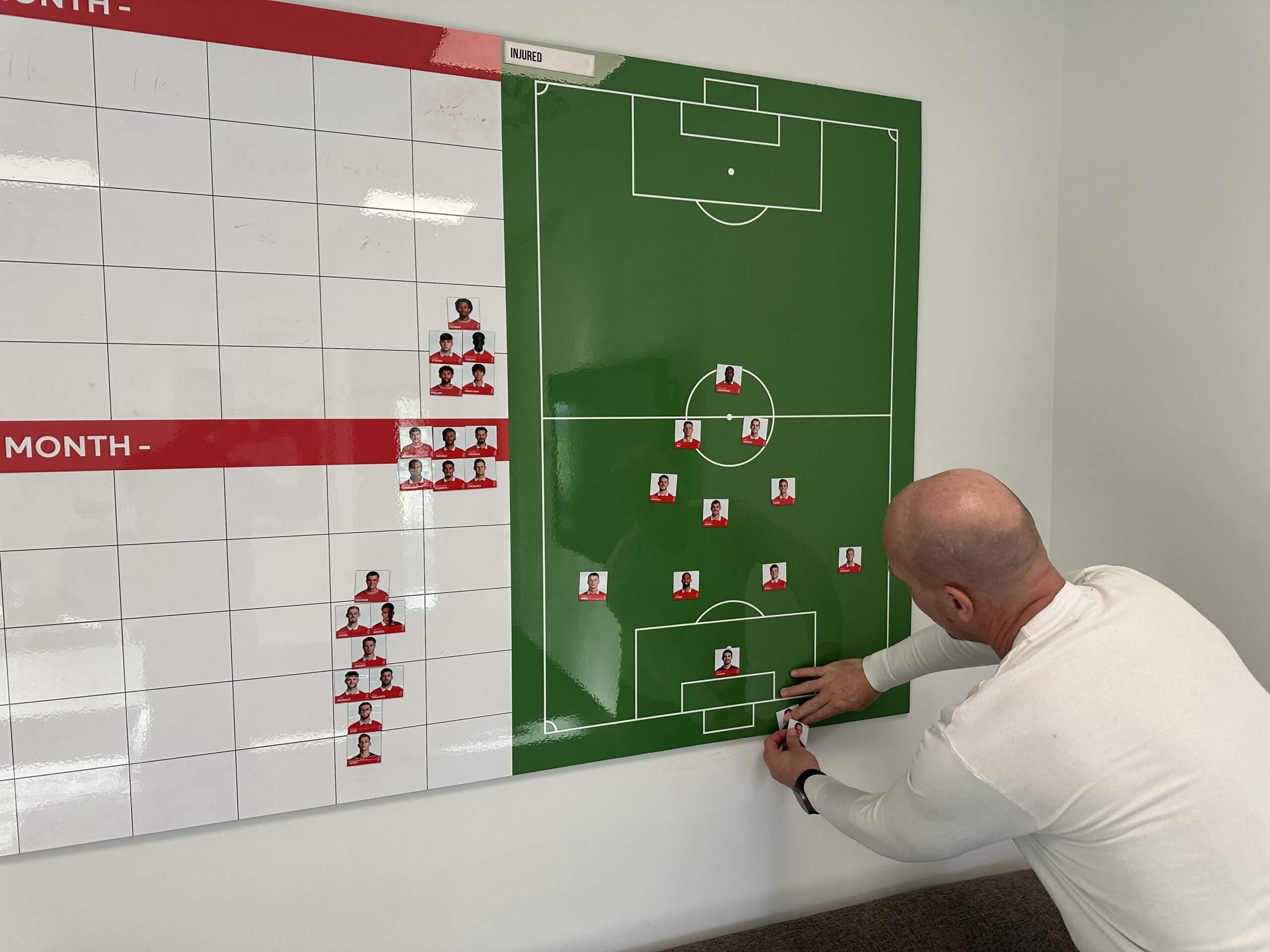
Bristol City’s injury list grew as the fixture schedule became more challenging (Stuart James/The Athletic)
It’s 12:45, two and a quarter hours before kick-off. Struber has been at the training ground since 08:30. The players arrived much later, initially for a set-piece meeting. Struber attaches a lot of importance to throw-ins, in particular how to recycle the ball through rotations, and finds it strange that some coaches are more preoccupied with goal kicks, bearing in mind there are so many more throw-ins in a match.
“It’s the same when we speak about on-ball moments for a player,” he adds. “How long do you think is the average time that players are on the ball in the Premier League?”
I guess two minutes. “It’s only one minute,” Struber replies. “And then you have 89 minutes without the ball.”
Having glanced at the tactics board, I notice Bristol City are set up in a 4-3-2-1 formation.
“So we have Christmas, and we play with the Christmas tree,” Struber says, smiling. “The system is a little bit different, but I think this could work on a really good level today.”
Struber looks at his watch — we need to leave for the stadium. The players travel by coach from the training ground, but Struber drives his car for the 10-minute journey.
With all the planning over, I wonder how he’s feeling. “Excited,” he replies. “This is a big chance to send a statement. But it’s not always about sending a statement outside; it’s also for ourselves.”
It’s a beautiful December day, so much so that Struber puts his sunglasses on in the car. He’s also wearing blue jeans and white trainers, which is an unusual look for a manager on a matchday in England.
“I know that!” Struber says, laughing. “I got many messages about my jeans after the Southampton game, which was the first time I’d worn them here. The fans gave me great appreciation for that. It’s normal to coach a team in Austria or Germany wearing this. But not here.
“I think every coach must have his own way. Sometimes I see Championship coaches go to matches like they’re getting married, in a suit, but that’s not me. I feel good with jeans, I feel good with sneakers. I remember when I did it at Barnsley and one fan said, ‘You look like you came from the pub to the stadium!’.”

‘I got many messages about my jeans after the Southampton game,’ says Struber (Stuart James/The Athletic)
As we pull into Ashton Gate, some supporters spot Struber. His biggest fan, however, is wearing a high-vis jacket.
“Gerhard!” says a steward, offering a handshake as Struber winds down the window.
“Hello. How are you?” Struber asks.
“Gerhard, you’re my best friend after that little scrap against Millwall,” the steward says. “You have gone so much higher in my estimations. You have a good day.”
“Thank you,” Struber says, smiling and not quite knowing what else to say in response to the mention of a mass brawl that took place at the end of the Millwall game a fortnight ago.
Struber parks and grabs his bag. “I hope we can celebrate today,” he says. “But you know this will not be easy.”
Three hours later: Bristol City 2-0 Middlesbrough
December 26: West Brom 1-2 Bristol City
Sunday, December 28, Bristol City’s training ground: Have bag will travel… far away from Salzburg
A half-opened suitcase rests next to Struber’s desk.
“I always live out of that,” he says, laughing. “We travel a lot. We came from West Brom. We go to London today to play Millwall tomorrow.”
Struber also went to Austria earlier in the week to see his family, returning to Bristol on Christmas Day for a training session 24 hours before the Boxing Day game at West Brom.
The festive schedule is relentless — four fixtures in 10 days — meaning there is little opportunity to spend time with those close to him.
“We are a really big family and Christmas is the only chance that everyone, including my parents and my parents-in-law, sit at the table together,” Struber says. “It has a big value in my family, so this year was not easy.”
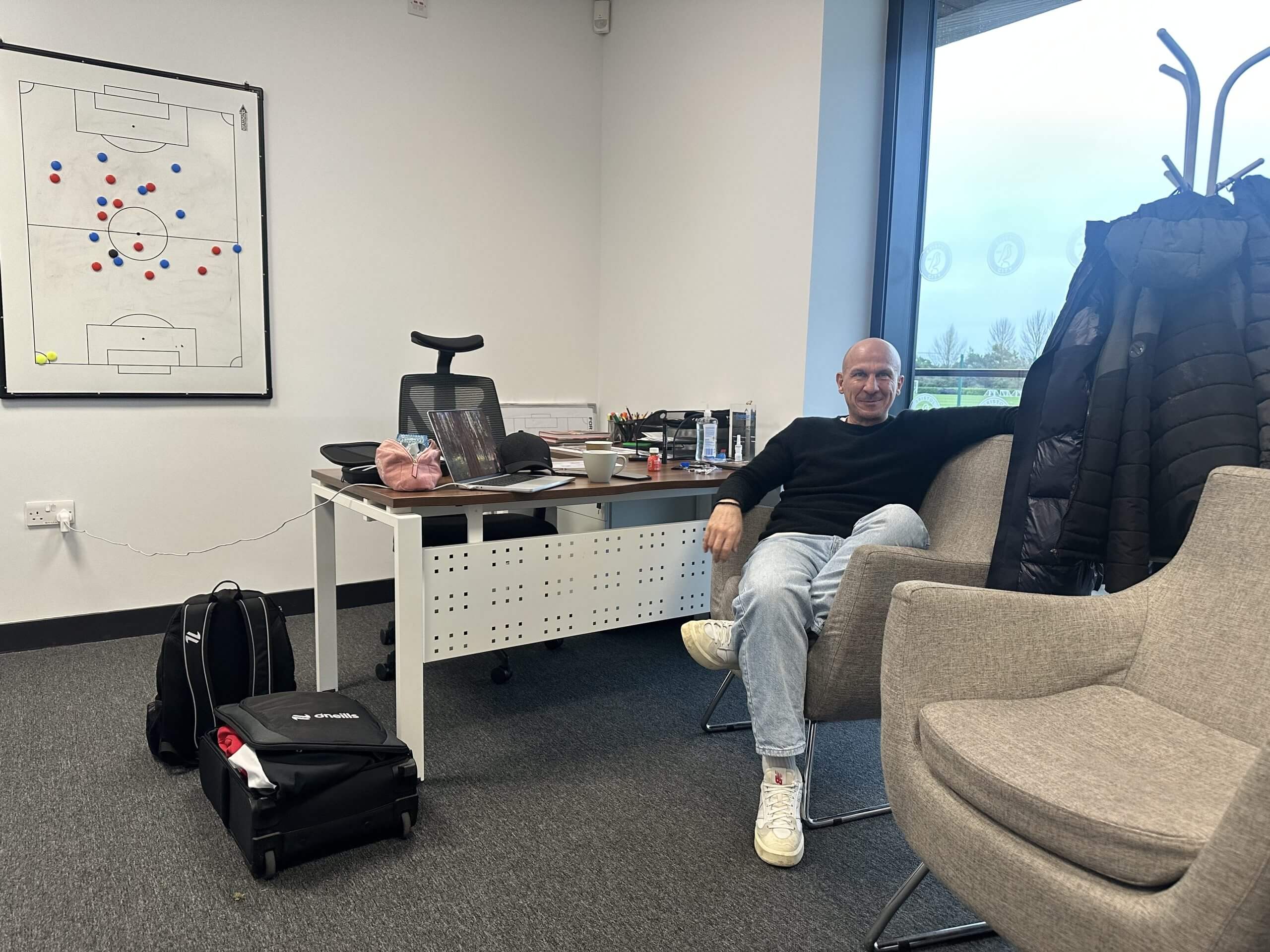
Struber largely lived out of a suitcase over the busy Christmas period (Stuart James/The Athletic)
Lisa, Struber’s wife, and their two children, Simona, 24, and Bastian, 16, live in Salzburg. It’s tough being apart — Struber misses the little things, like being able to drive his son to football, or having breakfast as a family.
But moving everyone over from Austria makes little sense. “My wife is working there. My son is in school in Salzburg, and my daughter is working in an elementary school, like a teacher,” he explains. “I could bring them out and after three months, maybe without the results we want, the club say, ‘Gerhard, please search for a new club’. My family know that the football world of a head coach is not romantic.”
It’s natural to think that life was perfect for them all when Struber was managing Red Bull Salzburg during the 2023-24 season, but nothing could be further from the truth.
“I came back from America and thought, ‘Well, now I can work at home, be together with my kids, and have a Champions League club in front of my house’. But this, in the end, was really difficult,” says Struber, who lost his job in April 2024, with Salzburg joint top of the table but out of form.
“I can tell you now that I would always — and especially for my family — work a big distance away from my home city because of how people were bringing, without boundaries, criticism to me or to my kids. That was so bad in Salzburg. My kids can do nothing about it — their father is a football coach — but they got so much s*** on social media about me.”
Indeed, Struber says there have been times in management when he has felt worse for his children after a defeat than he does for himself, “because I know what questions they have to answer when I lose”.
Financially, the job is rewarding. But clearly, there are huge sacrifices, too. I wonder whether Struber’s children ever asked their father if he could go back to doing something different to allow him to spend more time with them.
“Never,” he replies. “Simona and Bastian know what the job means for me. At the same time, I would say we have really high-quality time when we come together. Maybe when you do things every day, you don’t have the same appreciation that we have for that.
“And the solution is that my family visit me here, and I nearly always find a slot in the international break to go home. It’s normal in our Struber family world.”
December 29: Millwall 2-1 Bristol City
January 1: Bristol City 5-0 Portsmouth
January 4: Bristol City 0-2 Preston
Thursday, January 8, The Orchard Inn, Bristol: Cider, flying, and promotion
“In Bristol, it’s like a religion,” Struber says.
Standing by the bar at The Orchard Inn, Struber is talking about cider — a drink that is a staple diet of West Country life and deeply embedded in the fan culture at Bristol City, too.

Struber partakes in the Bristol ‘religion’… cider (Stuart James/The Athletic)
‘Drink Up Thy Zider’, by Adge Cutler & The Wurzels, is played at Ashton Gate after every victory, and ‘Gerhard Struber’s Cider Army’ is a regular chant from the stands.
None of that, however, helps either of us to know where to start with choosing one of the 17 different varieties of cider listed on the blackboard in a backstreet pub that first opened its doors in 1834.
“Some stories have happened here,” Struber says, looking around.
Struber goes on to tell a surprising one about himself, but not before a local has talked us into sampling what he’s drinking.
“Give it a try, it’s fizzy,” the man says, holding up a full glass.
It’s Natch, a dry, strong cider.
Struber takes a sip and shakes his head.
“You don’t like it?” asks the man, laughing.
“No. Absolutely not!” Struber says.

A local tries to get Struber to try a pint of Natch (Stuart James/The Athletic)
In the end, we both order a pint of Ember – spiced cider with blackberry – and take a seat.
Some football managers make little connection with the area where they work, but Struber’s relationship with Bristol goes well beyond travelling between his apartment and the training ground.
This pub, close to the marina but hidden away and probably unknown to a lot of Bristolians, is familiar territory for him following a stroll with a colleague in pre-season.
“I like the city,” Struber says. “To run on the harbourside, I feel the history with the big ship, the SS Great Britain. And, of course, I feel that there are many people in the city who love football, who love Bristol City.
“In the stadium, they sing ‘Struber’s Cider Army’. When you hear that, it gives you the feedback: ‘Hey, they like me, they appreciate the football we play’. But I’m not a dreamer. When you work in this world, you have to accept the rules. I know we have to win. When you lose too much, you can smile the whole day, no one will applaud. Everyone will say, ‘Please go back to Austria’.”

Struber has already built a strong relationship with Bristol (Stuart James/The Athletic)
As Struber takes a sip of cider and puts down his glass, he drops something unexpected into the conversation.
“I’m not sure this is possible time-wise, but I would like to get my private pilot licence,” he says.
Seeing the shocked expression on my face, Struber explains how he has been fascinated by planes ever since he flew for the first time as a 16-year-old player with Salzburg. Many years later, when he was Salzburg’s manager, he spent some time in the cockpit and loved the experience.
“I dream a little bit about it, so I want to start — maybe in Bristol,” he adds. “Next to my stressful job here, maybe it’s something where I can come in touch with completely different people, different topics, and I like that.
“Right now, I’m at the beginning of the process, in a pilot pool. It’s the medical appointment, and then it’s a case of how much I can do online from the theory, and of course, then you have to do the practical — I have to fly.”
For now, his priority is getting Bristol City’s promotion push off the ground, and Struber sounds super motivated on that front. They are currently 10th, but only two points outside the play-offs.
With the New Year in mind, Struber plans to hold a “kick-off event” away from the club to “change the promotion culture” among players and staff.
“We can see that performance is on a good level, but results… not stable enough to be in the best spots in the league — that’s my feeling,” he says. “So we have to do everything in our hands to bring out the best from the players. I want us to go training every day and speak about promotion, and of course, our actions must reflect this, too. Average is not enough. We have to think bigger.”
It seems that Struber’s glass is half full in Bristol in more ways than one. I point to his cider, which doesn’t seem to be going down.
Struber looks at his watch and the daylight outside. “I think it’s maybe not the right time for it,” he says, laughing.
January 10: Bristol City 5-1 Watford (FA Cup)