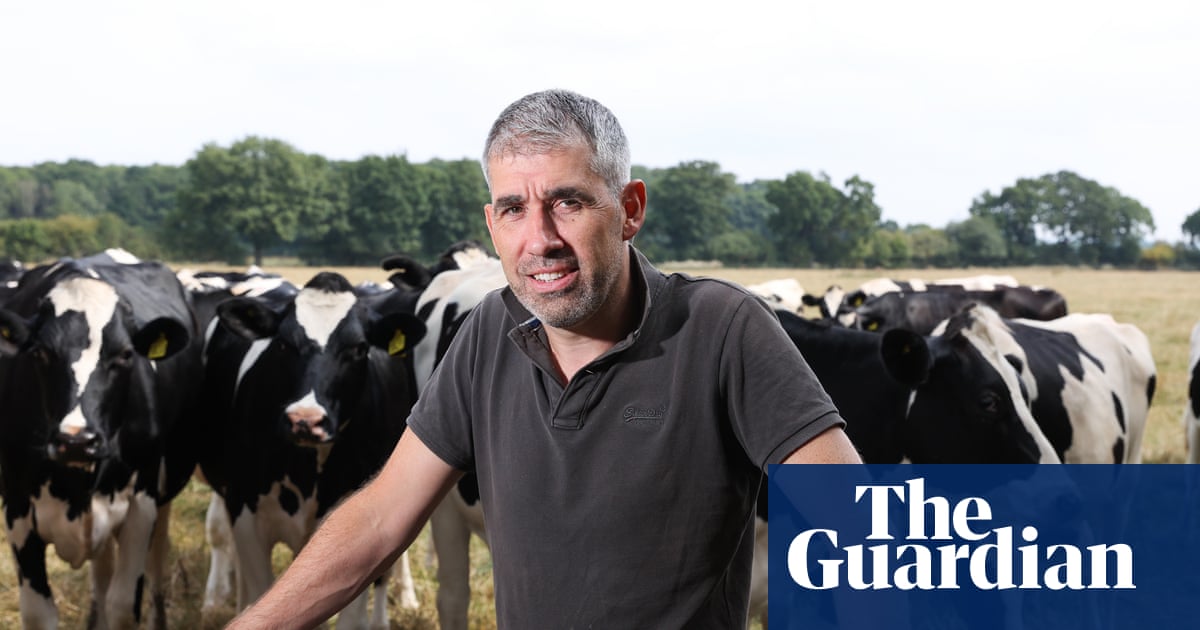
“Every morning that I roll out of bed at 4.40am, I know I’m losing £1,800 that day, just by getting up.” This is the stark daily reality for Paul Tompkins, as he and his fellow dairy farmers struggle in the face of plummeting milk prices.
Tompkins, who is the third generation to run his family’s 234-hectare (600-acre) farm in the Vale of York, can produce milk for about 40p a litre from his 500-strong herd of black and white Holstein cows. However, he is being paid only 29p a litre by his milk processor, leaving him operating at a loss, despite trying to run his business as efficiently as possible.
Margins have always been tight, in an industry where supermarkets have traditionally used low milk prices to tempt shoppers through to door. Tesco, Sainsbury’s, Morrisons and Asda are currently charging £1.65 for four pints, which equates to 41p a pint, or 73p a litre. The UK processing industry is dominated by three main players – Arla, Müller and First Milk.
Tompkins, the chair of the dairy board at the National Farmers’ Union (NFU), is no outlier: his cost of production is the same as the national average.
“Dairy farmers are really good at sharing information, so I can benchmark myself against other businesses,” he says. “Every day we get up and try to do more with less.”
If farmgate milk prices remain at the current level, Tompkins believes his farm will make a loss of at least £660,000 this year. However, they appear to be on a downwards trajectory, which could make the hit even bigger.
Dairy is a globally traded commodity and farmers are used to market volatility, as the price fluctuates according to supply and demand. However, the speed of the current decline in prices appears to have caught many producers by surprise.
It has prompted some to ask whether falling prices could also help cool food price inflation and bring costs down for cash-strapped consumers.
The price decline has been blamed on global oversupply of milk, which is outstripping demand.
“It is a scary time for producers,” says Mike Houghton, a farm consultant and partner at Andersons.
“American production is up and New Zealand is hanging on in there. A lot depends on China and how much they buy and that has not gone up. It all comes together and is a perfect storm. There is too much milk.”
More than 7% extra milk was produced by British farmers in the final three months of 2025 compared with the five-year average, according to the Agriculture and Horticulture Development Board (AHDB).
Some of the current UK overproduction can be traced back to the dry spring and drought conditions experienced across the country in early 2025. A lack of grass for grazing caused many dairy farmers to buy animal feed for their herds – which was relatively cheap at the time, leading to well-fed cows producing record-breaking volumes.
Processors struggled to cope with the quantity of milk. In the past few months, the situation has worsened and some producers and processors have had to throw milk away.
The picture for dairy producers looks very different from a year ago, when some were benefiting from higher wholesale prices.
Some of Britain’s largest supermarkets, including Tesco and Sainsbury’s, have committed to paying their farmers based on the cost of production, and other farmers are part of cooperatives, but these groups are not open to all. However, many farmers say they have little choice in who collects their milk, nor the price they are paid, as they are reliant on local processors.
“Unless you’re on a cost-of-production-aligned retail contract now, you’re losing money, or, at very best, breaking even. How long this goes on for, no one really knows,” says Robert Craig, a dairy farmer from Cumbria who is the current chair of the Royal Association of British Dairy Farmers.
Robert Craig, the chair of the Royal Association of British Dairy Farmers, says many dairy owners are losing money. Photograph: Handout
The latest price shock comes as farmers have been knocked by a host of other cost increases – such as fertiliser and fuel – as well as chronic labour shortages after Brexit and the pandemic. The government’s move to introduce inheritance tax on agricultural assets above £2.5m has been an additional concern.
The environment secretary, Emma Reynolds, recently told an agricultural audience at the Oxford Farming Conference that the government – which has faced a backlash in rural constituencies it fought hard to win at the election – would support British farmers, as she praised their resilience in the face of volatile markets.
However, in the face of financial pressures, significant numbers of dairy farmers have left the industry since the pandemic. Nearly 20% of British producers have quit since October 2019, according to figures from the AHDB, cutting their numbers from 8,720 to 7,010 in just six years.
Despite this, the volume of milk produced in Britain has stayed steady, thanks in part to consolidation in the sector, ever-larger herds and remaining producers working to become more efficient.
Now farmers and industry experts warn the latest milk price shock will lead to more calling it a day.
Houghton predicts that as many as 10% of dairy producers – or 700 farmers – could leave the industry for good.
“It’s a combination of factors, if you don’t have a successor, if you have got to reinvest in slurry and silage capacity just to manage production which won’t put on the bottom line, then why would you do all that at a milk price of 35p?” he says.
Many shoppers will wonder whether falling wholesale prices will be reflected in the cost of dairy products in their shopping baskets, after months of persistently high food inflation.
Some consumers may be waiting a while. The average time lag for lower prices feeding through to consumers is seven months, according to the AHDB. Retail prices for butter are expected to fall “but not until April, with the biggest price drops from June”, wrote Grace Withers, AHDB’s lead retail insight manager in a recent research note. The price of cheddar is also expected to start coming down from July.
Morrisons said it had reduced the prices of some milk, butter and cheese products in recent days.
Meanwhile, the nation’s coffee lovers are unlikely to enjoy lower prices for their cappuccinos any time soon.
“Milk and dairy are a significant cost but far and away not the only one”, says Jeffrey Young, the chief executive of the consultancy Allegra Group. “Rent and people costs are way more substantial. The minimum wage is going up again. Chains might reduce their price increases but it’s unlikely that lower prices will be passed on to consumers.”