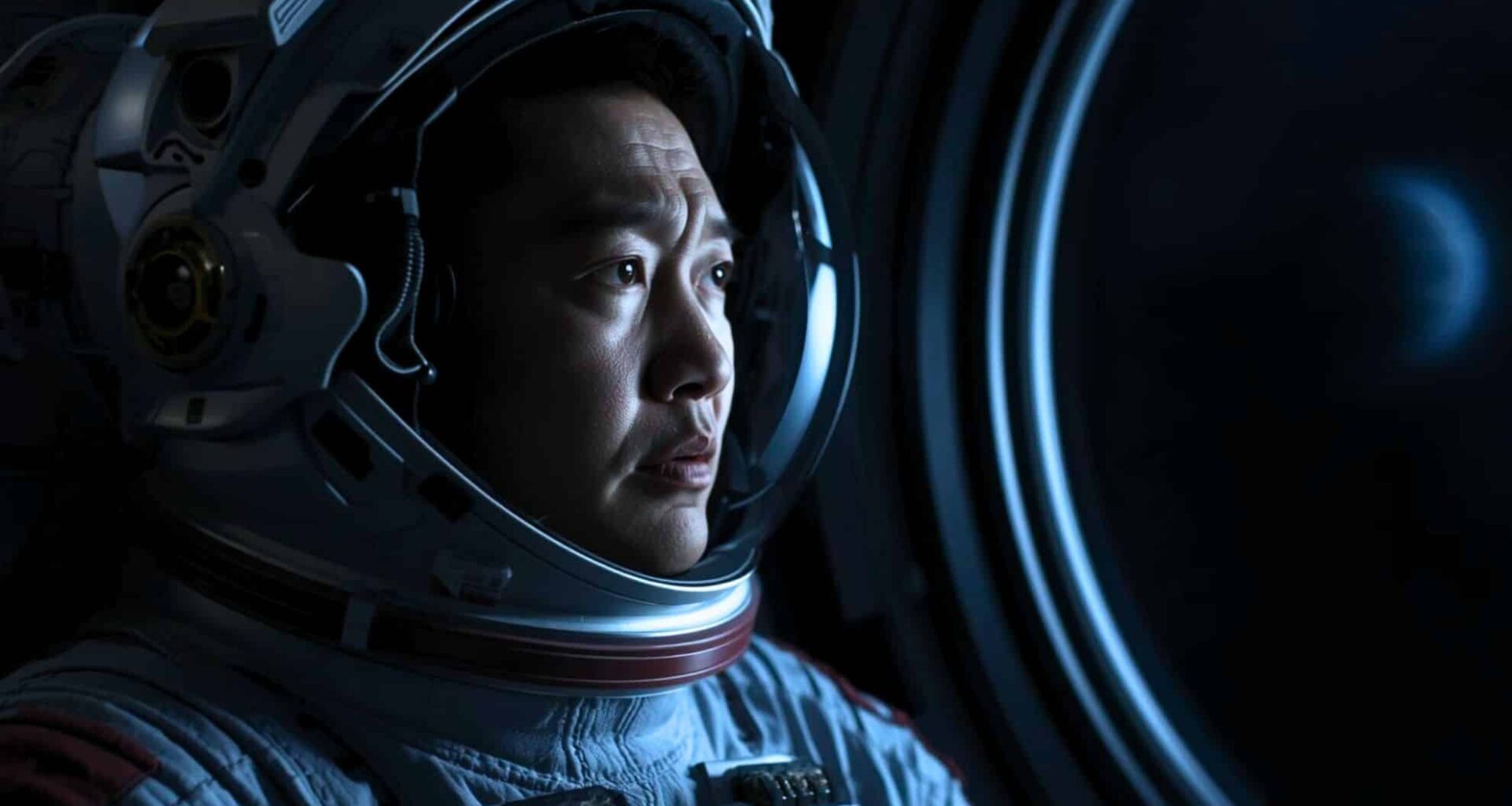
In 2003, during China’s first crewed spaceflight, a sound broke the silence. Inside the Shenzhou 5 capsule, orbiting more than 300 kilometers above Earth, Yang Liwei heard what he later described as knocking. The kind you might hear if someone tapped a metal bucket with a wooden hammer.
The source? Still unknown. The explanation? Still missing. Despite repeated attempts to replicate the event and years of expert analysis, no definitive cause has emerged. And Yang was not the last to hear it. Astronauts on later missions reported the same thing.
 Yang Liwei, China’s First Astronaut. © CGTN
In a vacuum, sound should not exist. Not without a medium to carry it. That simple principle, fundamental to physics, is what makes the incident so persistent. Space, by definition, is silent. Yet something was heard. And not just once.
Two decades later, the event sits in the archives of space history. Undigested. Unresolved.
Sound Without Air
Yang’s mission, Shenzhou 5, marked China’s entry into human spaceflight. He completed 14 orbits and spent just over 21 hours in space. The mission, both technically and politically significant, made China the third country to send a human into orbit on its own. But it also raised an enduring scientific question.
During the mission, Yang Liwei reported hearing a repetitive knock. It didn’t seem to come from inside the capsule. It wasn’t traced to any external source either. He checked the systems. Looked outside. Nothing. Upon return, he tried to reproduce the sound. No success.
 Liwei waves after emerging from the Shenzhou V space capsule in Inner Mongolia in 2003. © GettyImages
Physics does not leave much room for mystery here. “The travelling of sound requires a medium,” said Professor Goh Cher Hiang of the National University of Singapore, speaking to BBC News. Air, water, or solid material. In space, where there is none of the above outside the spacecraft, sound should not carry. That’s the part that continues to puzzle specialists.
The capsule was checked. No signs of impact. No mechanical failures. No anomalies in pressure or structural integrity. The sound, audible to the human ear, left no trace on instrumentation. A phenomenon without physical evidence.
More Than One Report
What made the incident harder to dismiss: it didn’t end with Yang.
Chinese state media later reported that astronauts on the 2005 and 2008 Shenzhou missions also heard unexplained knocking sounds during orbit. Similar in description. Equally untraceable. No physical causes identified. No deviations in telemetry data.
 Mr Yang’s maiden flight made him a hero in China. © AFP
Yang reportedly warned other crew members before launch. If you hear it, don’t panic. He told them it happened to him too. And it didn’t cause harm. It became, informally at least, a part of the experience.
The repetition across missions is what shifted the event from anecdote to pattern. Different crews. Different spacecraft. Same unexplained sound. Still, official mission records have not offered a mechanical or physical diagnosis.
Working Theories and Dead Ends
Engineers and scientists have offered several possible explanations. None have stuck.
One theory: thermal stress. When a spacecraft moves from sunlight into Earth’s shadow, temperatures can swing by hundreds of degrees Celsius in minutes. Materials expand and contract. Sometimes they creak or pop.
Professor Wee-Seng Soh, also from the National University of Singapore, suggested the noise could be “a result of expansion or contraction of the spaceship,” due to those temperature shifts. On the surface, a logical hypothesis. But it doesn’t fully match Yang’s description. The sound was rhythmic. Repetitive. Not sporadic, not scattered.
 Schematic of the thermal environment for electronics in spacecraft. ScienceDirect
Another theory: micrometeoroid impacts. Tiny fragments of space debris or dust travel at high velocity and can strike the spacecraft. A small hit might produce a knocking sound. But the capsule showed no external damage. And the noise, according to Yang, occurred more than once.
Some have raised the possibility of perceptual distortion. Perhaps an auditory hallucination triggered by stress, isolation, or pressure variations inside the cabin. But no strong evidence supports this line of thought. The capsule’s environment was stable. And no similar phenomena were widely reported across space programs with similar conditions.
Comparisons from Other Missions
China’s space program is not alone in encountering unaccounted-for sounds.
In 1969, astronauts on Apollo 10 reported a high-pitched “whistling” while orbiting the far side of the Moon. Cut off from Earth during that phase of the mission, they dubbed it “space music.” The audio remained classified for decades. Later, NASA attributed it to radio interference between command and lunar modules. Some engineers remained unconvinced.
Years later, during a 2021 flyby of Jupiter’s moon Ganymede, NASA’s Juno spacecraft recorded electromagnetic emissions that were later converted to sound. The 50-second audio track showed frequency changes, likely due to shifts in magnetic environment. But these were not acoustic signals. The spacecraft’s instruments translated electrical data into sound for human interpretation.
Likewise, the Van Allen Probes, launched in 2012 to study Earth’s magnetosphere, captured plasma waves that, when sonified, produced chirps, whistles, and moans. Again, not directly heard by humans. Recorded and converted.
Yang’s case stands apart. No sensors. No electromagnetic data. Just a sound, heard directly, reported clearly, and still without explanation.
From a technical perspective, the incident has not prompted visible procedural changes. China’s space agency has not issued any new guidelines or altered capsule design in response to the event. Future crews were briefed, but the sound was treated as a manageable unknown.