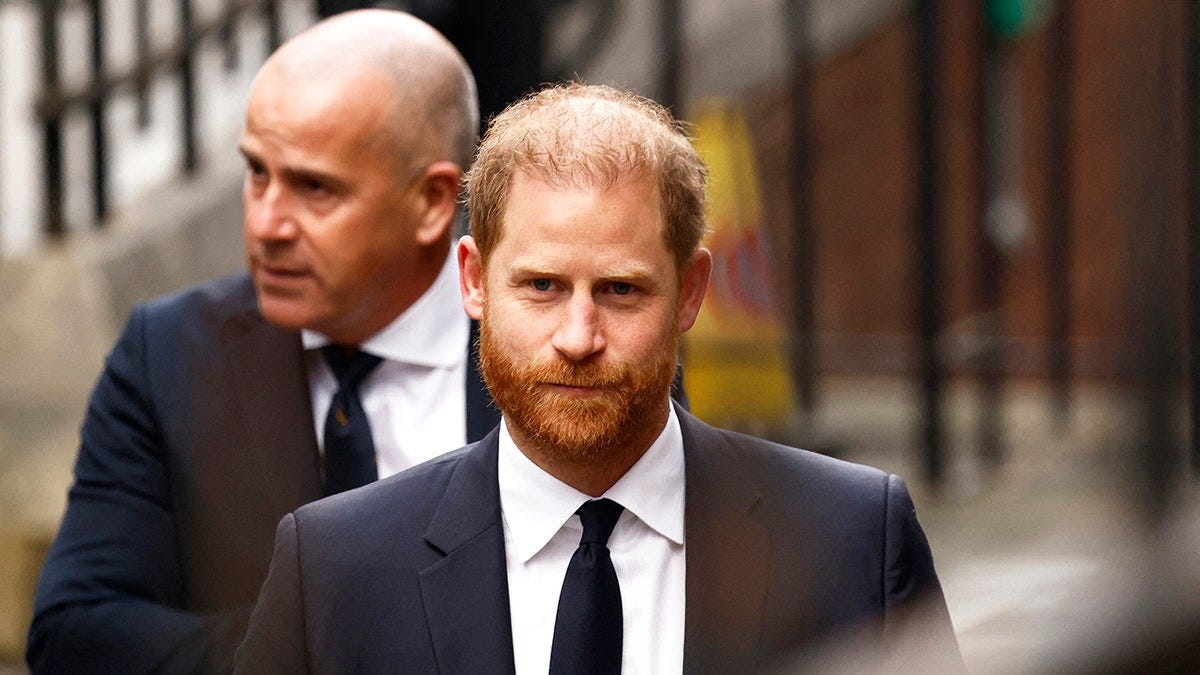
Prince Harry is returning to the High Court this week for what is now his third major legal confrontation with the British tabloid press. This time, the defendant is Associated Newspapers Limited, publisher of the Daily Mail and Mail on Sunday. The case itself has been years in the making, filed in 2022 and only now reaching trial.
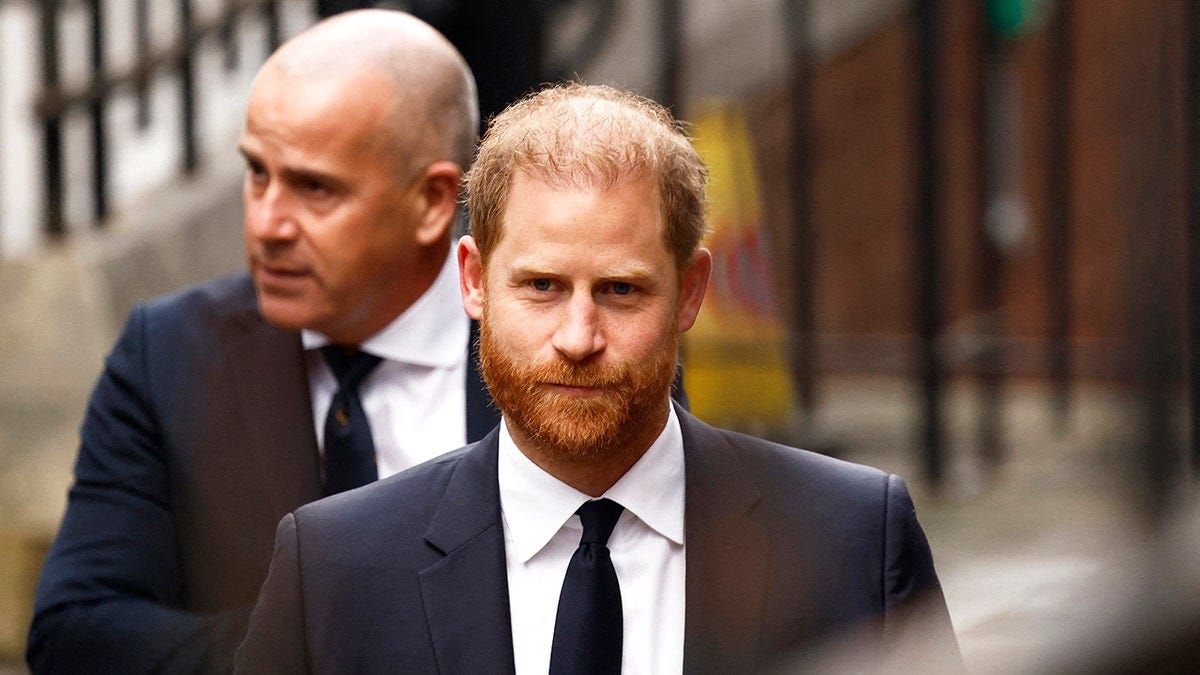 Prince Harry at London’s High Court on January 21st, 2026.
Harry himself is expected to give evidence imminently, earlier than initially scheduled, due to the defence shortening its opening submissions.
The legal question before the court is narrow but significant: whether Associated Newspapers, publisher of the Daily Mail, engaged in unlawful information-gathering practices (phone hacking, blagging, tapping, and the use of private investigators) between the 1990s and early 2010s. Harry and six other claimants allege that 14 articles published between 2001 and 2013 were secured through such means.
Harry’s team have also put forth that the stories caused him significant distress…without serving any legitimate public interest.
The broader story unfolding in court, accordingly, is not really about any one headline or article. It is about systems—media institutions that are now forced to account for themselves.
Harry’s barrister, David Sherborne, has framed the case as evidence of a “clear, systematic and sustained” culture of unlawful newsgathering.
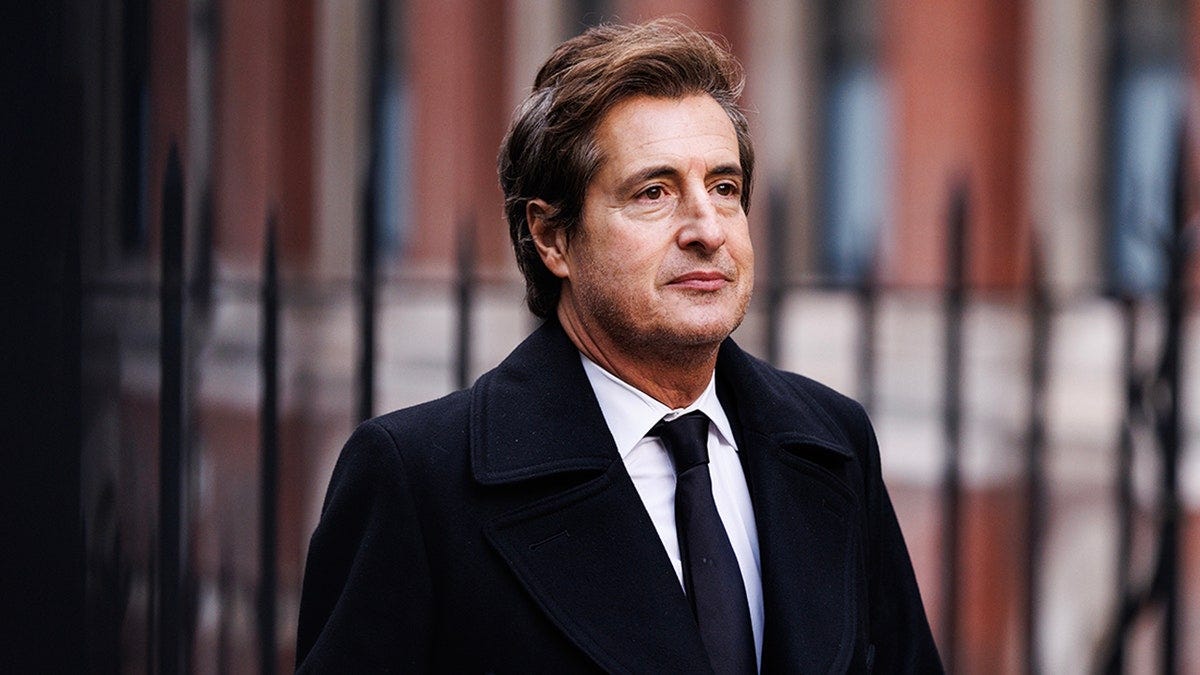 David Sherborne, Prince Harry’s barrister, arrives at London’s High Court during the legal action with Associated Newspapers Ltd. on January 20th, 2026.
Crucially, he has also drawn attention to what is no longer available for scrutiny: the court heard allegations of “mass destruction” of material on Tuesday, including large volumes of emails deleted prior to 2004. Associated Newspapers says this was the result of a routine email deletion policy. Sherborne’s implication was that evidence vanished at precisely the moment when it would later have mattered most.
Sherborne further alleged that Associated Newspapers was aware it had “skeletons in its closet,” having conducted internal investigations into phone hacking between 2003 and 2005. This was years before the Leveson inquiry forced the issue into public view.
In other words, the argument is not merely that wrongdoing occurred, but that the publisher had reason to understand its own vulnerability long before these claims were brought.
Thanks for reading The Fascinator! This post is public, so feel free to share it.
Associated Newspapers rejects this characterization entirely. Its legal team insists that unlawful practices were not widespread at its titles and that allegations to the contrary are “simply untrue.” They argue that the claimants’ case relies on inference rather than proof, pointing out that aside from a now-disavowed witness statement from a private investigator, there is no direct evidence of phone hacking or tapping by the publisher.
They have also advanced a more political defence: that this litigation is the product of a “coordinated strategy,” in which prominent figures were “recruited and corralled” into bringing claims together. The suggestion is not just that the evidence is weak, but that the case itself is “manufactured” (Reader, I ask you…aren’t all legal actions?) Associated Newspapers views this as an attempt to retrofit their organization into a scandal that properly belongs to other tabloids.
This framing reveals, if nothing else, how differently each side understands accountability.
For ANG and the defence, the absence of a neat paper trail excuses them. They point to the fact that there are (deletions notwithstanding) no emails to reference; there is no smoking gun, no direct linkage between a payment and a specific story.
But for the claimants—including Prince Harry, Liz Hurley, Sadie Frost Law, Sir Elton John, and others—the absence of such an explicit paper trail is, itself, part of the story. If unlawful practices were informal, outsourced, or deliberately insulated from documentation (as earlier tabloid cases have suggested they were), then evidentiary gaps are a feature, not a bug.
 Elizabeth Hurley and Damian Hurley arrive for the court case against Associated Newspapers, Ltd. at The Royal Courts of Justice in London on January 20, 2026.
This is where the case stops being abstract and we can, once again, consider the human toll.
If the alleged practices were designed to leave no trace, then the harm they produced would not arrive as one single, provable rupture. It would be felt most acutely not in documents, but in the mind of the person being reported on, written about, and watched.
That tension runs directly through the most emotionally charged part of Prince Harry’s case. His lawyer’s opening statements do not describe individual moments of violation (although those are also accounted for), but a sustained condition. He grew up with the sense that his movements, relationships, and private life were being monitored; that loved ones were frightened by what might be exposed next; that trust in others was always perilous. In that context, paranoia is a rational response to the environment of Harry’s youth.
Royal expert Richard Fitzwilliams pointed out on Tuesday that Harry “has said his ‘life’s work’ is to reform the British tabloid press. It’s his personal crusade. He believes media excess contributed to his mother’s death and has had a ruinous effect on his relationships.”
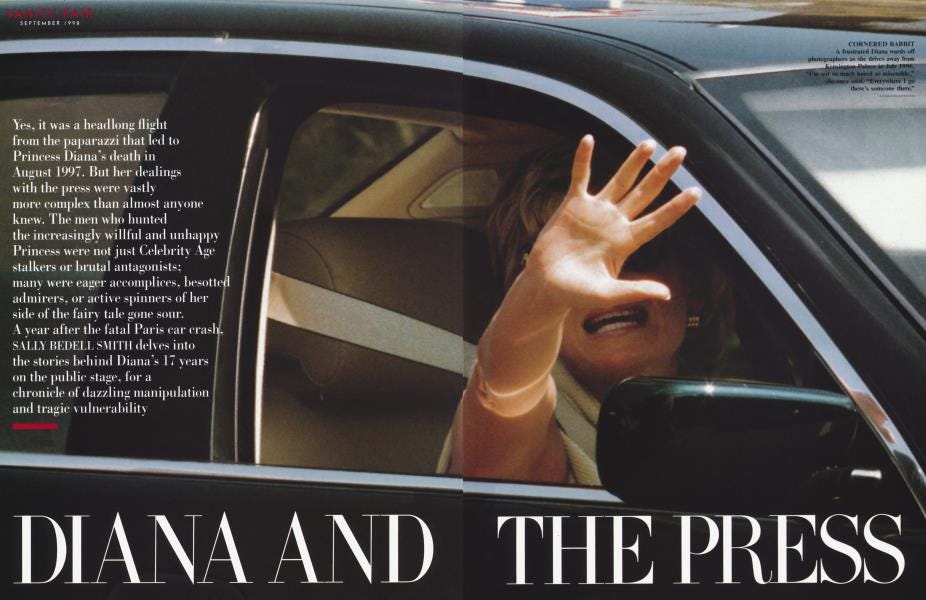 A Vanity Fair feature, DIANA AND THE PRESS, authored by Sally Bedell Smith in September 1998.
“Harry has spoken openly about the way he has been traumatized by the sound of a click of a camera,” Fitzwilliams went on. “Members of the royal family usually avoid the court like the plague… [but Harry is] prepared for a titanic struggle.”
The distress he describes, though it can’t be litigated, is nonetheless inseparable from the structure of the alleged wrongdoing. When intrusion is systemic, its effects can never be neatly itemized. They are cumulative, corrosive, and difficult to disentangle from the rest of life.
Courts are tasked with determining liability; they are far less equipped to measure this kind of harm. But by placing his experience in the British media ecosystem on the record, Harry is insisting that it be taken seriously nonetheless.
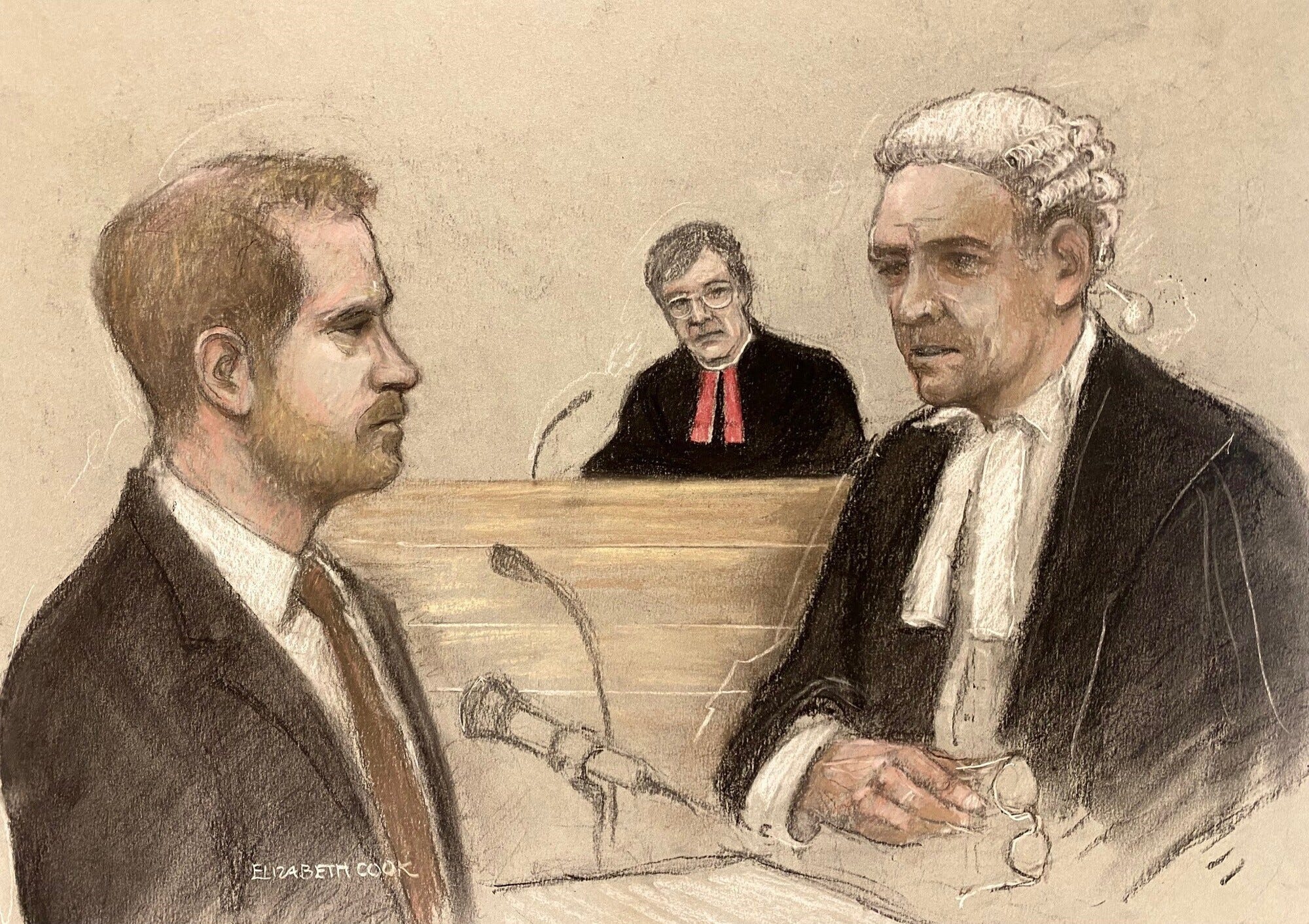 Court artist’s sketch of Prince Harry being cross-examined by Andrew Green KC as he gave evidence during the phone-hacking trial against Mirror Group Newspapers in 2023.
That record is what will outlast this trial—whatever the outcome. Even if Associated Newspapers successfully evades the claimants’ accounts of wrongdoing, the trial is already doing something crucial: documenting how Fleet Street explains itself when confronted.
Harry is often accused of “whinging,” of being obsessed with the past. A more accurate charge might be that he refuses to let the wrongdoings of the past dissolve into convenient vagueness. His lawyers have already named names—pinning most of the articles at the heart of their case on two well-known royal editors.
Two Royal Reporters Named in Phone Hacking Trial Involving Prince Harry
The phone hacking case against ANL (publisher of The Mail) kicked off Monday, Jan. 19th. Prince Harry is among the high-profile claimants, along with Elizabeth Hurley, Sir Elton John, Sadie Frost, and others…
Read more
15 hours ago · 13 likes · 3 comments · Meredith Constant
Attaching specific stories to specific journalists, rather than being a rehashing of old greivances, situates them within a broader culture of harm.
And regardless of the verdict, this trial ensures that the practices, defenses, and moral logic of Fleet Street during this era will survive as something difficult to dismiss: sworn testimony, preserved argument, and an enduring public record. Crucially, once something enters the historical record in this way, it becomes much harder to insist it was all “just how things were done.”