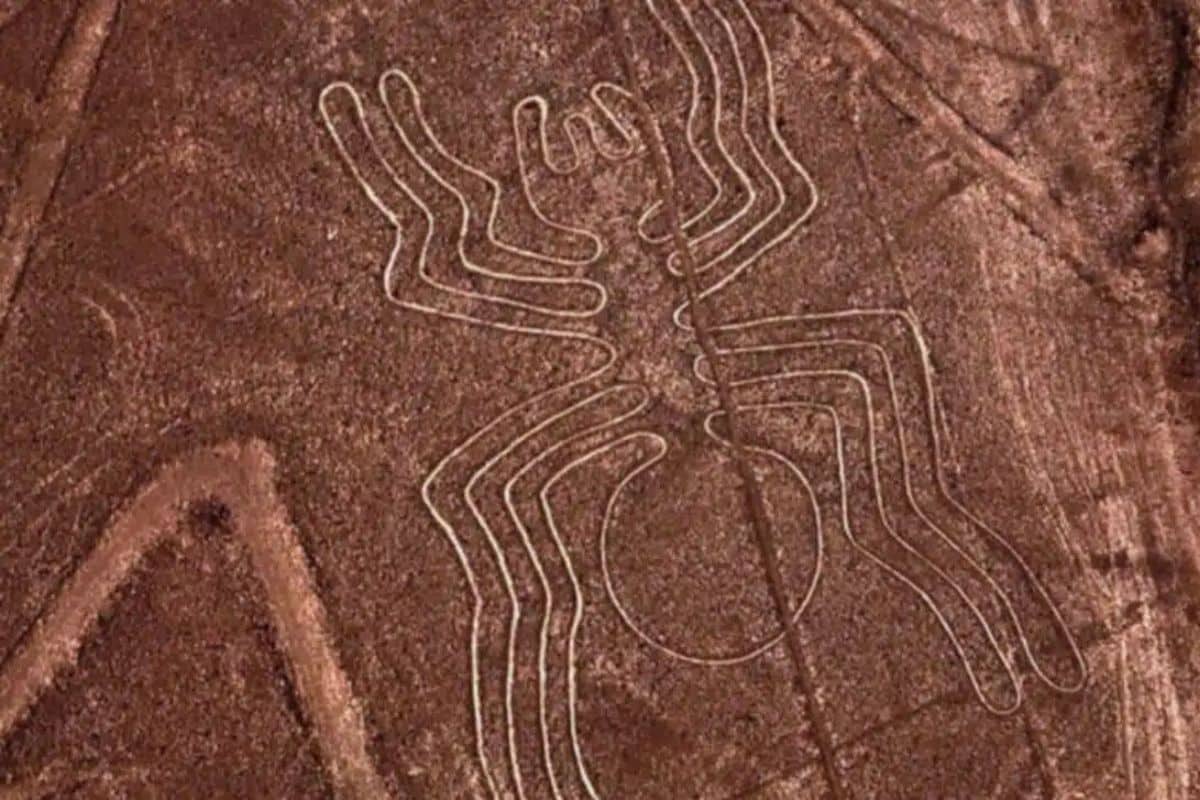
Artificial intelligence has unearthed hundreds of massive ancient designs hidden for centuries beneath Peru’s desert sands, revealing patterns and purposes that had long been overlooked.
In just six months, a joint team from Yamagata University’s Nazca Institute and IBM doubled the known number of Nazca lines, identifying 303 new geoglyphs scattered across Peru’s coastal desert. Published in the Proceedings of the National Academy of Sciences (PNAS) and confirmed by lead archaeologist Professor Masato Sakai, this discovery represents one of the fastest leaps in archaeological knowledge ever achieved at this UNESCO World Heritage site.
These vast designs – etched into the desert floor between 200 B.C. and A.D. 650 – depict stylized animals, plants, and geometric patterns, some stretching hundreds of meters across. Many of these intricate shapes had gone unnoticed until now due to the desert’s sheer scale and the limitations of traditional survey methods.
How AI changed the game
For over a century, archaeologists studied the Nazca lines using aerial photography, field surveys, and painstaking hand-drawn maps. The latest approach used AI algorithms trained on thousands of aerial images, enabling the system to detect faint lines and subtle geometries invisible to the human eye.
By processing terabytes of high-resolution satellite and drone images, AI flagged potential new figures in record time. “The ability to carry out the survey so quickly was thanks to AI,” explained Sakai. Once identified, each site was confirmed by archaeologists on the ground to ensure accuracy and proper context.
Among the new figures are cats, birds, fish, and abstract shapes – designs likely tied to ceremonial, astronomical, or territorial purposes. The precision of these images, many of which maintain flawless symmetry despite their immense size, highlights the Nazca people’s deep understanding of geometry and landscape planning.
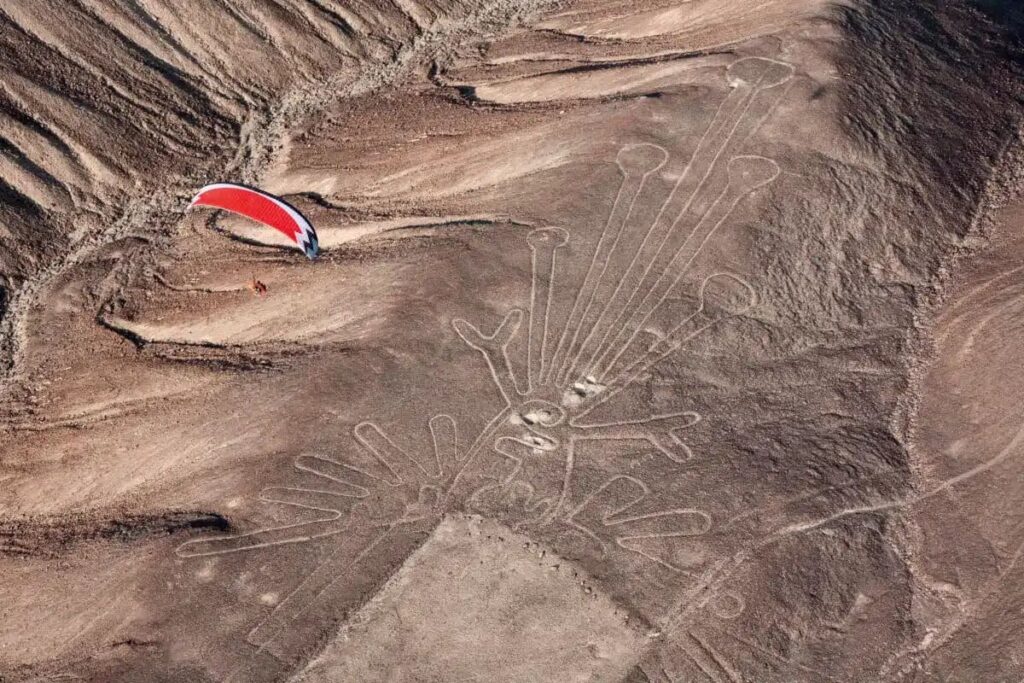
The Nazca Lines in the Peruvian desert, showing a geoglyph depicting a hummingbird. Credit: ALAMY
Evidence of ritual paths and sacred journeys
Although theories about the Nazca lines have ranged from astronomical calendars to alien messages, new findings point to a more grounded explanation. Sakai’s team believes that many of the newly uncovered figures formed ceremonial paths – routes walked during sacred processions meant to connect with deities and the surrounding environment.
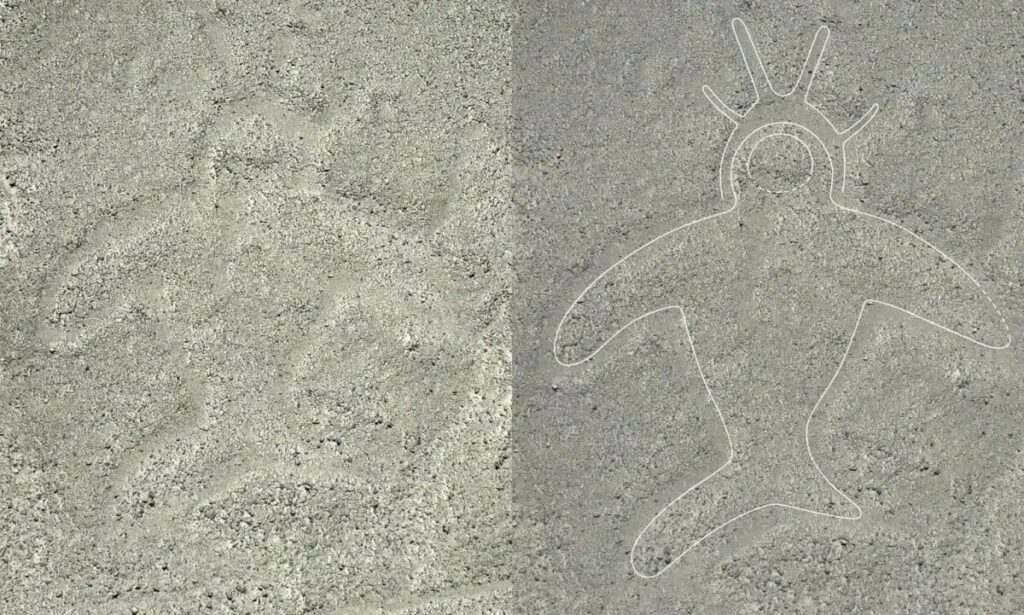
Credit: Yamagata University
This interpretation echoes the work of Maria Reiche, the German mathematician and astronomer who spent decades charting the lines and documenting their geometric precision. The direction, scale, and placement of these new geoglyphs support the idea that they were not random art, but elements of a broader spiritual landscape.
The expanding role of AI in exploring ancient worlds
The Nazca project is part of a growing movement in modern archaeology. AI is now helping locate ancient burial mounds across Europe, map hidden settlements beneath dense forests, and even identify long-lost shipwrecks on the ocean floor. At the Saruq Al Hadid site in the United Arab Emirates, AI analyzed satellite data to uncover artifact distribution patterns, allowing researchers to focus their excavations more efficiently.
Dr. João Fonte of ERA Arqueologia calls this technological evolution a “giant leap in efficiency,” noting that surveys once requiring years can now be finished in days. When paired with photogrammetry and remote sensing, AI gives scientists unprecedented insights into ancient landscapes, helping them reconstruct lost worlds with stunning precision.
Technology as a partner, not a replacement
Despite AI’s speed and scale, archaeologists stress the continued need for human judgment. Dr. Alexandra Karamitrou of the University of Southampton, who designs AI tools for archaeology, warns that “AI is not perfect, especially in this field.” Every discovery flagged by the algorithm must be verified in person – and false positives still pose challenges.
Still, progress is accelerating. As algorithms improve, the chance to protect endangered sites before they vanish grows dramatically. For Nazca, this means an ever-expanding map of one of humanity’s most mysterious civilizations – and a sharper view of the beliefs, rituals, and art of a culture that thrived more than 1,500 years ago.