Stay informed with free updates
Simply sign up to the Artificial intelligence myFT Digest — delivered directly to your inbox.
Parents and politicians lobbying for phone bans in schools and age limits on social media (Brain rot! Graphic material!) could spend some time examining their own dependence on technology (Brain rot! Graphic material!). I write this as someone who not only wastes time scrolling through clothes on Instagram and food I will never eat or cook on TikTok, but also reflexively replies to emails late at night.
Now technology is working its way into the most personal corners of our working lives. According to a spate of recent reports, employees are increasingly turning to chatbots for coaching and companionship. “I hate myself for saying it, but a big reason Gemini works [is] because it functions as the colleague with no drama,” one executive told Axios of Google’s bot, “It’s not overwhelmed from life. It won’t judge me or gossip for asking dumb or last-minute questions.”
This desire for a frictionless workplace, focused on efficiency rather than the bothersome waste of human interaction, may have been intensified by remote working. It chimes with a wider shift towards convenience, with ordering taxis, food or a new item of clothing as easy as a few swipes on our phones.
The writer Kathryn Jezer-Morton recently complained this was infantilising: “Tech companies are succeeding in making us think of life itself as inconvenient and something to be continuously escaping from, into digital padded rooms of predictive algorithms and single-tap commands,” she wrote. Her form of resistance is to be “friction-maxxing” — restoring some effort to life.
Perhaps at work, too, we should be more cautious about what we streamline: those irksome humans we share workspaces with are not wholly without benefit. Isolation at work is bad for employees but also for organisations. A study last year found that social interactions help “idea development” and spread “tacit and informal knowledge”.
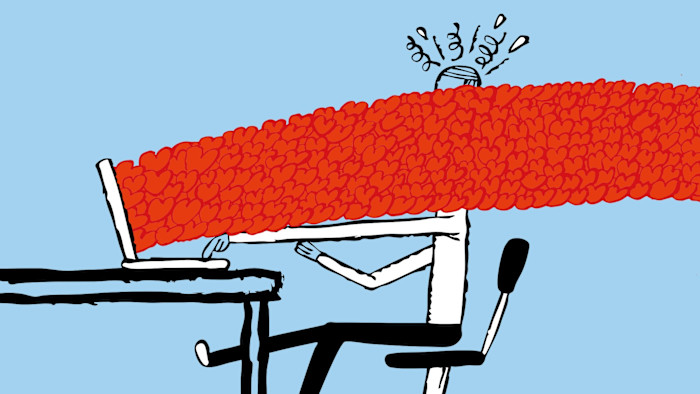
Turning to chatbots rather than colleagues poses another potential risk: becoming accustomed to sycophancy. Anyone who has used generative AI will be familiar with its fawning responses. According to the bots’ answers, all questions are great and all thoughts insightful. I don’t know about you, but some egos could do with a bit less boosting.
And yet, while happy to criticise rapacious, heartless tech companies, I am reluctant to place the blame solely on their shoulders. Surely AI’s reflexive positivity is less an algorithmic perversion than a mirror to our already pervasive ego-massaging culture?
According to business psychologist Tomas Chamorro-Premuzic, author of Don’t Be Yourself, the corporate world is rife with human executive coaches who “suck up to their clients and tell them they are amazing”. Such behaviour feeds bosses’ “insecure narcissism” but also keeps coaches on payroll, so “between telling a client what they want to hear and need to hear, [they] often opt for the ego-enhancing story”.
Some see this as stemming from dysfunction in a related field. One psychotherapist and coach wrote last year that people were turning to AI therapists because they weren’t any worse than human versions who had “stopped doing their jobs. Instead of challenging illusions, telling hard truths and helping build resilience, modern therapy drifted into nods, empty reassurances and endless validation.”
Insecure narcissism is modelled at the top. Donald Trump’s appetite for flattery seems only to have intensified: last month secretary of state Marco Rubio sang the president’s praises for “the most transformational year in American foreign policy since the end of the second world war — at least” as Trump appeared to fall asleep next to him.
For those without immense wealth and power, a desire to be flattered at work may be more understandable. Harvard historian Erik Baker says ordinary employees have experienced a “collapse of faith in the idea that earnings are a proportionate reward for a worker’s skill, knowledge, or human capital”. In lieu of appropriate compensation, some crave “validation instead”.
A whole host of AI coaching companies are more than willing to seize on this tendency by offering positive validation to workers. Many will argue their products are valuable; perhaps in a workplace devoid of feedback, or even a sprinkling of praise for a job well done, insincere flattery is better than nothing.
But as Kim Scott, author of Radical Candour, has written, AI will only be useful if it “will sometimes challenge your assumptions or suggest improvements”. If a virtual companion just “constantly reinforces your ideas without offering helpful feedback or asking probing questions, that’s not praise — it’s a performance”.