
The Bulletin of the American Scientists has moved the Doomsday Clock to 85 seconds to midnight. That is the closest we have ever been. And one thing is already obvious from a European perspective: as long as European countries allow other countries’ nuclear weapons to be based on their territory, the clock will stay dangerously close to midnight.
Nuclear dangers on the rise
The Bulletin rightly cites the expiration of the new START treaty, the last remaining nuclear arms control agreement between Russia and the United States as a cause for concern. So too is the massive investments made by all nuclear armed states on their arsenals, rising to over $100 billion in 2024, and only going up. Increased rhetoric across Europe, normalising the idea of new nuclear weapons and the possibility of proliferation is also contributing to this increased global risk.
Legitimate security concerns
The use of nuclear weapons anywhere will have significant consequences everywhere, including in countries far from the location in which the bombs are dropped. That is why the majority of countries are signatories or parties to the Treaty on the Prohibition of Nuclear Weapons (TPNW). The TPNW specifically outlaws nuclear threats, and offers a forum for countries concerned with nuclear risks to galvanise action. Recognising that nuclear deterrence policies are a security risk to all countries everywhere, TPNW states parties work across borders and at all political levels to advocate for an end to these policies of coercion and blackmail, and a return to the multilateral rules based order.
The view from Europe
Today, Europe is ringed by US nuclear bombs in six NATO countries and Russian nuclear weapons deployed in Belarus. These weapons are not under European democratic control, yet they are intended to be used in Europe. The scale of damage to civilians and critical infrastructure is unimaginable, especially considering the explosive power of most of these weapons is three times that of the bombs that incinerated the cities of Hiroshima and Nagasaki. The Doomsday Clock announcement should be a trigger for a serious conversation: why are Europeans still accepting this?
A nuclear chessboard across Europe
Seven European countries host foreign nuclear weapons. Around 100 US B61 nuclear gravity bombs are currently stationed in six countries; Belgium, Germany, Italy, the Netherlands, The United Kingdom and Türkiye, under NATO’s nuclear-sharing arrangements. The US is deploying new nuclear bombs at these NATO bases, incorporating Boeing’s guided tail-kit and with flexible yields up to three times more powerful than the bomb dropped on Hiroshima.
These bombs are designed to be used in Europe. They turn host countries into launchpads – and targets. Russia has now deployed dozens of tactical nuclear weapons in Belarus, including nuclear-capable missile systems with the range to hit European capitals in minutes. From a citizen’s point of view in Brussels, Berlin, Warsaw or Vilnius, these are mirror images of the same problem: US weapons in Europe and Russian weapons in Belarus are stationed on foreign soil, controlled by foreign leaders and meant to be used on European territory.
The Doomsday Clock is telling us that this logic – turning Europe into a nuclear chessboard again – is part of what keeps the world so close to catastrophe.
Other people’s bombs – and other people’s politics.
US nuclear bombs in Europe are under the control of the US president. Host states provide bases, pilots and aircraft – and accept the political and humanitarian risk – but the decision to use the weapons lies in Washington. The same is true in Belarus. Russian nuclear weapons deployed there remain under Russian command. Belarusians have no meaningful say over how they are used, yet would suffer the consequences of any strike or retaliation.
Florian Eblenkamp, ICAN’s Advocacy Officer, warns: “When one person in Washington can, in the span of a few days, throw NATO into doubt over Greenland or trade, it becomes harder to justify basing European security on US nuclear weapons stationed here; US nuclear bombs in Europe are now hostages to US domestic politics.European citizens run the risk, but do not hold the keys”.

Moving back the clock
The urgency of this moment demands action. The only credible way to permanently move back the hands of the clock is to stigmatise, prohibit and eliminate nuclear weapons through the TPNW.
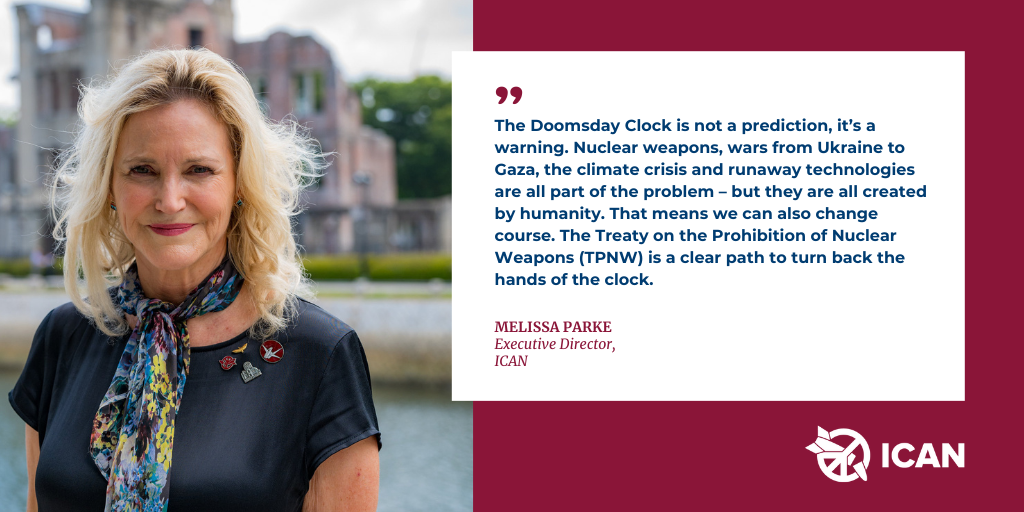
“The Doomsday Clock is not a prediction, it’s a warning. Nuclear weapons, wars from Ukraine to Gaza, the climate crisis and runaway technologies are all part of the problem – but they are all created by humanity. That means we can also change course. The Treaty on the Prohibition of Nuclear Weapons (TPNW) is a clear path to turn back the hands of the clock”, Melissa Parke, ICAN’s Executive Director.
Alexandra Bell said, the President and CEO of the Bulletin of the Atomic Scientists, also said: “Everytime we’ve been able to push back on these existential threats it’s because everyday citizens have gotten engaged” and continued; “We have time left to fix the problems that we ourselves have created”.